
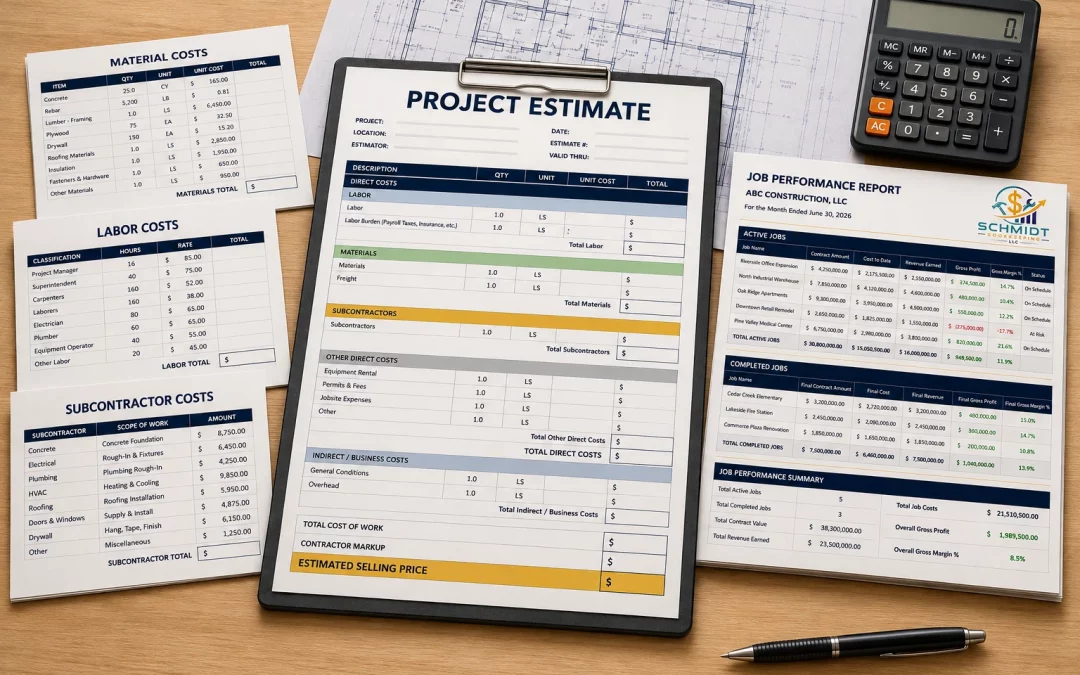
Being busy does not always mean your construction business is charging enough.
You can have a full schedule, plenty of work under contract, and strong revenue while still struggling to produce the profit you expected. The problem may not be how much work you have. It may be whether your prices are covering the full cost of doing the work and leaving enough profit to support the business.
For contractors, pricing is more than adding a percentage to labor and materials. Your price has to account for direct job costs, labor burden, overhead, and the profit the business needs to remain financially healthy.
The real question is not simply:
Can I win the job at this price?
It is:
Can I complete the job at this price and still produce the profit my business needs?
Understanding that difference is an important part of Financial Visibility.
Being Busy and Being Profitable Are Not the Same
A contractor can stay busy and still underprice work.
Every new job brings revenue into the business, but revenue alone does not tell you whether the work is financially worthwhile. The job also consumes labor, materials, subcontractors, equipment, and other resources.
Then the business still has expenses that may not belong neatly to one project.
Insurance has to be paid. Office expenses continue. Vehicles, software, administrative labor, professional fees, and other overhead do not disappear just because they are not listed prominently on an estimate.
If your pricing covers the obvious job costs but does not adequately support those additional costs and leave room for profit, more work can sometimes create more activity without creating the financial result you expected.
That is why the starting point for pricing should be a reliable understanding of your costs.
Start With the Complete Cost of the Job
Before deciding how much to charge, you need to understand what it actually costs your company to perform the work.
For most construction businesses, that begins with several major categories.
Direct Job Costs
Direct costs are costs you can reasonably connect to a specific project.
Depending on your type of construction business, they may include:
- Labor used on the job
- Materials
- Subcontractors
- Equipment or equipment rentals
- Permits
- Job-specific supplies
- Other costs directly associated with completing the project
If these costs are missing or incomplete, the starting point for your price is already unreliable.
But direct costs are only part of the picture.
Do Not Forget Labor Burden
An employee who earns $30 per hour usually costs the business more than $30 per hour.
The additional cost associated with employing that worker is commonly referred to as labor burden.
Depending on the business, labor burden can include costs such as payroll taxes, workers’ compensation, benefits, paid time off, and other employee-related expenses.
If you estimate labor using wages alone, you may be understating what labor actually costs the company.
That difference matters.
A job can appear profitable on an estimate when the wage rate is used, then produce a much weaker result after the complete labor cost is recorded.
Reliable pricing therefore requires more than knowing how many labor hours a job should take. You also need a reasonable understanding of what those labor hours actually cost the business.
Your Price Also Has to Support Overhead
Not every business expense belongs to one particular job.
Construction companies also have overhead—the costs required to operate the business whether a particular project is underway or not.
That may include expenses such as:
- Office and administrative costs
- Business insurance
- Software
- Accounting and bookkeeping
- Phones and communication
- Vehicles and general transportation costs
- Shop or office expenses
- Professional fees
- Certain management costs
- Other ongoing operating expenses
These expenses still have to be paid from the money the company earns.
If every project covers its direct costs but contributes too little toward overhead, the jobs may appear successful individually while the company as a whole struggles to produce adequate net profit.
Your pricing system therefore needs to do more than recover job costs.
It has to help support the business behind the jobs.
Before the Business Produces Profit, It Has to Cover Its Costs
Understanding overhead also helps explain the idea of break-even.
At the company level, break-even is the point where the business has generated enough revenue and gross profit to cover the costs required to operate. Before that point, the business has not yet produced a true net profit.
For a contractor, that matters because every job needs to contribute more than the direct cost of completing the work.
A project may cover its labor, materials, subcontractors, and other direct costs and still contribute too little toward the overhead required to run the company.
That means a contractor can complete jobs that appear profitable at the job level while the business as a whole struggles to produce adequate net profit.
The goal is not simply to reach break-even.
The business needs pricing that helps it:
- Recover the complete cost of performing the work
- Contribute toward overhead
- Move beyond break-even
- Produce sustainable profit
This is another reason pricing cannot be evaluated from direct job costs alone.
You need to understand what each job contributes to the financial health of the entire business.
Markup and Margin Are Not the Same Thing
One of the most important pricing distinctions for contractors is the difference between markup and gross margin.
They are related, but they are not interchangeable.
Markup compares the amount added to a cost with the original cost.
Gross margin compares gross profit with the selling price.
For example, assume a project is expected to cost $80,000.
If you add a 25% markup:
$80,000 × 25% = $20,000
The selling price becomes:
$100,000
If the job performs exactly as estimated, the gross profit would be $20,000.
But the gross margin is not 25%.
It is:
$20,000 ÷ $100,000 = 20%
So a 25% markup produces a 20% gross margin in this example.
That distinction becomes important when you are trying to price toward a specific profitability target.
If you wanted a 25% gross margin on the same $80,000 of expected cost, the required selling price would be approximately:
$80,000 ÷ (1 − 25%) = $106,667
The markup required to produce that margin would be approximately 33.3%.
This is one reason contractors can believe they are pricing for a certain profit percentage and later discover that the actual margin is lower than expected.
The terms matter because the math matters.
A Markup Percentage Alone Does Not Tell You Whether the Price Is Right
There is no single markup percentage that automatically makes every construction job profitable.
A percentage that works for one contractor may not work for another because their cost structures are different.
A general contractor, electrician, remodeler, plumber, HVAC contractor, painter, and specialty trade contractor may have very different combinations of:
- Labor
- Materials
- Subcontractors
- Equipment
- Overhead
- Project duration
- Risk
- Capacity
- Desired profit
Even two contractors performing similar work can have very different financial requirements.
That is why pricing based only on what competitors charge can be dangerous.
Your competitor’s price does not tell you your competitor’s costs.
It definitely does not tell you your costs.
Market conditions matter, but they do not replace an understanding of the financial structure of your own business.
Job Costing Tells You Whether Your Pricing Assumptions Worked
An estimate is your expectation before the project.
Job costing shows what actually happened.
That makes reliable job costing one of the most useful tools for evaluating whether your pricing is working.
For each completed or substantially completed job, compare the original expectations with the actual results.
Look at questions such as:
- Was actual labor close to estimated labor?
- Did material costs come in as expected?
- Were subcontractor costs accurate?
- Did equipment costs exceed the estimate?
- Were all change orders billed?
- Did the job produce the expected gross profit?
- Did the actual gross margin match the target?
A job that finishes below your expected margin does not automatically mean your original price was wrong.
Execution problems can reduce profitability too.
Labor may take longer than expected. Materials may cost more. Rework can occur. Scope can change. A missed change order can reduce revenue.
That is why pricing and job performance have to be evaluated together.
Pricing establishes the financial expectation. Job costing provides the evidence needed to determine whether that expectation was realistic.
Look for Patterns Across Multiple Jobs
One weak job can be an exception.
A repeated pattern is more informative.
If similar jobs consistently finish below the gross margin you expected, the problem deserves closer review.
The cause might be:
- Costs are being underestimated
- Labor burden is incomplete
- Overhead is not adequately considered
- The markup is too low for the desired margin
- Labor productivity assumptions are unrealistic
- Materials or subcontractors regularly exceed estimates
- Change orders are not being priced or collected consistently
- Certain types of work simply perform worse than others
This is where Financial Visibility becomes more useful than looking at one estimate or one job in isolation.
You want to understand what the numbers are telling you across the business.
Signs You May Not Be Charging Enough
No single sign proves that your prices are too low, but several patterns should cause you to investigate.
Revenue Keeps Growing but Profit Does Not
If sales continue increasing while net profit remains weak, the business may be taking on more work without retaining enough of the revenue.
Pricing is one possible cause.
Jobs Regularly Miss Their Margin Targets
If actual gross margins consistently finish below what you planned, review both your estimating assumptions and your job execution.
Labor Is Consistently More Expensive Than Estimated
This may indicate inaccurate labor-hour estimates, incomplete labor burden, productivity issues, or some combination of the three.
Overhead Feels Difficult to Cover
If individual jobs appear profitable but the company struggles to cover its normal operating expenses, your job-level gross profit may not be contributing enough toward overhead.
Change Orders Are Eroding Profit
Additional work that is performed but not properly priced, documented, billed, or collected can reduce the profitability of an otherwise healthy job.
Pricing Is Based Mostly on Competitors
Competitor information can provide market context.
It cannot tell you whether a price works for your business.
Use Financial Reports to Test the Bigger Picture
Pricing should not be evaluated from estimates alone.
Several financial reports can help you see whether your pricing is supporting the business as intended.
Job Performance Report
A Job Performance Report helps you evaluate revenue, job costs, gross profit, and profitability at the individual project level.
This is where you can begin comparing pricing expectations with actual performance.
Income Statement
Your Income Statement helps you move from individual jobs to the company as a whole.
It shows whether the gross profit produced by your projects is ultimately enough to support operating expenses and leave a reasonable net profit.
Budget vs. Actual Report
A Budget vs. Actual Report can help identify where actual financial performance is moving away from what the business expected.
Together, these reports provide more useful information than simply asking whether there is money in the bank or whether sales are increasing.
They help connect pricing decisions to actual financial results.
A Practical Pricing Review
If you are unsure whether you are charging enough, work through the question in this order.
1. Verify Your Direct Costs
Make sure your estimates capture the major costs required to complete the work.
2. Understand Your Full Labor Cost
Do not rely on hourly wages alone if the business incurs additional employment costs.
3. Account for Overhead
Understand what the business must earn beyond direct job costs to support ongoing operations.
4. Know the Difference Between Markup and Margin
Be clear about which percentage you are using and what it actually produces.
5. Establish a Profitability Expectation
Know what financial result the job is intended to produce before the work begins.
6. Compare Estimated Results With Actual Results
Use job costing after the work begins to determine whether the assumptions behind the price were accurate.
7. Review Patterns, Not Just Individual Jobs
Use multiple completed jobs to identify recurring estimating, pricing, or operational problems.
8. Adjust Future Decisions
The purpose of reviewing past financial results is not simply to explain what already happened.
It is to make the next estimate, price, and project decision with better information.
Pricing Is a Financial Visibility Question
The question “Am I charging enough?” cannot be answered reliably by looking at a competitor’s estimate, choosing an arbitrary markup, or checking whether the bank account has money in it.
You need accurate information about your costs.
You need reliable job costing.
You need to understand the relationship among cost, markup, gross profit, gross margin, overhead, and company-level profitability.
Then you need to compare what you expected to what actually happened.
That progression reflects the larger Construction Visibility System™:
Capture → Organize → Analyze → Report → Advise
Accurate financial information is captured and organized. Job results are analyzed. Financial reports provide evidence. That information can then be used to make better pricing decisions.
Bookkeeping is part of the process.
Financial Visibility is what allows the contractor to use those numbers to make a better decision.
The Goal Is Not Simply to Charge More
Charging enough does not automatically mean raising every price.
Sometimes the real issue is an inaccurate estimate.
Sometimes it is job performance.
Sometimes labor burden is incomplete.
Sometimes overhead is poorly understood.
Sometimes certain jobs, customers, or types of work simply do not produce the financial result the business needs.
The objective is to understand why your pricing produces the results it does.
Once you can see the relationship between your costs, your prices, and your actual job profitability, you can make pricing decisions based on financial evidence instead of guesswork.
That is the difference between knowing what you charged and understanding whether you charged enough.
Frequently Asked Questions
What is a good markup for a construction contractor?
There is no universal markup that works for every contractor. The appropriate markup depends on your direct costs, labor burden, overhead, desired profit, type of work, risk, and other characteristics of your business.
The better question is whether your pricing produces the gross profit and overall profitability your business requires.
Is markup the same as profit margin?
No.
Markup measures the amount added to cost relative to the original cost. Margin measures profit relative to the final selling price.
Because they use different starting points, the percentages are not the same.
How do I know whether my prices cover overhead?
Looking only at individual job costs may not answer that question.
You also need to evaluate the gross profit produced by your jobs and compare company-level revenue and gross profit with operating expenses on your Income Statement.
Can a profitable job still be underpriced?
Potentially.
A job can produce some gross profit but still earn less than the business expected or required. That is why it is useful to compare actual gross margin with the target established when the work was priced.
Why should contractors review estimated versus actual job costs?
Estimated-versus-actual comparisons show whether the financial assumptions used to price the work matched what occurred in the field.
Over time, that information can improve estimating, pricing, job selection, and profitability decisions.
Evaluate Pricing With the Costs Behind It
Use this worksheet to review the financial information behind your pricing and consider whether your prices are covering job costs, overhead, and the profit the business needs.
Better Pricing Starts With Better Financial Information
If you cannot clearly see your actual job costs, gross profit, margins, and company expenses, answering “Am I charging enough?” becomes much harder.
Construction-specific job costing and reliable bookkeeping create the financial foundation needed to evaluate those questions.
Schmidt Bookkeeping helps contractors organize and understand that financial information so they can see where their business stands and make better decisions about the work ahead.