
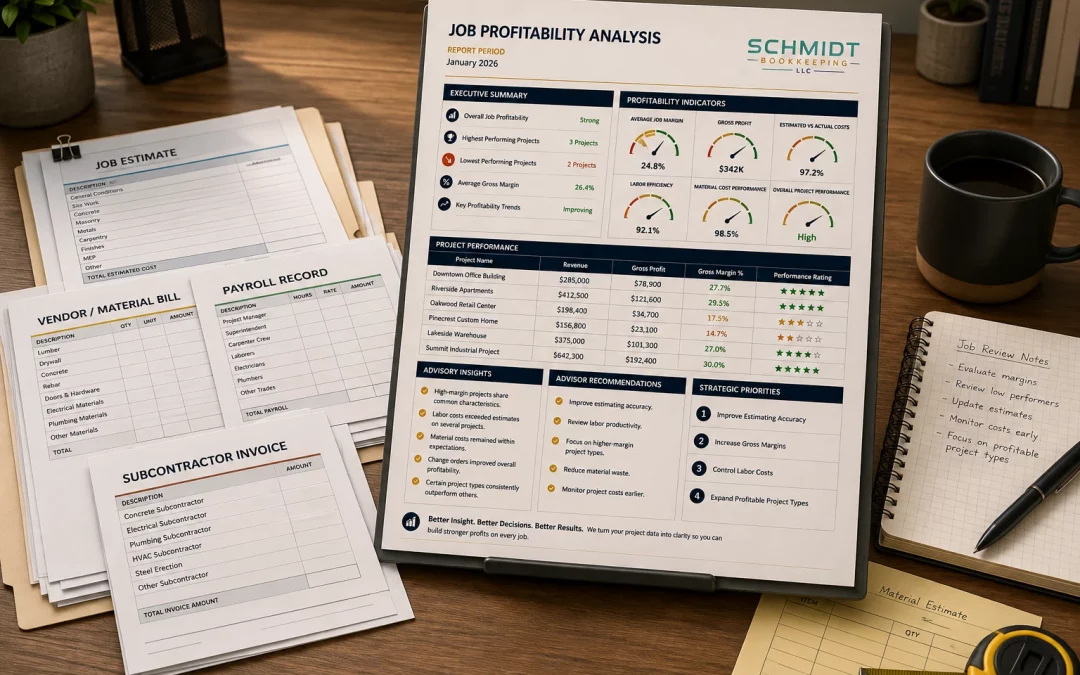
How Contractors Can Tell Which Construction Jobs Are Actually Making Money
A construction company can be profitable overall while individual jobs lose money.
One strong project can help cover the losses from another. Several profitable jobs can hide one project that went badly. And a job with a large contract value can look successful while producing less profit than a much smaller project.
That is why company-level profitability only tells you part of the story.
If you want to understand where your profit is actually coming from, you need to look at the financial performance of individual jobs.
That starts with reliable job costing.
What Does It Mean for a Construction Job to Be Profitable?
A profitable job produces more revenue than the direct costs required to perform the work.
At its simplest:
Job Revenue
↓
Less Direct Job Costs
↓
Job Gross Profit
If a project produces $100,000 of revenue and requires $75,000 of direct costs to complete, the job produces $25,000 of gross profit.
But the dollar amount alone does not tell you everything.
You also need to understand the job’s gross margin—how much of each revenue dollar remains after direct job costs.
That helps you compare projects of different sizes.
A $500,000 project may produce more gross-profit dollars than a $100,000 project while still producing a weaker margin.
Knowing both numbers gives you better Financial Visibility.
Gross profit tells you how many dollars the job produced.
Gross margin helps you understand how efficiently the job produced them.
Why Job Revenue Doesn't Tell You Whether a Job Made Money
Contractors naturally pay attention to contract value and revenue.
A large job feels important. A growing backlog feels encouraging. Higher revenue can make the business appear stronger.
But revenue tells you how much work you sold—not how much money the work produced.
A $250,000 project can be less profitable than a $100,000 project if the larger job requires substantially more labor, materials, subcontractor costs, equipment, or other direct expenses.
A project can also start with an attractive estimate and lose margin as the work progresses.
For example:
- labor hours may exceed the estimate;
- material costs may increase;
- subcontractor costs may run over budget;
- equipment may remain on the job longer than expected;
- rework may consume additional labor and materials;
- project delays may increase direct costs;
- approved changes may not be captured properly.
The job may still generate plenty of revenue.
That does not mean it produced the profit you expected.
What Costs Should You Track to Understand Job Profitability?
To understand whether a job is profitable, you need reliable information about the costs associated with performing that job.
Depending on your business and the type of work you perform, those direct costs may include:
- field labor;
- labor burden assigned to the job;
- materials;
- subcontractors;
- equipment or job-specific rentals;
- permits;
- delivery or freight costs;
- other costs directly attributable to completing the project.
The exact cost structure will vary from one construction company to another.
The important part is consistency.
If job-related costs are missing, assigned to the wrong project, or recorded inconsistently, the profitability information becomes less reliable.
A job can appear profitable simply because some of its costs are sitting somewhere else.
That is why job costing is more than knowing how much you billed.
You need to know what the work actually cost.
How Do You Calculate Profit on a Construction Job?
At the job level, one of the most useful starting points is gross profit.
The basic calculation is:
Job Revenue − Direct Job Costs = Job Gross Profit
For example:
Job Revenue: $200,000
Direct Job Costs: $150,000
Gross Profit: $50,000
That tells you how much gross profit the project generated before considering the broader costs of operating the company.
But if you want to compare that project with other jobs, you also need context.
That is where gross margin becomes useful.
Why Gross Margin Matters When Comparing Construction Jobs
Gross-profit dollars can be misleading when you compare jobs of very different sizes.
Consider two projects.
Job A
Revenue: $100,000
Direct Job Costs: $70,000
Gross Profit: $30,000
Gross Margin: 30%
Job B
Revenue: $300,000
Direct Job Costs: $240,000
Gross Profit: $60,000
Gross Margin: 20%
Job B produced twice as many gross-profit dollars.
But Job A produced a stronger margin.
That does not automatically mean Job A was the better project. Project duration, crew capacity, risk, and other business considerations may still matter.
But the comparison tells you something important:
Revenue and gross-profit dollars alone do not tell the entire story.
Gross margin gives you another way to compare how different jobs perform.
Over time, that can help you identify patterns in the work your company performs.
Why Estimated Profit and Actual Profit Can Be Different
Most contractors expect a project to produce a certain amount of profit when they estimate or price the work.
But estimated profitability and actual profitability are not the same thing.
The estimate represents what you expected to happen.
Actual job performance tells you what happened.
That makes several comparisons useful:
Estimated Revenue vs. Actual Revenue
Estimated Costs vs. Actual Costs
Estimated Gross Profit vs. Actual Gross Profit
Estimated Gross Margin vs. Actual Gross Margin
If a project was expected to produce a 30% gross margin but ultimately produced 20%, the important question is not simply whether 20% is “good” or “bad.”
The more useful question is:
What changed?
Did labor run over?
Did material costs increase?
Were subcontractor costs higher than expected?
Was the original estimate too aggressive?
Did the project scope change?
Were change orders captured and billed properly?
Did production take longer than planned?
The difference between estimated and actual performance gives you a place to start looking.
Job Costing Helps Explain Where Profit Was Gained or Lost
Job costing organizes revenue and costs by project.
Instead of seeing only company-wide expenses, you can see how costs relate to specific jobs.
That allows you to ask better questions.
Which jobs used more labor than expected?
Which projects experienced material overruns?
Which jobs required more subcontractor work?
Which projects maintained their expected margins?
Which jobs consistently performed better than others?
This is where job costing becomes more than an accounting process.
It becomes a source of Financial Visibility.
The goal is not simply to record job costs correctly.
The goal is to understand what those costs are telling you about the work.
Can a Profitable Construction Company Still Have Losing Jobs?
Yes.
One highly profitable job can offset losses from another. Several strong projects can hide a weak one. And company overhead can affect the final result even when individual projects perform well.
That means a profitable Profit & Loss Statement does not automatically mean every project was successful.
Likewise, one losing job does not necessarily mean the entire company is unprofitable.
You need both levels of visibility.
Company-level reporting helps you understand whether the business is profitable.
Job-level reporting helps you understand where that profitability is coming from.
What Does a Job Performance Report Tell You?
A Job Performance Report brings job-level financial information together so you can evaluate projects more consistently.
Depending on your company’s reporting structure, it may help you compare information such as:
- job revenue;
- estimated costs;
- actual costs;
- gross profit;
- gross margin;
- estimated versus actual performance.
The report itself is not the goal.
The value comes from the questions it helps you answer.
Which jobs performed as expected?
Which jobs missed their expected margin?
Where did actual costs exceed estimates?
Which projects produced the most gross profit?
Which projects produced the strongest margins?
Are certain types of jobs consistently performing better than others?
Reliable reporting turns individual transactions into information you can use.
What Should You Look for When Comparing Jobs?
Looking at one project can tell you how that job performed.
Comparing several projects can reveal patterns.
For example, you may discover that:
- certain types of projects consistently produce stronger margins;
- particular project sizes perform better than others;
- labor-intensive work frequently exceeds estimated hours;
- certain customers create additional cost or complexity;
- specific services produce stronger financial results;
- some jobs generate substantial revenue but relatively little profit.
Those patterns can eventually influence estimating, pricing, staffing, project selection, and business strategy.
But don’t jump to conclusions from one unusual project.
One job can be affected by unusual circumstances.
The more useful question is whether the same pattern continues to appear across multiple projects.
Financial Visibility helps you separate an isolated problem from a recurring business issue.
What If Certain Jobs Consistently Produce Weak Margins?
If the same types of jobs repeatedly produce weak margins, that deserves attention.
But weak job profitability does not automatically tell you what the solution should be.
The problem could be:
- pricing;
- estimating;
- labor performance;
- material purchasing;
- subcontractor management;
- project execution;
- scope control;
- change-order management;
- the type of work itself.
The first step is not immediately deciding to stop taking the work.
The first step is understanding why the work is underperforming.
Once you understand that, you can make a more informed decision about whether the problem can be corrected—or whether that type of work simply does not fit the business.
Which Customers and Services Are Producing the Best Jobs?
Once you can measure profitability by project, another set of questions becomes possible.
Do certain customers consistently produce stronger jobs?
Do some customers create more rework, delays, administrative burden, or margin pressure?
Do certain services consistently generate stronger gross margins?
Does one type of work require more labor or supervision than another?
Those questions go beyond individual job profitability.
They help you begin understanding the mix of work that produces the best financial results for the company.
But those are separate decisions.
Job Profitability and Company Profitability Need to Work Together
Strong job profitability matters because the gross profit generated by your projects ultimately needs to support the rest of the business.
Your company still has overhead and operating expenses that are not necessarily tied directly to one project.
Those may include:
- office payroll;
- rent;
- insurance;
- software;
- professional services;
- administrative costs;
- marketing;
- other costs required to operate the company.
Your jobs need to produce enough gross profit, collectively, to help cover those expenses and leave the company with net profit.
That is why job profitability cannot be viewed completely in isolation.
A job may be profitable at the project level while the company still struggles financially if the combined gross profit from all projects is not enough to support the business.
This connects two levels of Financial Visibility:
Job profitability tells you how the work is performing.
Company profitability tells you what the business ultimately keeps.
You need both.
Financial Visibility Helps You Understand Which Work Is Actually Producing Profit
Knowing that the company made money is useful.
Knowing where that money came from is much more useful.
When job-level financial information is reliable, you can begin answering questions such as:
- Which jobs produced the strongest gross profit?
- Which jobs produced the strongest margins?
- Which projects performed close to estimate?
- Where did costs run over?
- Which types of work consistently perform well?
- Which projects need closer attention?
- Are job margins improving or declining?
That is the difference between simply having job-cost information and being able to use it.
The Construction Visibility System™ brings job costing, financial reporting, and financial analysis together so contractors can understand how individual projects contribute to the financial performance of the business.
The goal is not more reports.
The goal is better decisions.
Frequently Asked Questions
How do you calculate profit on a construction job?
A useful starting point is to subtract the direct costs required to perform the job from the revenue generated by that job.
The result is job gross profit.
You can then calculate gross margin to understand how much of each revenue dollar remained after direct job costs.
What costs should be included when determining job profitability?
Direct job costs may include field labor, materials, subcontractors, equipment or job-specific rentals, labor burden where appropriately assigned, permits, and other costs directly attributable to performing the project.
The exact cost structure depends on the construction company and type of work.
The important part is that job-related costs are captured consistently and assigned to the correct project.
What is a good profit margin on a construction job?
There is no single gross margin that is appropriate for every construction company or every type of project.
Project type, risk, labor requirements, company overhead, market conditions, pricing strategy, and other factors can affect the margin a business needs.
Industry benchmarks can provide context, but your own costs and financial structure determine what your company needs.
What's the difference between markup and profit margin?
Markup describes how much is added to cost when establishing a selling price.
Gross margin shows how much of the job’s revenue remains after direct job costs.
They are related, but they are not the same percentage.
Confusing the two can cause a contractor to expect more profit from a project than the pricing actually produces.
Why did a job make less money than expected?
A project can underperform for many reasons, including labor overruns, higher material costs, subcontractor overruns, estimating errors, project delays, rework, scope changes, or change orders that were not properly captured.
Comparing estimated and actual job performance helps identify where the difference occurred.
Can a construction company be profitable if some jobs lose money?
Yes.
Profitable jobs can offset losses from weaker projects, which means company-level profit can sometimes hide individual jobs that underperformed.
That is why contractors need both company-level and job-level Financial Visibility.
What report shows profitability by job?
A Job Performance Report can bring together job-level revenue, costs, gross profit, gross margin, and estimated-versus-actual information so individual projects can be evaluated and compared.
The exact information included depends on the company’s reporting structure.
How does job costing help contractors measure profitability?
Job costing organizes revenue and costs by project.
When job costs are captured accurately and consistently, contractors can compare what a project earned with what it cost to perform the work.
That makes it possible to evaluate gross profit, gross margin, estimated-versus-actual performance, and patterns across multiple jobs.
Do You Know Which Jobs Are Actually Driving Your Profit?
If you can see that the company made money but cannot identify which jobs produced that profit, you still have an important visibility gap.
Reliable job costing and job-level reporting help you understand what happened on individual projects.
Financial Visibility helps you use that information to understand why it happened and what it means for future decisions.
That is how job-level financial information becomes business intelligence.
Look Beyond the Profit Number on Each Job
These resources can help you understand why job profitability is easy to misread, identify where profit may be leaking from your work, and compare completed jobs using consistent financial information.
Need Better Visibility Into Job Profitability?
If you’re completing projects but still aren’t sure which jobs are actually making money, the problem may not be a lack of work.
It may be a lack of reliable job-level Financial Visibility.
A Book Review can help identify whether your bookkeeping and job-level financial information are giving you the visibility you need to understand which projects are actually producing profit.