
How Contractors Can Tell If Their Construction Business Is Profitable
You have work on the schedule. Crews are busy. Invoices are going out. Money is coming into the bank.
But is your construction business actually making money?
That question can be harder to answer than it sounds.
A busy construction company is not automatically a profitable construction company. Revenue tells you how much your business earns from its work. It does not tell you how much is left after paying for the jobs and running the company.
To understand whether your business is actually making money, you need to see what happens between revenue and profit.
That is where Financial Visibility begins.
What Does “Making Money” Actually Mean for a Construction Company?
At the simplest level, your construction company is making money when the revenue you earn is greater than the costs required to perform the work and operate the business.
But there are several layers between those two numbers.
You may have labor, materials, subcontractors, equipment, and other costs tied directly to jobs. Then you still have the expenses required to keep the business operating.
A useful way to think about profitability is:
Revenue
↓
Less Direct Job Costs
↓
Gross Profit
↓
Less Overhead and Operating Expenses
↓
Net Profit
Each level answers a different question about your business.
Revenue Tells You How Much Work You Sold
Revenue is the income your construction company earns from the work it performs.
Growing revenue can be a good sign. But revenue by itself does not tell you whether the work was profitable.
A $100,000 job is not automatically better than a $50,000 job.
What matters is what it cost you to earn that revenue and how much remained afterward.
Gross Profit Tells You What the Work Produced
Gross profit is what remains after the direct costs of performing the work are deducted from the revenue associated with that work.
Those costs may include labor, materials, subcontractors, equipment, and other costs directly connected to completing jobs.
Gross profit helps answer an important question:
Is the work itself producing enough money to help support the rest of the business?
Gross Margin Helps You Compare Performance
Gross margin shows your gross profit as a percentage of revenue. It helps you see how much of each revenue dollar remains after direct job costs.
That percentage makes it easier to compare financial performance across different periods, jobs, or types of work.
Two contractors could generate the same revenue and have very different gross margins because their costs are different.
The same can happen inside your own company from one job to another.
Net Profit Tells You What Remains
Gross profit is not the end of the story.
Your company still has costs associated with running the business. Depending on how your books are structured, those may include office expenses, insurance, software, professional fees, administrative payroll, and other overhead or operating expenses.
After the costs of running the business are accounted for, what remains is your net profit.
That is why a company can generate a healthy amount of revenue and still produce very little profit.
Why Revenue Doesn't Tell You Whether You're Profitable
Revenue is easy to notice.
You see contracts being signed. You send invoices. Deposits appear in the bank. Your sales numbers increase.
That activity can make the business feel successful.
But suppose revenue increases while labor costs rise faster. Materials are running over estimate. Jobs require more supervision than expected. Change orders are not being captured. Overhead keeps growing.
The company may be doing more work without keeping more money.
This is one reason growth can sometimes hide financial problems instead of solving them.
More revenue is valuable when the work produces adequate profit.
Revenue without adequate profitability can simply mean you are working harder to produce disappointing financial results.
Gross Profit vs. Net Profit: Contractors Need to Understand Both
Gross profit and net profit tell you different things.
Gross profit helps you understand how the work is performing.
Net profit helps you understand what the business ultimately keeps after the costs of running it.
That distinction matters because a problem at one level may require a different response than a problem at another.
If gross profit is weak, you may need to investigate job costs, estimating, pricing, labor performance, or project execution.
If gross profit looks reasonable but net profit is weak, the problem may be elsewhere. Overhead or other operating expenses may be consuming too much of what the jobs produce.
Financial Visibility helps you identify where the profitability problem begins instead of simply knowing that the final number is disappointing.
What Is a Good Profit Margin for a Construction Company?
This is one of the first questions contractors ask once they begin looking at profitability.
It is also a question that can be misleading if you expect one percentage to apply to every construction business.
Profit margins can vary based on trade, project type, company size, labor structure, subcontractor use, equipment requirements, overhead, geographic market, and the type of work being performed.
Even how you categorize costs can affect the margins you see.
Industry benchmarks can provide useful context. They should not replace an understanding of your own business.
A more useful set of questions is:
What margin is my company actually producing?
Is that margin sufficient to cover the costs of operating my business?
Is it improving or declining?
Which jobs are producing it?
Is the result sustainable?
A benchmark can tell you how your number compares.
Financial Visibility helps you understand why your number is what it is and what it means for your business.
Why Cash in the Bank Doesn't Tell You Whether You're Making Money
Your bank balance matters.
But it does not tell you the same thing as profit.
Cash measures money available at a particular point in time. Profit measures financial performance over a period of time.
The two are connected, but timing can make them look very different.
You might receive a large customer payment today for work performed earlier. You may have bills that have not been paid yet. You might owe payroll, subcontractors, or suppliers later in the week. Retainage may still be outstanding on completed work.
That means a healthy bank balance today does not automatically mean the company is profitable.
The opposite can also happen.
A profitable company can experience cash pressure when money is tied up in accounts receivable, retainage, or active jobs.
So when you ask, “Am I actually making money?”, don’t use the bank balance as your only answer.
Profitability and cash flow need to be understood separately.
Your Company Can Be Profitable While Some Jobs Lose Money
Company-level profit gives you the overall result.
It does not tell you whether every job contributed equally to that result.
One project may produce a strong margin while another barely breaks even. Another may lose money entirely.
If you only look at the company total, profitable jobs can hide weak jobs.
That is why construction companies need job-level visibility in addition to company-level financial reporting.
Job costing lets you compare what you expected a job to cost with what it actually cost. It helps you understand labor, materials, subcontractors, equipment, and other project costs.
Over time, those results help you identify patterns.
You can begin to see which jobs make money, which ones struggle, and why.
Signs Your Construction Business May Not Be as Profitable as It Looks
Profitability problems do not always announce themselves clearly.
Sometimes the business looks successful from the outside while the financial results tell a different story.
Watch for patterns such as:
- Revenue is increasing, but profit is not.
- You are consistently busy but still feel financially stretched.
- Job costs regularly exceed estimates.
- Gross margins are declining.
- You cannot explain why profit changed from one month to another.
- Overhead continues increasing without a corresponding improvement in profit.
- Some jobs appear successful, but you do not have reliable job-cost information to confirm it.
- You regularly need the next customer payment to cover current obligations.
- Your accountant tells you the business made money, but you cannot explain where that profit came from.
- You cannot confidently answer whether profitability is improving or getting worse.
One warning sign does not automatically mean the business is unhealthy.
The larger problem is not knowing what the numbers are telling you.
Which Financial Reports Show Whether You're Making Money?
You do not need dozens of reports to begin understanding profitability.
You need reliable reports that answer specific business questions.
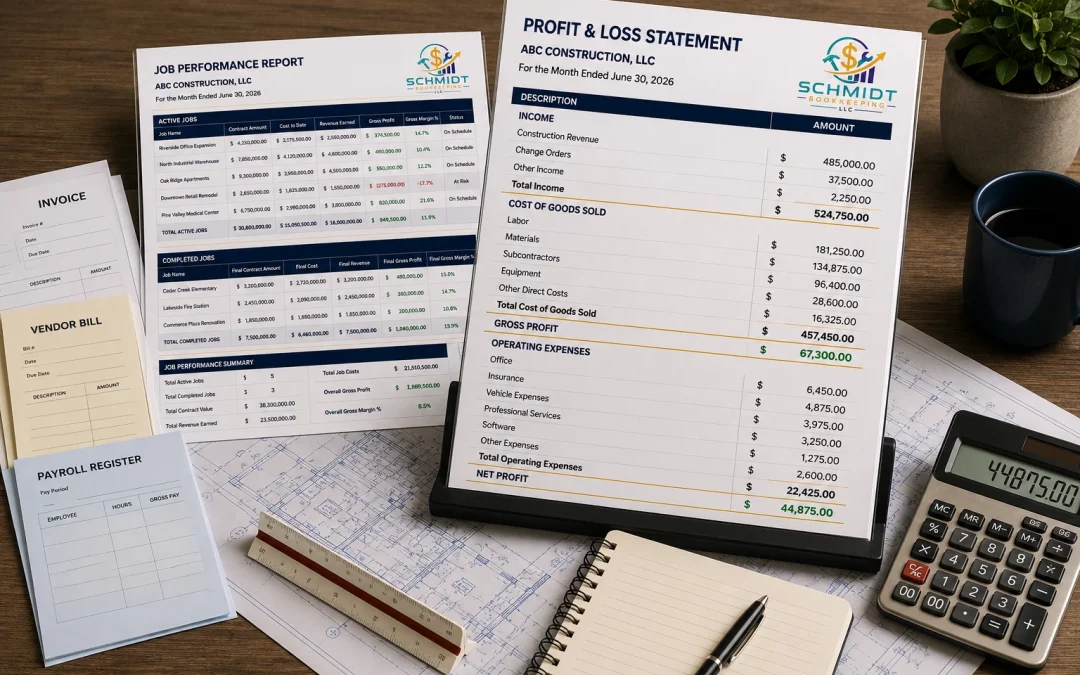
Profit & Loss Statement
Your Profit & Loss Statement shows revenue and expenses over a period of time and helps you understand whether the company generated a profit or loss.
It is one of the primary reports for evaluating company-level profitability.
But the report becomes more useful when the accounts are organized correctly and the numbers are current.
Job Performance Information
Company-level profit tells you how the entire business performed.
Job-level reporting helps you understand where that performance came from.
That distinction is especially important in construction because several jobs may be active at once and each can perform differently.
Balance Sheet
The Balance Sheet does not replace the Profit & Loss Statement for measuring profitability.
It gives you another part of the financial picture by showing what the business owns, what it owes, and its financial position at a point in time.
Statement of Cash Flows
The Statement of Cash Flows helps explain how cash moved through the business.
Again, cash flow and profit are not the same.
Looking at these reports together gives you a clearer understanding than relying on any one number.
What Should You Do If Your Construction Business Isn't Making Enough Money?
Start by resisting the urge to guess.
Low profitability does not automatically mean you need more sales.
First, identify where the financial result is breaking down.
If Certain Jobs Are Underperforming
Look deeper into job profitability.
Are labor hours running over estimate? Are material costs higher than expected? Are subcontractor costs changing? Are change orders being captured?
If Your Pricing Isn’t Producing Enough Margin
The problem may begin before the work starts.
Your prices need to account for the costs of performing the work and contribute enough toward the rest of the business.
If Expenses Are Consuming the Profit
You need to understand where the company’s money is being spent.
Separate direct job costs from overhead and operating expenses so you can see which categories are changing.
If You Show a Profit but Never Seem to Have Cash
You may have a cash-flow problem rather than a profitability problem.
Look at collection timing, accounts receivable, retainage, upcoming obligations, and how cash moves through active jobs.
The goal is not simply to find a disappointing number.
The goal is to understand what is causing it.
Financial Visibility Turns Profit Into Something You Can Manage
Bookkeeping records what happened.
Financial Visibility helps you understand what happened and use that information to make better decisions.
The Construction Visibility System™ connects accurate financial information with reporting, interpretation, and practical guidance so contractors can better understand profitability, job performance, cash flow, and the financial condition of the business.
Once you understand whether your business is actually making money, you can ask better questions.
Which jobs are producing that profit?
Is your pricing strong enough?
Where is the money going?
Why is cash still tight?
Is the business financially healthy?
Those are the questions good financial information should help you answer.
Frequently Asked Questions
How Do I Know if My Construction Company Is Profitable?
Start with reliable financial reports and determine whether revenue exceeds the costs of performing your work and operating the business.
Look at gross profit, gross margin, and net profit rather than relying only on revenue or your bank balance.
What's the Difference Between Revenue and Profit?
Revenue is the income your company earns from its work.
Profit is what remains after the costs of doing the work and running the business are deducted.
A construction company can generate substantial revenue without generating adequate profit.
What's the Difference Between Gross Profit and Net Profit?
Gross profit shows what remains after direct job costs are deducted from revenue.
Net profit goes further by accounting for the other costs required to operate the business.
Is Gross Margin the Same as Markup?
No.
They are related, but they measure different things. Markup is generally based on cost, while margin measures profit relative to revenue.
Confusing the two can lead to pricing that produces less profit than expected.
Can My Construction Company Be Profitable and Still Have No Cash?
Yes.
Profit and cash measure different things. A profitable company can experience cash pressure because of accounts receivable, retainage, billing timing, active-job costs, and upcoming obligations.
Can Some Jobs Lose Money Even When the Company Is Profitable Overall?
Yes.
Strong jobs can offset poor-performing jobs when you look only at company totals.
Job costing and job-level reporting help you see which projects are actually contributing to profitability.
What Financial Report Shows Whether My Construction Company Is Making Money?
The Profit & Loss Statement is a primary report for understanding company-level profitability over a period of time.
Job-level reporting adds another important layer by showing which projects contributed to the overall result.
Do You Have Enough Financial Visibility to Answer the Question?
You should be able to answer more than:
“How much revenue did we do?”
or:
“How much money is in the bank?”
You should be able to explain whether the company is profitable, what is driving that profit, whether margins are changing, and where you need to investigate when the results are not what you expected.
That is the difference between having financial information and understanding your business.
The Construction Visibility System™ is designed to help contractors make that transition.
Explore Profitability From More Than One Angle
These resources can help you read the numbers more clearly, ask better profitability questions, and work through your own construction business results.
When You Want Help Understanding What Your Numbers Are Telling You
If you have financial reports but still cannot confidently answer whether your business is actually making money, the problem may not be a lack of information.
You may need better visibility into what that information means.
A Book Review can help identify where your financial information is clear, where visibility may be limited, and which areas may deserve a closer look.