
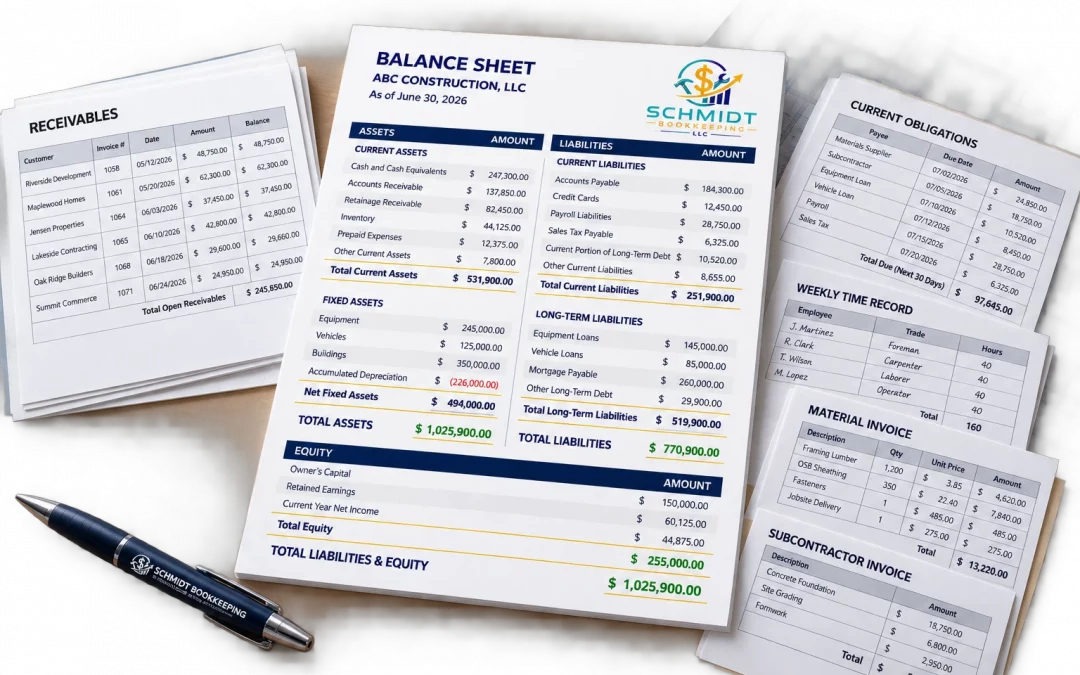
A construction business can have money in the bank and still be financially stretched.
There may be customer payments coming in, profitable jobs underway, and plenty of work on the schedule.
But payroll is still due.
Suppliers and subcontractors still need to be paid.
Materials may need to be purchased before the next customer payment arrives.
Taxes, debt payments, and other obligations continue regardless of when customers pay.
That is why looking at today’s bank balance does not fully answer an important financial question:
Does the business have enough short-term financial capacity to meet its obligations and support the work it has committed to perform?
Working capital helps answer that question.
It looks beyond the amount of cash available today and considers the relationship between the company’s short-term financial resources and its short-term obligations.
For a construction business, that relationship matters because the timing of spending, billing, and collecting rarely lines up perfectly.
Understanding working capital gives you another layer of Financial Visibility into whether the business has the capacity to keep operating reliably.
What Is Working Capital?
At its simplest, working capital is calculated as:
Current Assets − Current Liabilities = Working Capital
Current assets are assets the business generally expects to convert to cash, sell, or use within one year or its normal operating cycle, depending on the nature of the asset and the business.
Current liabilities are obligations the business expects to pay within that same general short-term period.
If current assets exceed current liabilities, the business has positive working capital.
If current liabilities exceed current assets, the business has negative working capital.
The calculation itself is straightforward.
Understanding what the result means for your construction business requires more context.
What Counts as a Current Asset?
Current assets can include items such as:
- Cash
- Accounts receivable
- Certain other short-term assets
Cash is the easiest to understand because it is already available in the bank.
Accounts receivable are different.
They represent amounts customers owe the business, but that money may not yet be available to pay payroll, suppliers, subcontractors, or other obligations.
That distinction becomes important when evaluating working capital.
A company may have substantial current assets on its Balance Sheet while a meaningful portion of those assets is still waiting to be collected.
The number matters.
So does what the number consists of.
What Counts as a Current Liability?
Current liabilities represent obligations the company expects to meet in the near term.
Depending on the business, they may include:
- Accounts payable
- Credit card balances
- Payroll-related liabilities
- Taxes payable
- Current portions of loans or other debt
- Other short-term obligations
These are financial commitments the business needs to support with its available resources and future cash collections.
Knowing that the business has $200,000 of current assets tells you something.
Knowing that it also has $180,000 of current liabilities tells you considerably more.
Working capital puts those two sides of the financial position into relationship.
Why Working Capital Matters So Much in Construction
Construction businesses frequently have to spend money before collecting the customer payment associated with that work.
Employees may need to be paid every week or every two weeks.
Suppliers may require payment for materials.
Subcontractors submit bills.
Equipment and operating expenses continue.
Meanwhile, the contractor may still be waiting for a progress payment, an invoice to be approved, a customer to pay, or retainage to be released.
That timing gap creates a financial requirement.
The business needs enough short-term financial capacity to continue operating while money moves through the project cycle.
The challenge can become larger when several jobs are active at the same time.
Each project may require:
- Labor
- Materials
- Subcontractors
- Equipment
- Insurance
- Other project costs
before all of the related customer payments have been collected.
A strong backlog can therefore be good news and still create financial pressure.
Profitable work does not automatically finance itself.
The business needs sufficient financial capacity to carry the work while it is being performed, billed, and collected.
That is one reason working capital matters so much in construction.
Positive Working Capital Does Not Automatically Mean You Have Enough
Suppose your company has:
$300,000 of Current Assets
and
$250,000 of Current Liabilities
Working capital is:
$50,000
That is positive working capital.
But does the business have enough?
The calculation alone cannot answer that.
Consider what may happen next.
A large payroll could be due.
Several material purchases may be required for newly started projects.
A quarterly tax payment may be approaching.
Customers may be taking longer to pay.
A significant portion of receivables may be held in retainage.
Several jobs may be consuming cash at the same time.
The business technically has positive working capital, but its short-term financial capacity could still be tight relative to what the company needs to support.
That is why the useful question is not simply:
Is working capital positive?
It is:
Is working capital sufficient for the obligations and operating demands the business actually faces?
Those are different questions.
Negative Working Capital Deserves Attention
Now consider the opposite situation.
If current liabilities exceed current assets, the business has negative working capital.
That means the short-term obligations represented in the calculation exceed the short-term financial resources represented there.
That deserves attention.
But negative working capital should lead to investigation rather than an automatic conclusion about the entire business.
You need to understand why it exists.
Is the condition temporary because of the timing of a large payment?
Have receivables been unusually slow to collect?
Has the business grown faster than its financial capacity?
Are liabilities increasing?
Did a large current debt obligation come due?
Are jobs failing to produce adequate profit?
Is the business routinely depending on future collections to meet obligations that are already due?
The working-capital calculation identifies the financial condition.
Financial Visibility helps you investigate what is causing it.
One unusual period may have a reasonable explanation.
A persistent pattern deserves closer attention.
The Quality of Working Capital Matters
Two construction businesses can report the same amount of working capital and still have very different financial positions.
Two businesses can have the same working-capital amount but very different liquidity because the assets included in that calculation may not become available cash at the same speed.
Imagine two contractors that each report $100,000 of positive working capital.
For the first contractor, a large portion of current assets may be cash and relatively current accounts receivable that customers are paying reliably.
For the second contractor, very little may be cash. A large portion of current assets may consist of older receivables or amounts that will take considerably longer to collect.
The arithmetic result may be identical.
The practical financial capacity may not feel identical at all.
The same principle applies to liabilities.
A company whose obligations are spread reasonably across its operating cycle may face a different short-term financial situation from one with a large concentration of payments coming due immediately.
So working capital should not be evaluated only by looking at the final number.
Look inside it.
What are the current assets?
How quickly can they become usable cash?
What are the current liabilities?
When must they be paid?
The composition and timing of working capital can matter almost as much as the arithmetic amount.
Accounts Receivable Can Make Working Capital Look Stronger Than Cash Feels
Accounts receivable can be one of the largest current assets in a construction business.
That makes receivables important to working capital.
But a receivable is not the same as cash in the bank.
Suppose a contractor has $250,000 in accounts receivable.
That amount may strengthen the current-asset side of the Balance Sheet.
But if customers have not paid yet, that $250,000 is not currently available in the bank to cover payroll, vendors, or other immediate expenses.
The age and collectibility of those receivables matter.
Ask:
- How much is outstanding?
- How old are the receivables?
- Are customers paying according to normal expectations?
- Is a meaningful amount becoming increasingly overdue?
- When is the money realistically expected to be collected?
A contractor can therefore have positive working capital while still experiencing significant cash pressure.
Working-capital position and immediately available cash are related, but they are not the same thing.
Accounts Payable and Other Current Obligations Matter Too
Receivables show part of what is expected to come into the business.
Current liabilities help show what needs to go out.
Accounts payable may include amounts owed to:
- Material suppliers
- Subcontractors
- Equipment vendors
- Other vendors and service providers
The business may also have:
- Credit card balances
- Payroll-related obligations
- Taxes
- Current debt payments
- Other short-term liabilities
The amount matters.
So does timing.
Imagine that a contractor expects to collect $100,000 from customers over the next several weeks.
That sounds positive.
But if $125,000 of payroll, vendor bills, taxes, and other obligations must be paid before those collections arrive, the business may still experience pressure.
That is why working-capital analysis becomes more useful when it goes beyond the Balance Sheet total and considers when resources are likely to become available and when obligations need to be met.
Retainage Can Complicate the Picture
Retainage creates another construction-specific challenge.
The contractor may have earned amounts that remain uncollected because retainage is being withheld under the contract.
That amount is not necessarily cash available today.
As retainage accumulates across multiple projects, the company may have more money tied up while payroll, suppliers, subcontractors, and other expenses continue.
That does not automatically mean the business has inadequate working capital.
It does mean retainage can affect how the company’s short-term financial capacity should be interpreted.
When evaluating working capital, it is useful to understand not merely how much is represented in receivables, but also how much of those amounts may remain unavailable for an extended period.
Active Jobs Add Another Layer
The Balance Sheet provides important information about current assets and current liabilities.
But a construction company’s active projects create another layer of context.
A project may still require substantial:
- Payroll
- Materials
- Subcontractor costs
- Equipment costs
- Other direct costs
before all related customer payments are collected.
That means the business needs to understand not only where it stands today, but what its active work may require next.
Work in Progress information can provide context about active jobs, including how much work is underway and where project timing may create additional financial demands before related billings and collections are complete.
The purpose here is not to turn working-capital analysis into a full WIP review.
It is to recognize that current jobs can create future short-term demands on the company’s financial resources.
Working capital needs to support the business that is actually operating—not merely the financial position shown at one moment in time.
How Much Working Capital Is Enough?
There is no single working-capital amount that is appropriate for every construction business.
A contractor with a small number of short-duration projects may have different needs from a company carrying several large projects over long periods.
A business whose customers pay quickly may have different needs from one that routinely waits months for collections.
A company with substantial retainage may need to carry more financial pressure before cash is released.
A rapidly growing contractor may need additional working capital simply because more projects require more money to move through the business.
Factors that can affect working-capital needs include:
- Company size
- Payroll requirements
- Number of active jobs
- Size of active jobs
- Project duration
- Billing structure
- Customer payment timing
- Accounts receivable aging
- Retainage
- Material requirements
- Subcontractor payment timing
- Debt obligations
- Tax obligations
- Seasonality
- Upcoming commitments
- Growth plans
That is why a universal answer such as:
“Every contractor should have $ of working capital.”
is not particularly useful.
Neither is assuming that one ratio or threshold can describe every construction business.
The better question is:
Does the business have enough short-term financial capacity for the financial demands it actually faces?
That answer requires context.
Growth Can Consume Working Capital
Growth often sounds like a solution to financial pressure.
More jobs mean more revenue.
More revenue should mean more money.
Eventually, successful growth may strengthen the business.
But growth can also consume working capital before it produces additional available cash.
A new project may require:
- Additional employees
- More payroll
- Larger material purchases
- More subcontractor spending
- Equipment
- Insurance
- Mobilization costs
- Other upfront project expenses
The business may incur those costs before receiving the related customer payments.
Now multiply that across several new projects.
Revenue may be increasing while the financial demands on the company increase even faster in the short term.
Accounts receivable may grow.
Retainage may grow.
Payroll may grow.
Accounts payable may grow.
The amount of money moving through the company may increase substantially.
Growth can therefore increase the need for working capital before it increases available cash.
That does not make growth bad.
It means growth needs financial capacity.
A contractor deciding whether the business can support additional work should understand that distinction before assuming that a larger backlog automatically creates a stronger short-term financial position.
Signs Working Capital May Be Getting Tight
Working-capital pressure does not always arrive as one dramatic event.
It can appear as a pattern.
Potential signs include:
- Difficulty covering payroll before customer collections arrive
- Increasing reliance on credit cards or short-term borrowing for ordinary operating expenses
- Vendors being paid later than usual
- Accounts receivable getting older
- Cash remaining consistently tight
- Current liabilities increasing faster than current assets
- Retainage becoming a larger portion of amounts owed to the business
- New projects creating immediate cash strain
- Difficulty absorbing normal payment delays or unexpected expenses
Any one of these may have a reasonable explanation.
A late customer payment can temporarily affect cash.
A large material purchase can create a short-term dip.
Several jobs starting simultaneously can temporarily increase financial pressure.
The concern is not that every period must look perfect.
The concern is when short-term financial pressure becomes routine and the business has little capacity to absorb normal construction variability.
Repeated patterns deserve investigation.
Which Reports Help You Evaluate Working Capital?
No single report explains every part of working capital.
Several reports can provide different pieces of the financial picture.
Balance Sheet
The Balance Sheet is the primary financial statement for evaluating the basic working-capital position.
It shows assets and liabilities at a particular point in time.
Current assets and current liabilities provide the numbers used in the working-capital calculation.
But the Balance Sheet is the starting point—not necessarily the end of the analysis.
You may need supporting reports to understand what those balances actually contain.
Accounts Receivable Aging
The Accounts Receivable Aging helps show amounts customers owe the company and how long those amounts have remained outstanding.
This provides important context for the current-asset side of working capital.
A large receivable balance may look strong on the Balance Sheet.
The aging report helps you see whether those receivables are current or whether a significant amount has remained unpaid for extended periods.
Accounts Payable Aging
The Accounts Payable Aging helps show outstanding vendor obligations.
It provides additional visibility into what the company owes and the age of those obligations.
That can help the contractor understand the liability side of short-term financial capacity.
Work in Progress Report
A Work in Progress Report provides construction-specific context around active jobs.
It can help the contractor understand what is happening across current projects and provide additional context for the financial demands associated with the work underway.
The objective is not to collect reports simply because they exist.
Each report answers a different part of the question.
Together, they help turn a working-capital calculation into a more useful understanding of the company’s short-term financial capacity.
A Practical Working Capital Review
Working capital becomes more useful when you review both the calculation and what sits behind it.
1. Calculate Current Working Capital
Start with:
Current Assets − Current Liabilities = Working Capital
Determine whether the result is positive or negative and how it compares with prior periods.
But do not stop there.
2. Look Inside Current Assets
Understand what makes up the current-asset balance.
How much is cash?
How much is accounts receivable?
How old are those receivables?
How quickly are customers paying?
How much may be tied up in retainage?
The objective is to understand how much of the company’s short-term financial resources are actually available—or likely to become available—when the business needs them.
3. Review Current Liabilities
Identify the company’s short-term obligations.
What is owed to vendors and subcontractors?
What payroll-related obligations exist?
What taxes are coming due?
What debt payments or other commitments must be met?
Then consider timing.
When will those obligations require cash?
4. Consider Active Project Demands
Look at the work currently underway.
What payroll will those projects require?
What materials still need to be purchased?
What subcontractor costs are approaching?
How much additional project spending may occur before the related customer payments arrive?
The answer helps connect the financial statement to the operating reality of the business.
5. Look Ahead
Working capital should support more than today’s bills.
Consider what is approaching.
Are several projects about to start?
Is a large tax payment coming?
Are equipment needs approaching?
Are debt obligations changing?
Is the company planning to hire?
Is the business preparing to take on significantly more work?
Upcoming commitments can change how much financial capacity the company needs.
6. Compare Capacity With Expected Demands
Now return to the actual decision question:
Do the business’s short-term financial resources reasonably support its short-term obligations and expected operating needs?
This is more useful than simply asking whether working capital is positive.
It connects the financial position to the business decisions being made.
7. Investigate the Pressure Points
If working capital appears tight, determine why.
Possible causes may include:
- Slow collections
- Aging receivables
- Retainage
- Rapid growth
- Large project startup costs
- Increasing liabilities
- Debt obligations
- Poor job profitability
- Weak overall profitability
- Billing timing
- Unusually large upcoming commitments
Different causes require different decisions.
The working-capital calculation tells you where to investigate.
Financial Visibility helps you understand what the numbers mean.
Working Capital Is a Signal, Not the Entire Business
Working capital is important.
But it does not answer every financial question.
It does not tell you whether individual jobs are profitable.
It does not tell you whether your pricing is adequate.
It does not explain every change in cash.
It does not tell you whether the company is profitable overall.
It does not automatically tell you whether growth is sustainable.
It does not guarantee that every receivable will be collected.
Working capital answers a narrower question:
What does the business’s short-term financial capacity look like relative to its short-term obligations?
That is an important part of financial health.
It is not the entire definition of financial health.
Working Capital Should Be Reviewed Over Time
A single working-capital calculation provides a snapshot.
The trend can provide additional context.
Consider how the company’s working capital is changing over time.
Is it strengthening?
Is it gradually declining?
Are current assets growing?
Are current liabilities growing faster?
Are receivables becoming a larger portion of current assets?
Is retainage increasing?
Is cash becoming tighter?
Are new jobs increasing the financial demands on the business?
A contractor may still have positive working capital today while the trend is weakening.
Another company may have experienced a difficult period but be moving toward a stronger position.
That is why consistent financial reporting matters.
It helps you distinguish a temporary timing issue from a developing pattern.
Financial Visibility Makes Working Capital Useful
The Construction Visibility System™ provides a practical way to understand how working-capital information becomes useful:
Capture → Organize → Analyze → Report → Advise
Financial activity and obligations are captured through accurate bookkeeping.
Cash, receivables, payables, liabilities, retainage, and other relevant financial information are organized so the relationships can be understood.
Working capital and its underlying components are analyzed in the context of the business.
Financial statements and supporting reports make that position easier to report and review.
Then the information can help advise the next decision.
Can the business comfortably support the work already underway?
Is short-term financial pressure increasing?
Do collections need attention?
Are liabilities becoming difficult to support?
Does the company have enough financial capacity to take on additional commitments?
Those are better questions than simply asking:
How much money is in the bank today?
Bookkeeping creates the financial structure.
Financial Visibility helps you understand what that structure means for the business.
The Goal Is Financial Capacity, Not a Perfect Number
There is no universal working-capital number that makes every construction company financially secure.
The right amount depends on the business.
Its projects.
Its payroll.
Its billing cycle.
Its customers.
Its liabilities.
Its retainage.
Its growth.
Its upcoming commitments.
The goal is not to chase a perfect number.
The goal is to understand whether the company has enough short-term financial capacity to support the obligations and operating demands it actually faces.
That means looking beyond cash.
It means looking beyond the working-capital calculation itself.
And it means understanding how the financial pieces work together.
When those relationships are visible, you can make better decisions about what the business can support—and where financial pressure may need attention.
Frequently Asked Questions
What is working capital in a construction business?
Working capital is the difference between a company’s current assets and current liabilities.
It provides a view of the business’s short-term financial capacity by comparing financial resources expected to be available in the near term with obligations expected to be paid in the near term.
For construction businesses, the calculation becomes more useful when it is considered alongside receivables, payables, retainage, active-project demands, and the timing of collections and payments.
How do I calculate working capital?
The basic calculation is:
Current Assets − Current Liabilities = Working Capital
Those amounts are generally found on the Balance Sheet.
A positive result means current assets exceed current liabilities. A negative result means current liabilities exceed current assets.
The calculation tells you the working-capital amount. Additional analysis is needed to determine whether that amount is sufficient for the particular business.
How much working capital should a contractor have?
There is no single amount that is appropriate for every contractor.
Working-capital needs can vary based on company size, payroll, active projects, billing cycles, customer payment timing, retainage, material and subcontractor requirements, debt, taxes, seasonality, growth, and upcoming commitments.
The more useful question is whether the company’s short-term financial resources reasonably support its short-term obligations and expected operating needs.
Can I have positive working capital and still have cash-flow problems?
Yes.
A company can have positive working capital while a large portion of its current assets consists of accounts receivable or other amounts that have not yet become available cash.
At the same time, payroll, vendors, subcontractors, taxes, and other obligations may need to be paid.
That is why working-capital position and immediately available cash are related but are not the same thing.
Which financial reports help me evaluate working capital?
The Balance Sheet provides the current assets and current liabilities used to calculate working capital.
Accounts Receivable Aging and Accounts Payable Aging reports provide additional information about amounts owed to and by the company.
For construction businesses, Work in Progress information can provide useful context around active projects and the financial demands associated with current work.
Together, these reports can provide a clearer view of the company’s short-term financial capacity.
Understand the Working Capital Pressure Behind Growth
These resources can help you understand why growth can put pressure on working capital and review whether your construction business has enough short-term financial capacity to support its current operations.
Better Decisions Start With Knowing What the Business Can Support
A construction business needs more than profitable work.
It needs enough financial capacity to carry that work while employees, vendors, subcontractors, taxes, and other obligations are being paid.
Working capital helps make that capacity visible.
But the final number is only the beginning.
Understanding what makes up the company’s current assets, what it owes, when money is expected to arrive, when obligations must be paid, and what active projects will require provides the context needed to interpret the number.
Schmidt Bookkeeping helps contractors organize and understand their financial information so short-term financial capacity, cash pressure, and the financial demands of the business become visible enough to support better business decisions.