
Your construction company can be busy, your jobs can be profitable, and your Profit & Loss Statement can show that the business made money—and you can still look at the bank account and wonder:
Where did all the cash go?
That can feel contradictory, but profit and cash are not the same thing.
Profit tells you whether the business earned money. Cash flow helps explain how cash actually moved into and out of the business.
For contractors, that difference matters because the timing of customer payments rarely matches the timing of job costs. You may have to pay employees, suppliers, subcontractors, and other expenses long before all of the cash from a job reaches your bank account.
Understanding that difference is an important part of Financial Visibility.
Can a Profitable Construction Company Still Be Short on Cash?
Yes.
A construction company can be profitable and still experience periods when cash is tight.
Imagine you complete $100,000 of work during the month and incur $75,000 of costs associated with producing that work.
From a profitability perspective, the work may have produced a positive result.
But that does not mean the full $100,000 is sitting in your bank account.
Some customers may not have paid yet. Part of the money may be held as retainage. Meanwhile, you may already have paid payroll, suppliers, subcontractors, insurance, loan payments, and other obligations.
The business can therefore be profitable on paper while experiencing real cash pressure.
That does not mean profitability is unimportant. It means profitability answers a different question.
Profitability asks: Did the business make money?
Cash flow asks: How did cash actually move through the business?
You need visibility into both.
What Is the Difference Between Profit and Cash Flow?
Profit measures financial performance over a period of time.
At a basic level:
Revenue − Expenses = Profit
If revenue exceeds expenses, the business may report a profit.
Cash flow looks at something different. It reflects the actual movement of cash into and out of the business.
Cash In − Cash Out = Change in Cash
Those two calculations are related, but they are not interchangeable.
A sale can contribute to revenue before the customer has paid you.
An equipment purchase can use a significant amount of cash without appearing entirely as an expense on the Profit & Loss Statement at the time you write the check.
Loan principal payments use cash but are not the same as an operating expense.
Owner distributions also reduce the cash available in the business without reducing accounting profit in the same way a normal business expense would.
That is why looking only at profit does not tell you how much cash should be in the bank.
Why Do Construction Businesses Experience Cash-Flow Gaps?
Construction creates a difficult timing problem.
The business often has to spend money before it receives the corresponding cash from the customer.
You may need to pay for:
- labor and payroll;
- materials;
- subcontractors;
- equipment;
- permits;
- insurance;
- fuel;
- and other job costs.
At the same time, customer payments may depend on invoices, progress billing, draw schedules, approvals, completion milestones, or retainage.
That creates a gap between:
when the business has to pay for the work
and
when the business gets paid for the work.
The larger that gap becomes, the more cash the business may need to carry its jobs.
A profitable project can therefore create cash pressure while it is underway.
How Does Payment Timing Affect Construction Cash Flow?
Suppose you have a job that is performing exactly as expected.
The estimate was solid. Labor is on track. Material costs are under control. The project should produce a healthy profit.
But during the month, you have to pay two payroll cycles, a large supplier invoice, a subcontractor, and several other job costs.
Your customer payment does not arrive until the following month.
The job may still be profitable. The problem is timing.
Cash left the business before the corresponding customer payment arrived.
This is one reason contractors can feel as though the business is constantly funding their customers’ projects.
How Can Job Costs Use Cash Before a Customer Pays?
Construction work requires resources before the project is finished.
Employees expect to be paid on payday. Suppliers expect payment according to their terms. Subcontractors submit invoices. Equipment needs fuel, maintenance, or rental payments.
Those obligations do not necessarily wait until your customer pays you.
Now multiply that across several active jobs.
One project may need a material order this week. Another may require heavy labor. A third may have a subcontractor payment due. Meanwhile, customer payments from earlier work may still be outstanding.
Individually, each project might be profitable.
Together, they can create significant short-term demand for cash.
That is why growth can sometimes increase cash pressure rather than immediately relieve it.
More work can mean more cash is required to support the work before the resulting cash is collected.
How Do Accounts Receivable Affect Available Cash?
Accounts receivable represents money customers owe the business.
That distinction is important:
Money owed to you is not the same as cash available to you.
If you have issued an invoice but have not collected it, the revenue may already affect your financial results while the cash remains outside the business.
For example, suppose customers owe you $80,000.
That $80,000 may represent completed and billed work, but you cannot use an unpaid invoice to cover this week’s payroll.
Until the customer pays, that money is not available in the bank account.
This is one reason a contractor can look at a profitable Profit & Loss Statement and still feel short on cash.
A meaningful part of the company’s financial activity may be sitting in receivables rather than in the bank.
Understanding how quickly customers pay is a separate financial question. For now, the important distinction is:
Revenue does not become available cash simply because an invoice was created.
Can Several Profitable Jobs Still Create Cash Pressure?
Yes.
In fact, this is one of the reasons cash flow can become more difficult as a contractor gets busier.
Imagine that you have five profitable jobs underway.
Each one requires labor and materials. Each one has a different billing schedule.
Some customers pay quickly. Others take longer. Some invoices are waiting for approval. One project has retainage. Another requires a large material purchase before the next billing milestone.
Every project may ultimately produce profit.
But the business has to support all five projects at the same time.
If cash is leaving faster than customer payments are arriving, the bank balance can decline even while the backlog looks strong and the projects appear profitable.
More profitable work does not automatically mean more available cash.
As the number and size of active jobs increase, the timing of cash becomes even more important.
Why Doesn’t Every Cash Payment Show Up as an Expense?
This is where the difference between profit and cash becomes especially important.
Not every dollar leaving the bank account appears on the Profit & Loss Statement in the same way.
Loan Principal
When you make a loan payment, part of the payment may be interest and part may reduce the amount you owe.
The principal portion uses cash, but it is not simply another operating expense.
Equipment Purchases
Buying a truck or piece of equipment can require a large cash payment.
But the accounting treatment of that purchase may spread its expense over time rather than showing the entire purchase as an immediate expense on the Profit & Loss Statement.
Owner Distributions
Money taken out of the business by an owner reduces available cash, but it is not the same as a normal operating expense used to calculate profit.
Tax Payments
Tax obligations can also require cash at times that do not neatly match the period in which the related profit was generated.
This is why the question:
“If the P&L says I made money, why isn’t that money in the bank?”
cannot always be answered by looking at the P&L alone.
Does a Low Bank Balance Mean the Business Is Losing Money?
Not necessarily.
A low bank balance deserves attention, but it does not by itself tell you whether the business is profitable.
Cash could be temporarily low because:
- customers have not paid yet;
- several jobs required significant up-front costs;
- retainage is being held;
- debt payments used cash;
- equipment was purchased;
- taxes were paid;
- owners took distributions;
- or several of these happened at the same time.
On the other hand, persistent cash shortages can also reflect deeper problems such as weak profitability, poor pricing, uncontrolled costs, slow collections, or insufficient working capital.
The bank balance shows you how much cash is available right now.
It does not explain the entire financial condition of the business.
That requires context.
What Does a Statement of Cash Flows Tell You?
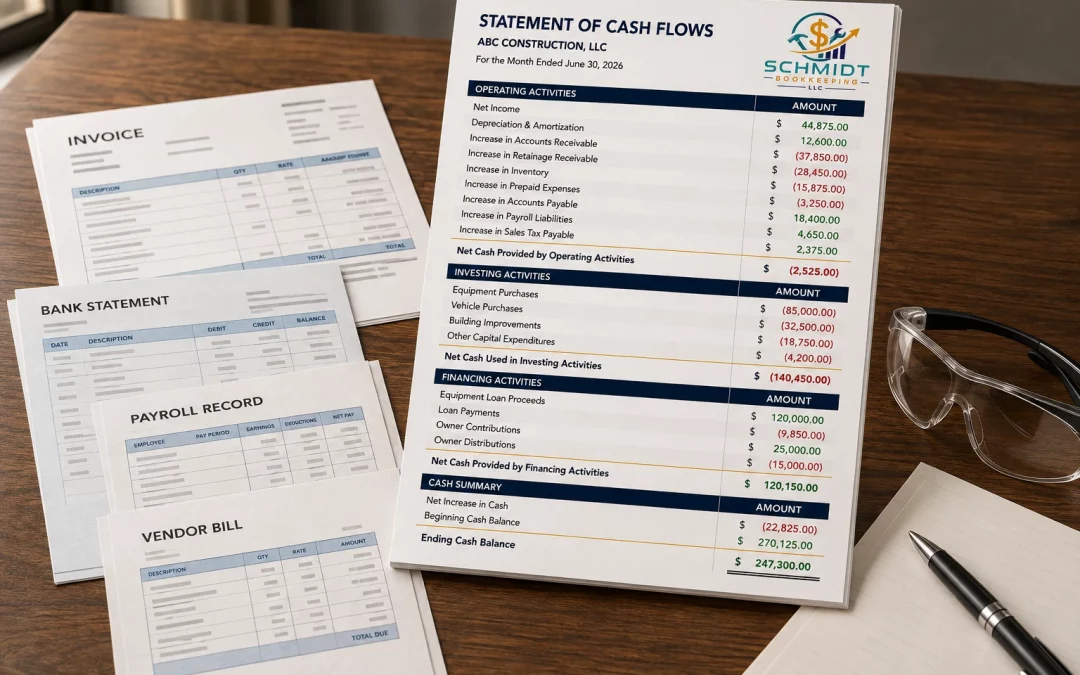
A Statement of Cash Flows, sometimes referred to more generally as a cash flow report, helps explain how cash moved through the business during a period of time.
While the Profit & Loss Statement helps answer:
“Did the business make money?”
cash-flow reporting helps answer:
“What happened to the cash?”
A Statement of Cash Flows generally organizes cash movement into three broad areas:
Operating Activities
Cash related to the normal operation of the business.
This can help show how day-to-day business activity is affecting cash.
Investing Activities
Cash related to longer-term assets, such as certain equipment purchases or sales.
Financing Activities
Cash related to borrowing, repaying debt, owner contributions, and other financing activity.
The exact report structure depends on the company’s books and reporting setup, but the purpose is the same:
to help explain why the cash balance changed.
The report itself is not the goal.
The goal is understanding what the cash movement is telling you about the business.
Why Should You Look at Profit and Cash Flow Together?
Looking only at profit can give you an incomplete picture.
Looking only at the bank balance can also give you an incomplete picture.
Consider four possible situations:
Profitable + Strong Cash Flow
The business is earning money and cash generation is supporting operations.
Profitable + Weak Cash Flow
The business may be earning money, but cash could be tied up in receivables, retainage, active jobs, equipment, debt payments, or other uses.
Unprofitable + Strong Short-Term Cash
The bank account may look healthy temporarily because of borrowing, owner contributions, collections from prior periods, or other cash sources.
Unprofitable + Weak Cash Flow
Both financial performance and cash availability may require attention.
None of those conclusions should be made from one number alone.
Financial Visibility comes from understanding how the numbers relate to one another.
What Should You Look at When Cash Feels Tight?
If the bank balance feels lower than expected, start by asking questions rather than jumping immediately to a conclusion.
Look at:
- whether the business is actually profitable;
- which jobs are producing profit;
- how much customers currently owe you;
- how quickly those receivables are being collected;
- whether retainage is being held;
- whether active jobs are consuming significant cash;
- whether large equipment or other asset purchases occurred;
- how much cash is being used for debt payments;
- whether owner distributions have increased;
- and how cash changed during the period.
The purpose is not simply to identify a low bank balance.
The purpose is to understand why it is low.
That distinction turns a cash problem from a feeling into something you can investigate.
Is Cash Flow the Same as Working Capital?
No. They are related, but they answer different questions.
Cash flow describes how cash moves into and out of the business over time.
Working capital helps describe the business’s short-term financial capacity to meet upcoming obligations.
A contractor can experience a temporary cash-flow gap without necessarily having a long-term working-capital problem.
But repeated difficulty covering payroll, suppliers, subcontractors, and other short-term obligations may signal that working capital deserves closer attention.
Why Is Understanding Cash Flow More Useful Than Simply Watching the Bank Account?
Your bank balance tells you what is there.
It does not necessarily tell you why it is there.
A $100,000 bank balance could mean the business is generating strong operating cash.
Or it could include borrowed money that has to be repaid.
A $25,000 bank balance could indicate a serious problem.
Or it could reflect a large planned equipment purchase immediately before several customer payments arrive.
The number needs context.
Reliable financial reporting helps connect the bank balance to the underlying activity of the business.
Instead of asking only:
“How much money is in the bank?”
you can begin asking:
“What caused cash to increase or decrease?”
“Is the business generating cash from normal operations?”
“How much cash is tied up waiting to be collected?”
“Are active jobs requiring more cash than expected?”
“Are financing, equipment, taxes, or owner distributions affecting the balance?”
Those are much more useful management questions.
Financial Visibility Helps Explain Why Profit and Cash Are Different
A contractor should not have to guess why a profitable month did not produce the expected bank balance.
That is one of the reasons accurate bookkeeping and reliable financial reporting matter.
The numbers need to connect.
The Profit & Loss Statement helps explain profitability.
Job-level reporting helps explain which projects are producing that profitability.
Cash-flow reporting helps explain how cash moved.
Receivables help explain how much customer money is still waiting to be collected.
Together, those pieces create a clearer financial picture.
That is the purpose of Financial Visibility.
Not more reports for the sake of having reports.
A clearer understanding of what is happening in the business so you can make better decisions.
Frequently Asked Questions About Construction Cash Flow
Why am I short on cash if my construction business is profitable?
Profit and available cash are different. Your business may have earned revenue that customers have not paid yet, while payroll, materials, subcontractors, debt payments, equipment purchases, taxes, and other obligations have already used cash.
The timing of cash entering and leaving the business can therefore create a shortage even when the business is profitable.
Is profit the same as cash flow?
No.
Profit measures financial performance over a period of time. Cash flow measures the movement of actual cash into and out of the business.
A profitable business can have negative cash flow during a period, and a business with cash in the bank is not necessarily profitable.
Why does my P&L show profit when my bank account is low?
The Profit & Loss Statement does not capture every reason cash changes.
Customer invoices may be recorded before they are collected, and cash may also be used for loan principal, equipment purchases, taxes, owner distributions, or other transactions that affect the bank account differently from P&L expenses.
How do accounts receivable affect construction cash flow?
Accounts receivable represents money customers owe you.
Until those invoices are paid, the money is not available in your bank account. A contractor can therefore report revenue and profit while a meaningful amount of cash remains tied up in unpaid invoices.
How does retainage affect cash flow?
Retainage delays the collection of a portion of money earned on a construction project.
The contractor may already have performed the work and paid many of the related costs while waiting for the retained amount to be released.
Can growing too fast cause cash-flow problems?
Growth can increase short-term cash requirements because additional jobs often require more labor, materials, subcontractors, and other costs before customer payments are collected.
Growth does not automatically create a problem, but contractors need enough financial capacity to support the timing gap.
What financial report helps explain where my cash went?
A Statement of Cash Flows helps explain how cash changed during a period by organizing cash movement into operating, investing, and financing activities.
It should be reviewed alongside other reports rather than used in isolation.
Does a low bank balance mean my construction company is unhealthy?
Not by itself.
A low balance may reflect payment timing, receivables, retainage, active job costs, equipment purchases, debt payments, taxes, or distributions.
Persistent cash shortages can indicate a deeper issue, but the bank balance alone does not identify the cause.
Do You Understand What Is Driving Your Construction Cash Flow?
Knowing whether your company is profitable is important.
Knowing which jobs are profitable gives you another layer of understanding.
But neither question completely explains how much cash is available today.
For that, you need visibility into how money is moving through the business.
That means understanding when customers are paying, when job costs are being funded, how much money is waiting in receivables or retainage, and what other uses of cash are affecting the bank balance.
The Construction Visibility System™ connects accurate bookkeeping, construction-specific organization, financial analysis, reporting, and practical interpretation so your numbers can help answer real business questions.
The process moves from Capture → Organize → Analyze → Report → Advise.
The goal is not simply to know your bank balance.
The goal is to understand why your cash position looks the way it does—and what that means for the decisions ahead.
Understand What Your Bank Balance Isn’t Telling You
These resources can help you separate the money in the bank from the cash actually available to the business and work through the factors affecting your construction company’s cash flow.
Need Better Visibility Into Your Cash Flow?
If your Profit & Loss Statement says the business is making money but the bank account keeps telling a different story, the first step is understanding what is driving the difference.
Schmidt Bookkeeping helps construction businesses build accurate books and reliable financial reporting through the Construction Visibility System™, turning financial information into clearer business decisions rather than treating bookkeeping as the final deliverable.