
Your construction business can be busy without being financially healthy.
Revenue may be growing. Jobs may be booked months ahead. Customers may be sending payments. There may even be a comfortable amount of money in the bank.
Those are useful pieces of information.
But none of them, by itself, tells you whether the business is financially healthy.
Financial health is not one number.
It is the relationship between several parts of the business: profitability, cash flow, working capital, receivables, liabilities, job performance, and the direction those numbers are moving over time.
A financially healthy construction business does not need every number to look perfect every month. It needs enough Financial Visibility to understand its overall financial condition, recognize problems that deserve attention, and make decisions based on financial evidence rather than appearances.
Revenue Alone Does Not Tell You
Revenue tells you how much the business generated from its work.
That matters, but revenue does not tell you what it cost to produce that work or what remained afterward.
A contractor can have substantial revenue while also experiencing:
- Weak job margins
- High overhead
- Cost overruns
- Poor cash flow
- Slow collections
- Increasing liabilities
- Inadequate working capital
That is why growth in revenue does not automatically mean the business is becoming financially stronger.
If revenue increases from one year to the next but costs increase even faster, the company may be doing more work without producing better financial results.
Revenue is part of the picture.
It is not the picture.
Neither Does the Bank Balance
The bank balance is another number that can easily become a shortcut for judging financial health.
When there is plenty of money in the account, the business can feel healthy.
When the balance gets low, it can feel like something is wrong.
Cash is extremely important, but today’s bank balance does not tell you the whole financial story.
The money currently in the account may include customer deposits or recently collected receivables. Some of it may already be needed for payroll, subcontractors, materials, taxes, debt payments, or upcoming projects.
Borrowed money can also increase the bank balance without improving profitability.
Timing matters too.
A large customer payment arriving today may make the balance look strong even though significant obligations are due next week.
The opposite can also happen. A temporarily low bank balance does not necessarily mean the business is financially unhealthy if the underlying business is profitable, receivables are collectible, obligations are manageable, and the cash shortage is primarily a timing issue.
Cash matters enormously.
But the amount in the bank today is not the same thing as the overall financial health of the business.
Financial Health Requires More Than One View
If neither revenue nor the bank balance provides the complete answer, what should you look at?
To evaluate financial health, it helps to look at the business through several financial lenses.
For a construction company, six are particularly useful:
- Profitability
- Cash flow
- Working capital
- Receivables and liabilities
- Job performance
- Financial trends
Each tells you something different.
The real value comes from understanding how they work together.
1. Is the Business Consistently Profitable?
A business ultimately needs to generate more than enough revenue to cover the cost of performing its work and operating the company.
That makes profitability one of the first places to look.
At a basic level, two measures are especially useful.
Gross profit shows what remains after the direct costs associated with producing the work are deducted from revenue.
Net profit shows what remains after the broader expenses of operating the business are also considered.
Both matter.
A company may produce reasonable gross profit on its projects but still struggle at the company level if overhead consumes too much of that gross profit.
The opposite problem can begin at the job level. If projects routinely produce inadequate margins, there may not be enough gross profit available to support overhead and still leave an acceptable net profit.
The financial-health question is not simply:
Did we make a profit this month?
A better question is:
Is the business producing adequate and reasonably consistent profit from the work it performs?
One strong month cannot necessarily compensate for a recurring profitability problem.
Likewise, one weak month does not automatically mean the business is unhealthy.
The pattern matters.
2. Is Cash Moving Through the Business Reliably?
A profitable construction company can still have cash problems.
That happens because profit and cash do not move through the business in exactly the same way or at exactly the same time.
You may perform profitable work today but wait weeks to collect the related receivable.
You may need to purchase materials or pay employees before receiving the customer’s next payment.
Retainage may delay collection of money the business has already earned.
Debt payments, equipment purchases, owner transactions, and other uses of cash can also affect the bank account differently from ordinary operating expenses.
That means financial health requires more than earning a profit.
The business also needs enough cash availability to continue operating reliably.
Can it meet payroll?
Can it pay vendors and subcontractors?
Can it cover normal operating expenses?
Can it meet debt and tax obligations?
Can it support the cash demands of active projects?
Repeated difficulty meeting those obligations deserves attention even when the Income Statement shows a profit.
Profitability tells you whether the business is producing financial value.
Cash flow helps you understand whether the company can continue operating while that value is being produced and collected.
A financially healthy business needs visibility into both.
3. Does the Business Have Enough Working Capital?
Cash is only one part of short-term financial capacity.
Working capital provides another view.
At its simplest:
Current Assets − Current Liabilities = Working Capital
Current assets represent short-term financial resources available to the business, while current liabilities represent obligations the business expects to meet in the near term.
The difference helps show the financial resources available to support near-term operations and obligations.
This is particularly important in construction.
A contractor may have substantial accounts receivable but still be waiting for customers to pay.
Retainage may remain outstanding.
Suppliers and subcontractors may need payment.
Payroll continues.
Active projects may require additional materials and labor before the next billing is collected.
As a result, a company can appear profitable while still operating with limited short-term financial capacity.
Working capital helps make that pressure more visible.
But this article is not about establishing a universal amount of working capital every contractor should maintain. The appropriate level depends on the business, its obligations, its project structure, its billing and collection cycle, and the financial demands of its work.
The important question here is whether working capital is strong enough to support the business’s current operating needs.
4. Are Receivables and Liabilities Under Control?
Financial health also depends on understanding what other people owe the business—and what the business owes to others.
Start with accounts receivable.
How much money has been earned but not yet collected?
How old are those receivables?
Is a significant amount sitting unpaid for extended periods?
How much is being held in retainage?
A large accounts receivable balance can look like a financial asset, but its usefulness depends partly on whether and when the money is actually collected.
Then consider the other side of the financial position.
What does the company owe?
That may include:
- Vendor balances
- Subcontractor obligations
- Credit cards
- Payroll-related liabilities
- Taxes
- Loans
- Other current obligations
The relationship matters.
Imagine two contractors that each have $150,000 in the bank.
One has relatively modest near-term obligations.
The other has $250,000 of bills, payroll, debt, taxes, and other commitments coming due.
The bank balance is identical.
The financial position is not.
This is why a Balance Sheet and aging reports can provide information that looking at the bank account alone cannot.
Financial health depends not only on what the business has, but also on what it owes and when those obligations must be met.
5. Are the Jobs Producing the Results the Company Needs?
Construction businesses have another layer of financial health that many general business measures do not reveal clearly enough:
the performance of individual jobs.
Company-level results ultimately depend on project-level economics.
If jobs are consistently missing their estimates, producing weak margins, experiencing cost overruns, or requiring more labor than expected, those problems eventually affect the financial health of the company.
Useful job-performance information may include:
- Job profitability
- Gross margin
- Estimated versus actual costs
- Cost overruns
- Labor performance
- Material performance
- Subcontractor costs
- Patterns across completed and active projects
The goal is not to expect every job to perform identically.
Construction work varies.
The goal is to determine whether the projects collectively produce the financial results the business needs.
A company can temporarily show acceptable overall profit while underlying job performance is weakening.
Perhaps a few unusually strong projects are offsetting several poor ones.
Perhaps overhead has not yet caught up with growth.
Perhaps cost overruns are becoming more frequent.
If you only look at company-level revenue and profit, those patterns may remain hidden until they become much larger problems.
Healthy company-level results need healthy underlying project economics.
6. Is the Financial Direction Improving or Deteriorating?
A financial statement for one month is a snapshot.
Financial health is easier to understand when you also look at direction.
Compare important financial information over time.
That may include:
- Revenue
- Gross profit
- Gross margin
- Net profit
- Cash
- Working capital
- Accounts receivable
- Liabilities
- Job profitability
The purpose is not simply to determine whether every number increased.
Some numbers should not necessarily increase.
Instead, look for meaningful patterns.
Are gross margins gradually declining?
Are receivables taking longer to collect?
Is working capital becoming tighter?
Are liabilities increasing?
Are jobs experiencing more frequent cost overruns?
Is revenue increasing while net profit remains flat?
Is cash becoming more difficult to manage even though the company is growing?
Direction can reveal changes that a single month’s numbers cannot.
A company can still be profitable today while several financial indicators are moving in an unhealthy direction.
The opposite can also occur.
One difficult month may look concerning in isolation while the longer-term financial trend remains sound.
Financial health is better understood in context.
Healthy Numbers Need to Work Together
This is where financial-health analysis becomes more useful than checking a list of individual numbers.
The signals need to be interpreted together.
Profitable, but Cash Is Constantly Tight
The Income Statement may show that the company is making money, but cash shortages continue.
That tells you the next question is probably not simply:
Are we profitable?
Instead, you may need to investigate collections, billing timing, working capital, debt payments, equipment purchases, owner transactions, growth demands, or other uses of cash.
Profitability is one piece of evidence.
The cash problem tells you there is more to understand.
Strong Cash, but Weak Profitability
A comfortable bank balance can coexist with poor underlying profitability.
The cash may have come from customer deposits, financing, prior-period collections, or other sources.
If jobs and operations are not producing adequate profit, the current cash position may not be sustainable.
Revenue Is Growing, but Margins Are Shrinking
Growth can look healthy from the outside.
More jobs.
More employees.
More invoices.
More revenue.
But if costs are increasing faster than revenue, the business may be doing more work while keeping less of what it earns.
The revenue trend looks positive.
The margin trend tells a different story.
Profitable, but Working Capital Is Weak
A company may report profit while struggling to comfortably meet short-term obligations.
That can happen when too much of the company’s resources are tied up in receivables, retainage, work in progress, or other areas while current liabilities continue to come due.
The profitability is real.
So is the liquidity pressure.
Company Profit Looks Healthy, but Jobs Are Becoming Less Profitable
Overall company results can sometimes hide deterioration at the project level.
If job margins are declining or cost overruns are becoming more common, today’s company profit may not represent the financial direction of tomorrow’s business.
Different financial signals answer different questions.
Together, they tell the larger story.
Warning Signs Deserve Investigation, Not Panic
Financial analysis should help you identify what deserves attention.
It should not turn every unfavorable number into an emergency.
Potential warning patterns can include:
- Profitability declining across multiple periods
- Cash shortages becoming routine
- Receivables getting older
- Working capital weakening
- Liabilities increasing without corresponding financial improvement
- Gross margins deteriorating
- Repeated job cost overruns
- Revenue increasing while profit fails to improve
- Financial reports arriving too late to support decisions
Any of those may deserve investigation.
But context matters.
A temporary increase in receivables may result from the timing of several large invoices.
A short-term decline in cash may result from a planned equipment purchase.
A weaker month may reflect project timing rather than a structural problem.
An increase in liabilities may support a deliberate investment that strengthens the business.
Financial reports can identify the question.
They do not always provide the operational explanation by themselves.
The goal is to recognize meaningful patterns and determine what caused them.
Which Financial Reports Help Show Financial Health?
No single financial report provides every part of the answer.
Different reports provide different views of the business.
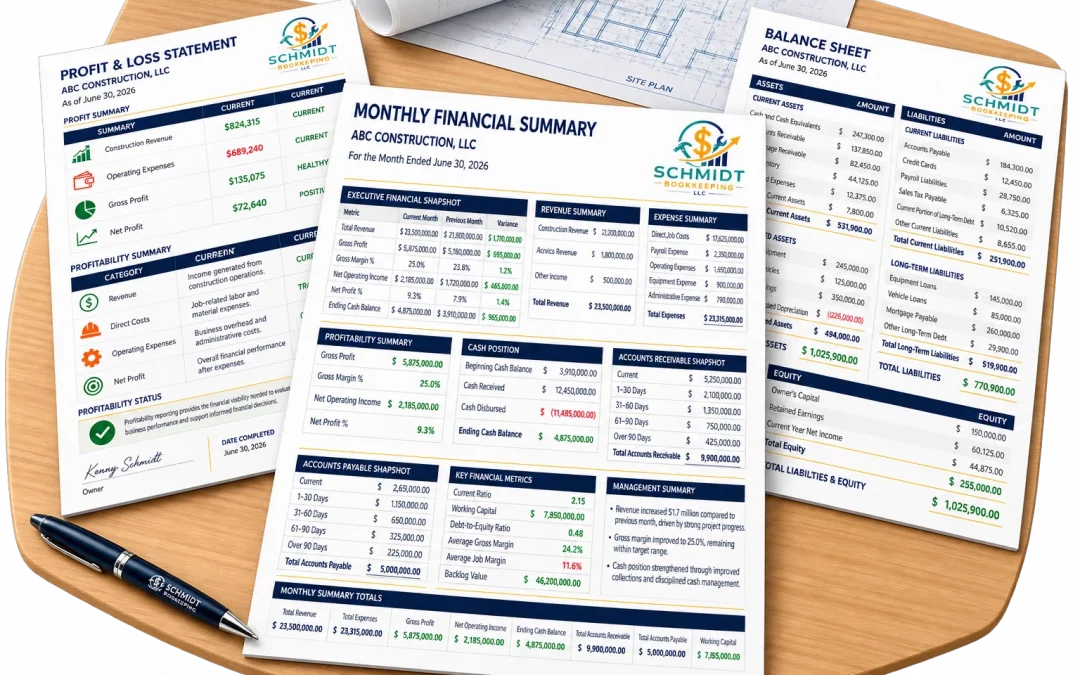
Monthly Financial Summary
A Monthly Financial Summary can bring several important indicators together into one consolidated view.
Depending on how it is structured, that may include revenue, profitability, cash, receivables, payables, working capital, margins, and other financial measures.
Its value is perspective.
It allows the contractor to see multiple signals together rather than reviewing each one in isolation.
Profit & Loss Statement
The Profit & Loss Statement helps show whether the business generated a profit over a particular period.
It provides visibility into revenue, costs, gross profit, operating expenses, and net income.
This is an important view of financial performance—but not a complete view of financial health.
Balance Sheet
The Balance Sheet shows financial position at a point in time.
It provides visibility into assets, liabilities, and equity.
It can also help evaluate areas such as cash, accounts receivable, debt, and working capital that cannot be understood from the Profit & Loss Statement alone.
Cash Flow Statement
The Cash Flow Statement helps explain how cash changed during a period.
It provides a different perspective from profitability because it focuses on cash activity.
Together, these reports help answer different parts of the financial-health question.
The objective is not to collect more reports.
It is to understand what each report tells you and how the information works together.
A Practical Financial Health Review
You do not need to reduce financial health to one score.
A structured review is more useful.
1. Review Profitability
Is the business consistently generating adequate gross and net profit?
Look beyond one month and consider the pattern.
2. Review Cash Availability and Cash Movement
Can the company reliably meet its normal operating needs and financial commitments?
If cash is consistently tight, investigate why.
3. Review Working Capital
Do the company’s short-term financial resources reasonably support its short-term obligations and operating needs?
Look at the relationship rather than cash alone.
4. Review Receivables and Liabilities
How much is owed to the company?
How quickly is it being collected?
What does the company owe?
When are those obligations due?
5. Review Job Performance
Are the projects producing the margins and financial results the company depends on?
Look for patterns rather than focusing only on one unusually good or bad job.
6. Compare Financial Trends
Are the important indicators strengthening, weakening, or remaining reasonably stable?
Changes over time often tell you more than a single snapshot.
7. Investigate Conflicting Signals
This is one of the most useful steps.
If profit is strong but cash is weak, find out why.
If revenue is growing but margins are shrinking, investigate the cost structure.
If cash is strong but profitability is poor, determine what is supporting the current cash position.
Conflicting signals are not something to ignore.
They are clues.
8. Decide What Requires Attention Next
Financial analysis becomes useful when it leads to a better question or decision.
Perhaps collections need attention.
Perhaps a group of jobs is underperforming.
Perhaps overhead has increased.
Perhaps working capital is becoming tight.
Perhaps nothing is fundamentally wrong and the unusual result has a reasonable explanation.
The financial information helps you determine where to look next.
Financial Health Is Not the Same as Financial Perfection
A financially healthy construction business can still experience problems.
It can have an unprofitable job.
A customer can pay late.
A truck can need an expensive repair.
Cash can become temporarily tight.
A month can be weaker than expected.
The company can carry appropriate debt.
None of those circumstances automatically makes the business financially unhealthy.
Construction is variable.
Projects start and finish at different times. Billing and collections do not always line up perfectly with expenses. Large purchases occur. Weather affects schedules. Customers delay payments. Job performance varies.
Financial health does not mean eliminating every fluctuation.
It means understanding whether those fluctuations are temporary events the business can absorb or signs of a larger financial problem.
That requires context.
And context requires Financial Visibility.
Financial Health Should Be Reviewed Regularly
Waiting until something feels wrong is not an ideal financial-management system.
By the time a cash shortage becomes severe, a margin problem may have existed for months.
By the time the bank balance creates concern, receivables may already have been aging.
By the time annual financial statements reveal weak profitability, several poorly performing jobs may already be complete.
Regular financial review helps make changes visible earlier.
That does not mean watching every number every day.
It means establishing a consistent process for reviewing the financial indicators that matter to the business.
Over time, that allows you to distinguish ordinary fluctuations from meaningful changes.
It also makes the question:
Is my business financially healthy?
easier to answer because you are no longer evaluating the company from a single moment in time.
Financial Visibility Makes Financial Health Measurable
The Construction Visibility System™ provides a useful way to understand how financial health becomes visible:
Capture → Organize → Analyze → Report → Advise
Financial activity is captured through accurate bookkeeping.
Transactions, job costs, receivables, liabilities, and other financial information are organized so they can be understood.
Profitability, cash flow, working capital, job performance, and trends are analyzed.
Financial reports make those relationships easier to report and review.
Then the information can help advise the next business decision.
Without that structure, a contractor may be left judging the business from revenue, workload, or the bank balance.
With it, the owner can evaluate the actual financial condition of the company.
Bookkeeping creates the structure.
Financial Visibility makes that structure useful.
The Goal Is to Know What Needs Attention
Construction businesses differ.
Their project types differ.
Their billing cycles differ.
Their cost structures differ.
Their working-capital requirements differ.
Their debt and equipment needs differ.
Their growth plans differ.
So the useful objective is not to make every financial measure look identical across every construction company.
It is to understand enough of the financial evidence to answer:
- Is the business consistently profitable?
- Can it reliably support its cash needs?
- Does it have sufficient short-term financial capacity?
- Are receivables and liabilities manageable?
- Are jobs producing the results the company needs?
- Are the important financial trends moving in the right direction?
- What deserves attention next?
When those relationships are visible, financial health becomes something you can evaluate rather than something you have to guess.
Frequently Asked Questions
How do I know if my construction business is financially healthy?
Look at multiple financial indicators together rather than relying on one number.
Profitability, cash flow, working capital, receivables, liabilities, job performance, and financial trends each provide a different view of the business.
A financially healthy business generally has enough visibility into those areas to understand its financial condition, meet its obligations, identify problems, and make informed decisions.
Can a profitable construction company still be financially unhealthy?
Yes.
A company can report a profit while experiencing serious cash-flow problems, weak working capital, aging receivables, excessive liabilities, or deteriorating job performance.
Profitability is an important part of financial health, but it is not the only part.
Does having money in the bank mean my business is financially healthy?
Not necessarily.
The bank balance shows how much cash is available at a particular moment. It does not tell you how much of that cash may be needed for payroll, vendors, taxes, debt, upcoming jobs, or other obligations.
It also does not tell you whether the business is profitable or whether the cash came from operations, customer deposits, collections, or borrowing.
What financial numbers should a contractor watch?
Useful measures can include revenue, gross profit, gross margin, net profit, cash, working capital, accounts receivable, liabilities, and job profitability.
The appropriate measures depend on the business and the decisions being made.
The important point is to monitor a consistent group of meaningful indicators rather than judging the business from whichever number happens to be most visible.
Which financial reports show the health of a construction business?
Several reports work together.
A Profit & Loss Statement provides information about profitability.
A Balance Sheet provides information about assets, liabilities, and financial position.
A Cash Flow Statement provides information about cash activity.
A Monthly Financial Summary can bring important indicators together for a broader review.
Construction-specific job-performance information adds another important layer because company financial health ultimately depends on the economics of the projects producing the company’s revenue.
Look Beyond Profit to Understand Financial Health
These resources can help you see why profitability alone does not tell you whether the business is financially healthy and work through the financial conditions affecting your construction company.
Better Financial Decisions Start With Seeing the Whole Business
A construction company can look successful and still have financial weaknesses that deserve attention.
It can also experience temporary financial pressure without being fundamentally unhealthy.
The difference is difficult to see when financial decisions are based primarily on revenue, workload, or the current bank balance.
Useful financial reporting brings the pieces together.
Schmidt Bookkeeping helps contractors organize and understand their financial information so profitability, cash flow, financial position, job performance, and financial trends become visible enough to support better business decisions.