
Money comes into your construction business, but sometimes it can feel like it leaves almost as quickly.
Customers are paying. Jobs are moving. Revenue may even be growing. Yet when you look at the bank account, you may find yourself wondering:
Where is all the money going?
For a contractor, there usually is not one simple answer.
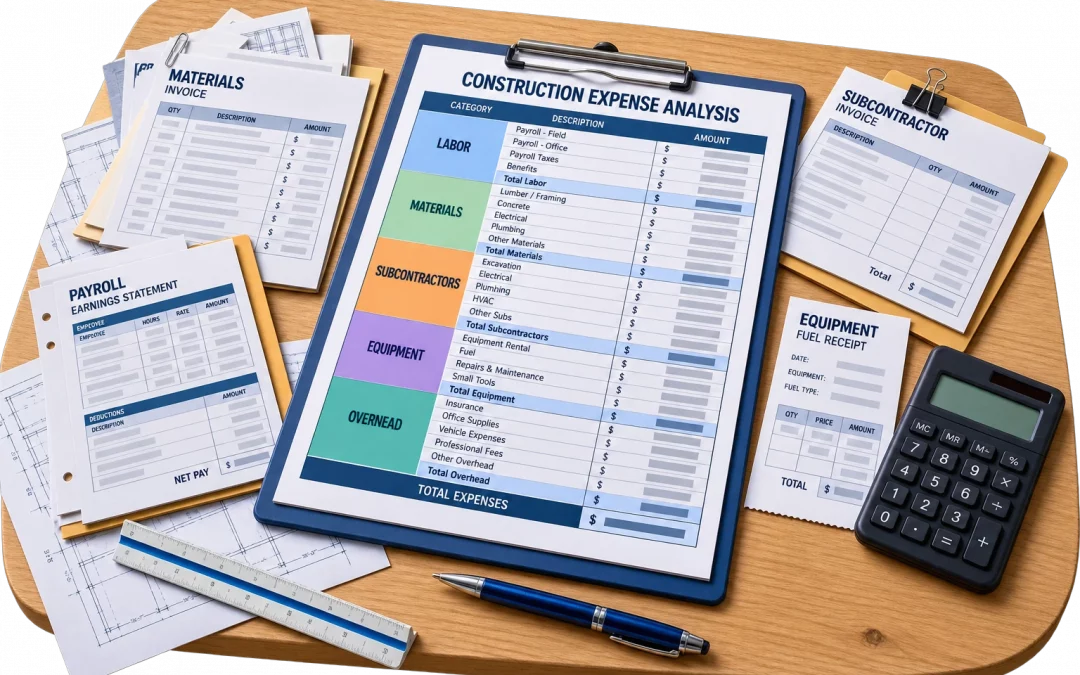
Some of the money is being used to perform the work. Labor, materials, subcontractors, equipment, and other job costs consume part of the revenue your projects generate.
Some of it supports the business behind those jobs. Insurance, software, administrative costs, vehicles, professional services, and other operating expenses continue whether they belong to one particular project or not.
And some money can leave the bank account without being an ordinary business expense at all.
The problem is that when all you see is money coming in and money going out, those different uses can blend together.
Understanding where the money is going requires more than looking at your bank balance.
It requires financial information that is organized well enough to show how the business is actually using its money.
That is an important part of Financial Visibility.
Money Leaving the Bank Is Not Always an Expense
One of the first distinctions to understand is that a decrease in your bank balance does not necessarily mean the business incurred an expense.
Cash can leave a construction company in several ways.
Some payments are ordinary business expenses, such as insurance, fuel, software, or office costs.
Others may represent direct costs of performing construction work, such as materials, subcontractors, or field labor.
But other cash outflows may be different.
For example, money may leave the bank because the business:
- Purchased a piece of equipment
- Paid principal on a loan
- Made an owner draw or distribution
- Transferred money between accounts
Those transactions affect cash, but they do not all appear on the Income Statement as ordinary expenses in the same way.
That distinction matters because “Where did my cash go?” and “What did my business spend on expenses?” are related questions, but they are not exactly the same question.
If the real concern is why a profitable business does not seem to have enough available cash, that requires looking more closely at cash flow and timing.
For understanding where the business’s resources are being used, however, a useful place to start is with the cost of performing the work.
Start With the Money It Takes to Perform the Work
Construction businesses have to spend money to produce revenue.
Before a contractor can complete a project, the company may need to pay employees, purchase materials, hire subcontractors, rent equipment, obtain permits, and cover other job-specific costs.
These are generally direct job costs when they can reasonably be connected to a particular project.
Depending on the type of work you perform, direct job costs may include:
- Field labor
- Materials
- Subcontractors
- Equipment or equipment rentals
- Permits
- Job-specific supplies
- Other costs directly attributable to the project
That means a substantial amount of the money flowing out of a healthy construction business may simply reflect the cost of producing the work that generates its revenue.
Spending money is not automatically a problem.
The important question is whether you can clearly see what the money was spent on, which jobs consumed it, and what financial result those jobs produced.
That is where consistent job costing and financial categorization become important.
Labor Can Cost More Than the Wage Rate Suggests
Payroll is often one of the largest uses of money in a construction company.
But the amount leaving the business for labor may be greater than what an owner expects if the comparison is based only on employee wage rates.
An employee’s full cost can include more than hourly wages.
Depending on the business, additional employment costs may include payroll taxes, workers’ compensation, benefits, paid time off, and other labor-related costs.
That does not mean those costs are necessarily excessive.
It means the business needs to see labor based on what it actually costs—not just the wage printed on an employee’s paycheck.
If labor costs are not categorized and understood consistently, a contractor may know that payroll is expensive without having enough information to understand why it is expensive or how it relates to job performance.
Materials and Subcontractors Can Consume Revenue Quickly
Materials and subcontractors can also represent significant uses of project revenue.
A contractor may collect a large customer payment and then quickly use much of it to pay suppliers and subcontractors associated with the work.
That can make the original deposit or progress payment feel larger than the amount the business ultimately retains.
The amount spent in these categories can also vary considerably from one project to another.
A material-heavy project may produce a very different spending pattern from a labor-heavy project.
A general contractor using substantial subcontractor labor may have a different cost structure from a contractor performing most of the work with employees.
That is why totals alone are not enough.
You want financial information that helps you distinguish among:
- Material spending
- Subcontractor spending
- Labor costs
- Equipment costs
- Other job costs
And when possible, you want those costs associated with the jobs that created them.
Otherwise, you may know that a lot of money was spent without knowing where the work actually consumed it.
Then There Is the Cost of Running the Business
Not every cost belongs directly to a job.
A construction company also has expenses required to operate the business itself.
These are commonly described as overhead or operating expenses.
Depending on the company, they may include:
- Business insurance
- Office and administrative payroll
- Accounting and bookkeeping
- Software
- Phones and communication
- Shop or office costs
- General vehicle expenses
- Professional fees
- Advertising and marketing
- Certain management costs
- Small tools and supplies
- Other ongoing business expenses
These costs may not appear on an individual project estimate in the same way as lumber, field labor, or a subcontractor invoice.
But they still have to be paid.
The gross profit generated by the company’s projects ultimately has to support those operating expenses before the business can produce adequate net profit.
That is why understanding where the money goes requires looking at both the jobs and the company behind the jobs.
Overhead Is Not Automatically Waste
When business owners begin reviewing expenses, it can be tempting to assume that reducing overhead is always the answer.
It is not that simple.
A construction company needs resources to operate.
Insurance protects the business. Software may improve operations. Administrative employees may keep billing, scheduling, documentation, and communication moving. Professional services can support areas the contractor should not or cannot handle alone.
Even marketing can be a necessary business investment when it supports the right kind of work.
The goal is not to label every overhead expense as unnecessary.
The goal is to understand:
- What the business is spending
- How much it is spending
- How that spending is changing
- Which costs are significant
- Which costs deserve further review
Financial records can help identify the questions.
They do not automatically determine the operational answer.
A higher expense may be a problem.
It may also reflect growth, additional capacity, changing project volume, higher prices, or a deliberate business decision.
Visibility comes before judgment.
Categorization Determines What You Can See
Good bookkeeping does more than record that money left the bank.
It organizes financial activity so the information can be understood later.
Consider a contractor who has thousands of dollars recorded in categories such as:
Miscellaneous Expense
General Expense
Other
The transactions may technically be recorded, but those categories provide very little useful information.
What was the money actually used for?
Was it job-related?
Was it overhead?
Was it equipment?
Was it an owner transaction?
Was it a recurring cost or an unusual purchase?
The same problem occurs when direct job costs are mixed with general business expenses or when similar transactions are categorized differently from month to month.
Poor categorization makes spending harder to analyze.
Consistent categorization creates structure.
That structure allows a contractor to move from:
“Money keeps disappearing.”
to questions such as:
“Why did material costs increase?”
“How much are we spending on insurance?”
“What happened to vehicle expenses this quarter?”
“Which vendors account for most of our subcontractor spending?”
Those are much more useful financial questions.
This is where bookkeeping becomes part of Financial Visibility.
Look at Spending by Category, Not Just Transaction
A bank feed or transaction list can show hundreds of individual payments.
That is useful for recording activity.
It is not always useful for understanding the business.
To evaluate where the money is going, individual transactions need to become meaningful financial categories.
Instead of reviewing every payment one at a time, you can begin asking:
- How much went to labor?
- How much went to materials?
- How much went to subcontractors?
- How much went to equipment?
- How much went to overhead?
- Which operating-expense categories are largest?
- Which vendors receive a significant portion of spending?
- Which costs occur repeatedly?
- Which categories have changed materially?
That is the difference between having a list of transactions and having organized financial information.
The first tells you what moved.
The second begins to tell you what it means.
Compare Spending Over Time
A single month does not always tell the full story.
Construction businesses can have uneven activity.
Project schedules change. Large material purchases may happen in one month. Insurance may be paid annually. Equipment may need repairs. Seasonal conditions can affect fuel, labor, and project activity.
That is why trends matter.
Comparing financial information across multiple periods can help identify changes such as:
- Fuel costs increasing
- Insurance becoming more expensive
- Software subscriptions accumulating
- Administrative payroll growing
- Material spending changing with project mix
- Equipment costs increasing
- Particular vendors receiving more of the company’s spending
- Certain overhead categories becoming larger over time
A change does not automatically mean something is wrong.
It tells you where to ask the next question.
For example, higher material spending may be perfectly reasonable if revenue and material-intensive work also increased.
Higher administrative payroll may make sense if the company added capacity to support growth.
The purpose of the comparison is not to find something to criticize.
It is to identify changes that deserve explanation.
Budget vs. Actual Shows Where Spending Differed From Expectations
Historical comparisons tell you how spending changed.
A budget adds another perspective:
What did you expect to happen?
A Budget vs. Actual comparison can help a contractor see where actual spending differed from what the business planned.
For example, you may discover that:
- Insurance was close to budget
- Fuel was higher than expected
- Administrative payroll was lower
- Software costs increased
- Equipment repairs materially exceeded the plan
That does not mean every unfavorable variance requires an immediate cut.
It means the business now has a specific difference to investigate.
Instead of saying:
“Our expenses seem high.”
you can ask:
“Why were equipment repairs significantly higher than expected?”
That is a much more useful management question.
Use Financial Reports to See the Bigger Picture
Once financial activity is categorized consistently, reports can organize that information into views that are easier to evaluate.
Income Statement
The Income Statement helps show how revenue is being consumed across the business.
Depending on how the books are structured, it can help you see revenue, direct or job-related costs, gross profit, operating expenses, and net income.
This gives you a company-level view of whether the revenue being generated is ultimately producing enough profit after the costs of performing the work and operating the business.
Budget vs. Actual Report
A Budget vs. Actual Report compares what the business expected with what actually occurred.
This can help identify expense categories or other financial areas that are materially different from plan.
The value is not simply seeing that a number is higher or lower.
It is knowing where further investigation may be useful.
Expense Analysis
An expense analysis provides a more focused look at where business spending is concentrated and how those categories are changing.
Depending on the information available, that may include reviewing:
- Spending by category
- Spending by vendor
- Changes over time
- Recurring expenses
- Significant increases or decreases
- Unusual activity
Together, these views provide more Financial Visibility than simply checking whether the bank balance feels high or low.
A Practical Spending Review
If you are trying to understand where your construction business’s money is going, work through the question in this order.
1. Make Sure Transactions Are Categorized Consistently
Before analyzing spending, make sure similar transactions are being treated consistently.
If the underlying bookkeeping is unreliable, the analysis will be unreliable too.
2. Separate Job Costs From Business Overhead
Understand which costs belong to performing projects and which costs support the company as a whole.
That distinction helps you evaluate both job performance and company performance.
3. Identify Other Uses of Cash
Separate ordinary expenses from transactions such as equipment purchases, loan principal payments, owner draws or distributions, and transfers.
This prevents every decrease in cash from being interpreted as an expense.
4. Review the Largest Spending Categories
Identify where the greatest amounts of money are being used.
Large categories are not automatically problems, but they deserve to be understood.
5. Compare Current Spending With Prior Periods
Look for meaningful changes rather than evaluating each month in isolation.
6. Compare Actual Spending With Expectations
If the business uses a budget, identify where actual results differ materially from the plan.
7. Investigate Significant Changes
Ask what caused the difference.
Was it project mix?
Growth?
Higher vendor prices?
Additional employees?
Equipment repairs?
A new recurring expense?
An unusual transaction?
8. Decide What, If Anything, Needs to Change
The purpose of financial analysis is not merely to describe the past.
It is to improve the next decision.
Some spending may need to be reduced.
Some may need to be managed differently.
Some may be completely appropriate.
And some may reveal a different problem elsewhere in the business.
Where the Money Goes Is Only Part of the Question
Understanding spending is important, but it is not the final measure of financial health.
A contractor can know exactly how much was spent on labor, materials, subcontractors, and overhead and still need to answer another question:
Is the business producing enough profit after those costs?
That requires looking at the relationship between revenue, job costs, gross profit, operating expenses, and net income.
The two questions work together.
Where is my money going? helps you understand how financial resources are being used.
Am I actually making money? helps you understand the financial result those activities are producing.
Financial Visibility Turns Spending Into a Decision
Knowing that money left the business is only the beginning.
Useful financial information should help you understand:
What happened, Where it happened, and What deserves attention next.
That progression reflects the Construction Visibility System™:
Capture → Organize → Analyze → Report → Advise
Transactions are captured.
Financial activity is organized into meaningful categories.
Spending patterns are analyzed.
Reports make those patterns easier to see.
That information can then support better decisions about costs, operations, pricing, capacity, and the future of the business.
Bookkeeping is the process that creates the structure.
Financial Visibility is what allows you to use that structure to understand where the money is going.
The Goal Is Not Simply to Spend Less
Every construction business spends money.
That is necessary.
Labor costs money.
Materials cost money.
Subcontractors cost money.
Insurance, vehicles, software, equipment, administrative support, and professional services cost money.
The objective is not to minimize every expense.
It is to understand:
- Where the money is going
- Why it is going there
- How spending is changing
- Which costs deserve further investigation
- Whether the financial results support the business
Once those relationships are visible, decisions about spending can be based on financial evidence rather than the feeling that money is simply disappearing.
That is the difference between knowing money left the bank and understanding where your money is actually going.
Frequently Asked Questions
What are the biggest expenses for a construction company?
The largest costs depend on the type of construction business and the work it performs.
Common major categories include labor, materials, subcontractors, equipment, insurance, vehicles, and other operating expenses.
The important point is not whether your spending matches another contractor’s. It is whether your financial records clearly show your own cost structure and how it relates to the revenue and profit your business produces.
What is the difference between job costs and overhead?
Job costs are costs that can reasonably be connected to performing a specific project, such as project labor, materials, subcontractors, or job-specific equipment.
Overhead generally supports the business as a whole rather than one individual job. Examples may include office costs, general insurance, administrative expenses, software, and professional fees.
Keeping the two reasonably separated helps contractors understand both project performance and company-level profitability.
Is every payment from my business bank account an expense?
No.
Cash can leave the bank for reasons that are not ordinary Income Statement expenses.
Examples can include equipment purchases, loan principal payments, owner draws or distributions, and transfers between accounts.
This is why bank activity alone does not provide a complete explanation of business expenses or profitability.
How can I tell which business expenses are increasing?
Consistent bookkeeping allows expenses to be compared by category across multiple periods.
Reviewing monthly, quarterly, or year-to-date information can help identify categories that are increasing and determine whether those changes are expected, temporary, or worth investigating further.
Budget vs. Actual comparisons can provide additional context when the business has established financial expectations.
Which financial report shows where my business money is going?
There is not always one report that answers every part of the question.
An Income Statement helps show how revenue, job-related costs, operating expenses, and profit relate at the company level.
A Budget vs. Actual Report can show where spending differed from expectations.
More focused expense analysis can help identify category, vendor, and spending trends.
The most useful view depends on the specific question you are trying to answer.
See What Is Driving Your Business Spending
These resources can help you understand why business expenses change and review where your construction company’s money is actually going.
Better Spending Visibility Starts With Organized Financial Information
If transactions are inconsistently categorized, job costs are mixed with overhead, or financial activity is buried in vague expense accounts, it becomes much harder to understand where the business’s money is going.
Construction-specific bookkeeping creates the financial structure needed to separate those activities and produce useful reports.
Schmidt Bookkeeping helps contractors organize their financial information so they can see how money is being used, recognize patterns that deserve attention, and make better business decisions with greater Financial Visibility.