
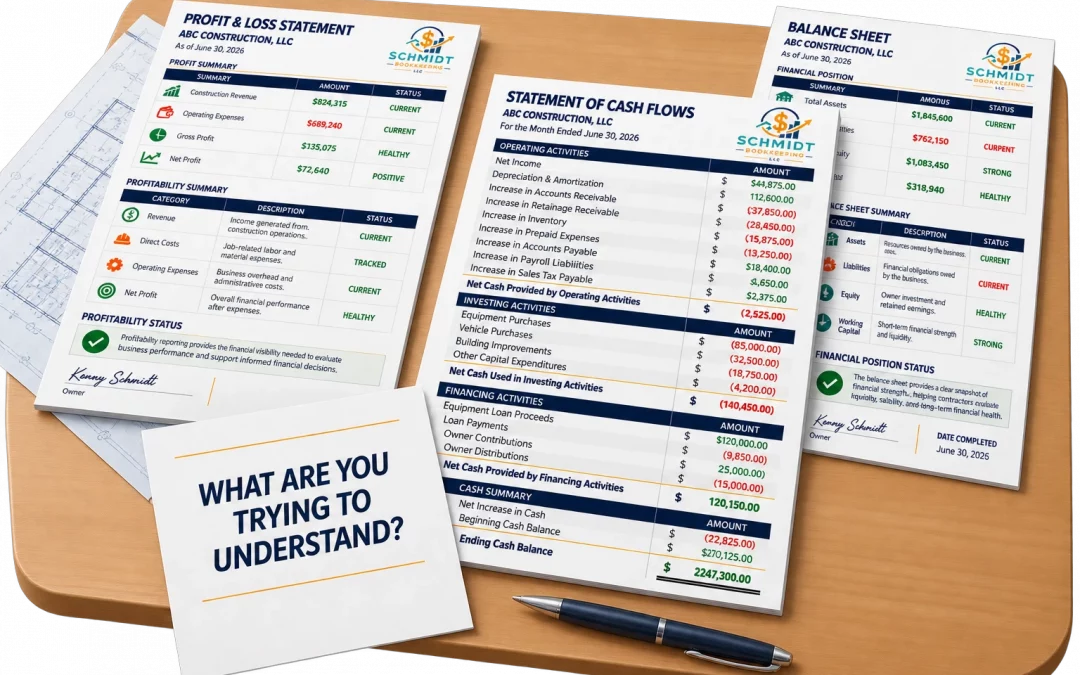
Your accounting system can probably produce more financial reports than you will ever want to read.
Profit & Loss Statements. Balance Sheets. Cash Flow Statements. Job reports. Work in Progress reports. Accounts Receivable Aging. Accounts Payable Aging. And plenty of other schedules, summaries, and detail reports.
Having access to all of those reports does not necessarily create Financial Visibility.
The more useful question is:
Which report helps me answer the business question I am trying to understand?
That is what makes a financial report useful.
A Profit & Loss Statement can help you understand profitability. A Balance Sheet can help you understand financial position. A Statement of Cash Flows can help explain how cash moved. Job-level reports can help you understand project performance. Aging reports can help you see money waiting to come in or obligations waiting to be paid.
No single report answers every question.
The report that matters most depends on the question you are trying to answer.
Financial Reports Are Different Views of the Same Business
Your construction company is one business, but its financial activity can be viewed from several different perspectives.
You may want to know:
- Is the business profitable?
- Why did cash change?
- What does the company own and owe?
- Which jobs are performing well?
- Where do active jobs stand financially?
- Which customers still owe us money?
- What do we currently owe vendors and suppliers?
Those are different questions.
They require different financial information.
That is why two reports can both be accurate while appearing to tell very different stories.
Your Profit & Loss Statement may show that the company earned a profit during the month.
Your bank account may still feel tight.
Your Balance Sheet may show a significant Accounts Receivable balance.
Your A/R Aging may reveal that much of that money has been outstanding longer than expected.
Your company may be profitable overall while certain jobs are performing poorly.
None of those reports necessarily contradicts another.
They are different views of the same business.
Financial Visibility comes from understanding what each view shows—and when you need another view to complete the picture.
Profit & Loss Statement — Is the Business Making Money?
The Profit & Loss Statement—often called the P&L or Income Statement—shows the financial results of the business over a period of time.
Depending on how your financial records are structured, it may show information such as:
- Revenue
- Direct costs or cost of goods sold
- Gross profit
- Operating expenses
- Net profit
The P&L is the natural place to start when your question is:
Is the business generating profit over this period?
It can also help you compare performance from one period to another and identify changes in revenue, gross profit, expenses, and overall profitability.
But the P&L does not answer every financial question.
A profitable month does not necessarily mean the related customer payments have been collected.
The P&L does not tell you, by itself, which customers still owe money.
It does not tell you the company’s complete financial position.
And company-level profitability does not tell you whether every individual job was profitable.
Use the Profit & Loss Statement when the question is primarily about business profitability over a period of time.
If you need to understand why that profit did—or did not—turn into cash, you need another financial perspective.
Balance Sheet — What Is the Financial Position of the Business?
The Balance Sheet shows the financial position of the company at a specific point in time.
Its three broad areas are:
Assets — resources the business owns or controls.
Liabilities — obligations the business owes.
Equity — the remaining financial interest in the business after liabilities are considered.
For a contractor, the Balance Sheet can help provide visibility into areas such as:
- Cash
- Accounts receivable
- Other current assets
- Accounts payable
- Credit cards and other current liabilities
- Loans and other debt
- Equity
- Working capital
The Balance Sheet is particularly useful when the question is:
What does the business own, what does it owe, and what is its financial position right now?
That is different from asking how profitable the company was during the month.
The Profit & Loss Statement covers financial performance over a period.
The Balance Sheet shows financial position at a point in time.
Both matter, but they answer different questions.
The Balance Sheet also has limits.
It can tell you the total amount recorded in Accounts Receivable, for example, but that total alone does not tell you which customers owe the money or how long those balances have been outstanding.
It can show cash at a point in time, but it does not fully explain why cash increased or decreased during the period.
Use the Balance Sheet when the question is about financial position rather than simply profit.
Statement of Cash Flows — Why Did Cash Change?
Profit and cash are related, but they are not the same thing.
A construction company can report a profit while cash declines.
It can also receive cash during a period for reasons that do not represent current operating profit.
The Statement of Cash Flows helps explain how cash moved through the business during a period.
It generally organizes cash activity into three broad categories:
Operating activities — cash associated with the normal operations of the business.
Investing activities — cash associated with longer-term investments and assets.
Financing activities — cash associated with debt, owner financing, distributions, and other financing activity.
That makes the Statement of Cash Flows particularly useful when the question is:
Where did cash come from, and where did it go?
The report helps connect the company’s financial activity with the change in its cash position.
But it does not replace the P&L.
It does not replace the Balance Sheet.
And it does not replace the detailed reports needed to understand collections, payables, or individual jobs.
Profit tells you whether the business earned money. The Statement of Cash Flows helps explain how cash actually moved.
Those are different questions.
Job Performance Report — Which Jobs Are Actually Performing?
Company-level financial reports can tell you how the overall business performed.
They cannot always tell you what happened inside each individual project.
That matters in construction because two jobs contributing revenue to the same company can produce very different financial results.
A useful Job Performance Report can help bring together job-level information such as:
- Contract or revenue information
- Estimated costs
- Actual costs
- Cost categories
- Job profitability
- Performance against expectations
The primary question becomes:
How is this individual job performing financially?
That helps the contractor move beyond company-wide results and see where profitability is actually being created—or lost.
A company can report an overall profit while one or more jobs underperform.
Conversely, one highly profitable job can temporarily make overall company results look stronger while problems exist elsewhere.
Company-level profit can hide meaningful differences between individual jobs.
Job-level reporting makes those differences easier to see.
But even a profitable job does not answer every question.
It does not automatically mean the customer has paid.
It does not mean the company has sufficient working capital.
And it does not prove that the overall business is financially healthy.
Use the Job Performance Report when you need to understand the financial performance of individual work.
Work in Progress Report — Where Do Active Jobs Stand Financially?
Completed jobs can be reviewed against their final results.
Active jobs require another perspective.
A Work in Progress report—or WIP report—helps provide financial visibility into construction work that is still underway.
Depending on the contractor’s reporting requirements and accounting method, WIP information may bring together areas such as:
- Contract value
- Costs incurred
- Estimated costs
- Project progress
- Billing
- Revenue recognition
- Overbilling or underbilling relationships where applicable
The purpose here is not to turn every contractor into a WIP accountant.
The important distinction is simpler:
Use WIP reporting when you need visibility into the financial condition of active, unfinished work.
A Profit & Loss Statement may tell you what has been recognized in the company’s financial results.
A job report may show costs and performance for a particular project.
WIP reporting can provide additional context about where active projects stand financially while the work is still being completed.
That makes it especially useful for contractors whose financial results are heavily influenced by projects spanning multiple reporting periods.
A/R Aging — Who Owes Me Money, and How Long Has It Been Outstanding?
The Balance Sheet may show a total Accounts Receivable balance.
That tells you how much customer money is recorded as being owed to the business.
But one total does not tell you enough about the collection situation.
An Accounts Receivable Aging report adds another layer of visibility by showing information such as:
- Customers with outstanding balances
- Amounts still owed
- How long balances have been outstanding
- Concentrations of receivables
- Older balances that may deserve investigation
Its primary question is:
Who owes us money, and how long has it been outstanding?
This distinction matters.
Suppose the Balance Sheet shows $200,000 in Accounts Receivable.
That number alone does not tell you whether most of the balance was billed recently or whether a significant portion has been outstanding much longer than expected.
The A/R Aging helps make that timing visible.
The Balance Sheet can tell you how much Accounts Receivable exists. The A/R Aging helps show where that receivable is sitting and how long it has been outstanding.
It still does not automatically tell you why a particular customer has not paid.
The cause may involve billing, documentation, approval timing, retainage, disputes, customer behavior, collection follow-up, or another issue.
The report identifies where the money is sitting.
Further analysis helps explain why.
A/P Aging — What Do I Owe, and How Long Has It Been Outstanding?
Accounts Receivable represents customer money the business is waiting to collect.
Accounts Payable represents obligations the business owes to vendors, suppliers, subcontractors, and other parties recorded through the payables process.
An Accounts Payable Aging report can help show:
- Who the business owes
- Outstanding balances
- How long amounts have been outstanding
- Near-term payment obligations
- Older unpaid balances requiring attention
Its primary question is:
Who do we owe, how much is outstanding, and how long have those balances remained unpaid?
This becomes especially useful when considered alongside Accounts Receivable.
A/R Aging helps show money customers owe the business.
A/P Aging helps show obligations the business owes to vendors and other parties.
Those two reports do not replace a complete working-capital or cash-flow analysis, but together they can provide useful context around short-term financial timing.
The Reports Become More Useful When You Compare Them
Knowing what each report does is useful.
Knowing how to use them together is more useful.
A financial question often begins with one report and then requires another report to understand the complete situation.
Profit but No Cash
Suppose the Profit & Loss Statement shows that the business is profitable.
That answers one question:
Did the business generate profit?
But cash declined during the same period.
Now you have another question:
Why didn’t that profit result in more available cash?
The Statement of Cash Flows can help explain how cash moved.
The A/R Aging may show that a significant amount of earned and billed customer money remains outstanding.
Now the contractor has a more complete picture.
The P&L was not wrong.
It simply was not designed to answer the entire cash question.
Strong Company Profit but Weak Jobs
Suppose the P&L shows healthy company-level profitability.
The overall result looks positive.
Then the Job Performance Report shows that several projects are underperforming while a smaller number of strong jobs are carrying much of the company’s profit.
Now the contractor has information that the company-wide P&L could not provide by itself.
The question changes from:
Are we profitable?
to:
Where is that profit actually coming from?
That can affect estimating, pricing, project selection, operations, and future growth decisions.
Positive Working Capital but Collection Pressure
Suppose the Balance Sheet shows that current assets exceed current liabilities.
That may indicate positive working capital.
But the A/R Aging shows that a meaningful portion of those current assets consists of older customer receivables.
At the same time, the A/P Aging shows vendor and supplier obligations that need to be paid sooner.
The Balance Sheet provides one view.
The aging reports add timing and detail.
Together, they provide better Financial Visibility into the company’s short-term financial capacity.
The reports become more useful when they help explain one another.
Don't Ask One Report to Answer a Question It Wasn't Designed to Answer
A financial report can be accurate and still be the wrong report for the question you are asking.
That distinction matters.
If you want to know whether the company is profitable, the bank balance alone is not enough.
If you want to understand why cash changed, the P&L alone is not enough.
If you want to know whether customers are paying on time, total Accounts Receivable on the Balance Sheet is not enough.
If you want to know whether every job is profitable, company-wide net income is not enough.
If you want to understand the financial condition of unfinished projects, completed-job results are not enough.
A report becomes misleading when you expect it to answer a question it was not designed to answer.
The report may be correct.
The problem is the mismatch between the report and the decision.
A better approach is to start with the question.
Then identify the financial report that provides the most relevant starting point.
A Practical Question-to-Report Framework
If you’re asking… |
Start with… |
|---|---|
| Is the business making money? | Profit & Loss Statement |
| What is our financial position right now? | Balance Sheet |
| Why did cash change? | Statement of Cash Flows |
| Which jobs are performing well or poorly? | Job Performance Report |
| Where do active jobs stand financially? | Work in Progress Report |
| Who owes us money, and how long has it been outstanding? | A/R Aging |
| Who do we owe, and what is outstanding? | A/P Aging |
The important words are start with.
They do not mean look at only.
The first report helps orient you to the question.
Other reports may provide the context needed to understand what the first report is showing.
For example, you might start with the P&L to evaluate profitability and then review job-level reports to understand where that profit came from.
You might start with the Balance Sheet to evaluate financial position and then review A/R and A/P Aging to understand the timing and composition of current balances.
You might start with the Statement of Cash Flows to understand cash movement and then review A/R Aging to investigate whether collections contributed to cash pressure.
Start with the business question. Then use the financial report that helps answer it.
Which Reports Should You Review Every Month?
There is no benefit in reviewing a report simply because your accounting system can generate it.
A useful recurring financial-review process should focus on the information that helps you understand the condition of the business and make the decisions currently in front of you.
Depending on the contractor, that review may draw from several of the reports discussed here.
The appropriate mix can vary based on:
- Business model
- Company size
- Number and type of active projects
- Reporting method
- Billing structure
- Current financial conditions
- Decisions requiring attention
A contractor with significant active project complexity may need more WIP visibility.
A contractor experiencing collection pressure may need greater attention on A/R Aging.
A business managing tight short-term obligations may need to pay close attention to cash, receivables, payables, and financial position.
The objective is not to create the largest possible monthly reporting package.
The goal is not to review more reports. It is to review the reports that help answer the decisions you need to make.
Once you know which reports provide the relevant views, the next question is what information from those reports should be monitored consistently from month to month.
That is a different decision.
A Monthly Financial Summary Can Help Bring the Views Together
Reviewing multiple financial reports does not mean every monthly financial conversation needs to begin with a stack of separate documents.
A well-designed Monthly Financial Summary can bring selected information from several financial perspectives into one review point.
That can make recurring financial review more efficient.
But a summary does not eliminate the need to understand the reports behind it.
If the summary indicates that cash declined, you may need to review the Statement of Cash Flows.
If receivables increased, you may need the A/R Aging.
If profitability weakened, you may need the P&L and job-level reporting.
If financial capacity becomes a concern, you may need the Balance Sheet and supporting receivable and payable information.
A summary helps organize the conversation. The underlying reports help investigate the questions the summary reveals.
That preserves the value of both.
Financial Reports Depend on Accurate, Organized Financial Information
A financial report cannot create reliable visibility from unreliable financial information.
Before useful reporting can happen, the underlying financial activity needs to be captured and organized correctly.
That is why financial reporting belongs inside the larger Construction Visibility System™:
Capture → Organize → Analyze → Report → Advise
Financial activity is captured through accurate bookkeeping.
Transactions, jobs, customers, vendors, accounts, costs, billing, payments, and other information are organized into a financial structure that can be understood.
That information can then be analyzed for patterns, relationships, and financial conditions.
Financial statements and supporting schedules report those conditions in a form that can be reviewed.
Then the information can help advise the next business decision.
Financial reporting sits primarily in the Report stage of that system.
But the report depends on everything before it.
And its value comes from what the contractor can do with the information afterward.
Financial Reports Are Tools for Financial Visibility
A Profit & Loss Statement is not valuable simply because it exists.
Neither is a Balance Sheet.
Neither is a Statement of Cash Flows.
Neither is an A/R Aging report.
Their value comes from helping you answer business questions.
Are we profitable?
Where is the cash going?
Which jobs are performing?
What do customers owe us?
What do we owe?
Where do active projects stand?
What is the financial position of the company?
Those are not bookkeeping questions for the sake of bookkeeping.
They are business questions.
Bookkeeping creates the financial records and structure needed to answer them.
Financial Visibility helps you understand which information matters for the decision in front of you.
That is the difference between receiving financial reports and actually using them.
The Goal Is Not More Reports
More reports do not automatically create better financial management.
A contractor can have a large reporting package and still have very little clarity about the business.
The objective is not to collect reports.
It is to understand what each report helps you see.
Start with the business question.
Choose the report that provides the most relevant view.
Then bring in additional financial perspectives when the first report does not provide enough context.
Over time, that creates a much more useful financial-review process.
You stop asking:
Which numbers am I supposed to look at?
And start asking:
What am I trying to understand, and which financial information will help me understand it?
That is a better foundation for financial decision-making.
Frequently Asked Questions
What financial reports should a construction company review?
The reports a construction company should review depend on the financial questions and decisions facing the business.
Commonly useful reports include the Profit & Loss Statement, Balance Sheet, Statement of Cash Flows, Job Performance Report, Work in Progress Report, Accounts Receivable Aging, and Accounts Payable Aging.
Each provides a different financial perspective.
The goal is not simply to review every available report. It is to understand which reports provide useful visibility into profitability, cash, financial position, job performance, active work, collections, and obligations.
What is the most important financial report for a contractor?
There is no single financial report that is most important for every contractor or every decision.
If the question is profitability, the Profit & Loss Statement may be the best starting point.
If the question is financial position, start with the Balance Sheet.
If the question is cash movement, review the Statement of Cash Flows.
If the question is job performance, use job-level reporting.
The report that matters most depends on the question you are trying to answer.
What is the difference between a Profit & Loss Statement and a Balance Sheet?
The Profit & Loss Statement shows financial performance over a period of time. It generally reports revenue, costs, expenses, and profit.
The Balance Sheet shows the company’s financial position at a specific point in time. It reports assets, liabilities, and equity.
One helps answer:
How did the business perform during the period?
The other helps answer:
What is the financial position of the business right now?
Both are important, but they provide different views.
Why do I need a Cash Flow Statement if I already have a Profit & Loss Statement?
Because profit and cash are not the same thing.
The Profit & Loss Statement helps show whether the business generated accounting profit during a period.
The Statement of Cash Flows helps explain how cash actually moved through operating, investing, and financing activities.
A company can be profitable while cash declines, so reviewing both reports can provide a more complete financial picture.
What financial report shows whether a construction job is profitable?
Job-level financial reporting is generally needed to evaluate the profitability of individual construction projects.
A Job Performance Report can help compare information such as job revenue, estimated costs, actual costs, and resulting profitability.
The company-wide Profit & Loss Statement can show whether the overall business is profitable, but it does not necessarily show which individual jobs created or reduced that profit.
What is the difference between A/R Aging and A/P Aging?
Accounts Receivable Aging shows customer amounts owed to the business and how long those balances have been outstanding.
Accounts Payable Aging shows amounts the business owes to vendors, suppliers, subcontractors, and other parties recorded through accounts payable.
A/R Aging helps show money customers owe the business.
A/P Aging helps show obligations the business owes to vendors and other parties.
Reviewing both can provide useful context around short-term financial timing.
Do contractors need a WIP report?
Not every contractor has the same reporting requirements, and the appropriate use of WIP reporting depends on the business, its projects, and its accounting and reporting needs.
For contractors with significant work extending across reporting periods, WIP information can provide important visibility into the financial condition of active, unfinished projects.
It can help connect contract value, costs, estimates, progress, billing, and related financial relationships that may not be fully understood from company-level reports alone.
See How the Reports Work Together
These resources can help you understand why no single financial report gives you the whole picture and work through which reports are most useful for the decisions you need to make in your construction business.
Better Decisions Start With Looking at the Right Financial Information
Financial reports are not the end product.
They are tools for understanding the business.
The Profit & Loss Statement helps you see profitability.
The Balance Sheet helps you see financial position.
The Statement of Cash Flows helps explain cash movement.
Job Performance Reports help you see individual project performance.
WIP reporting helps you understand active work.
A/R Aging helps you see customer money still outstanding.
A/P Aging helps you see obligations waiting to be paid.
None tells the whole story by itself.
The report that matters most is the one that helps answer the business question in front of you.
Together, and used for the right questions, they turn financial records into something much more useful.
Financial Visibility.
Schmidt Bookkeeping helps contractors organize and understand their financial information so the reports they receive become useful tools for understanding the business and making better decisions.