
You completed the work.
Your employees have been paid.
Materials have been purchased.
Subcontractors may already have submitted their bills—or been paid themselves.
You may even be looking at a profitable job.
But the customer’s money still has not reached your bank account.
For many construction businesses, that creates a frustrating question:
Why am I always waiting to get paid?
The answer is not always that customers are simply slow.
A payment delay can begin long before an invoice becomes overdue. Billing may be delayed. Required documentation may be missing. A pay application may be waiting for approval. An invoice may need to be corrected. Retainage may be withheld under the contract. Or a customer may actually be taking longer to pay than expected.
That is why understanding accounts receivable requires more than knowing how much customers owe you.
You need to understand where between performing the work and collecting the cash your money is getting delayed.
That visibility can help you separate normal payment timing from problems that deserve attention.
Revenue Is Not the Same as Cash
One of the most important financial distinctions for a construction business is that performing work does not automatically put money in the bank.
There are several steps between doing the work and having the related cash available to use.
Work Is Performed
Your company provides labor, materials, equipment, subcontracted work, or other construction services.
The business begins incurring the costs associated with that work.
Revenue Is Earned
Depending on how the business reports revenue, some or all of the financial result associated with the work may appear in its reports before the related cash is collected.
Revenue showing in the financial reports does not mean the related cash has arrived.
The Customer Is Billed
An invoice, progress bill, or pay application is prepared and submitted.
Once billed, an amount the customer owes may become part of accounts receivable.
But a receivable is still not cash.
The Money Is Collected
Only when the customer actually pays does the related money become available to the business.
That distinction explains why a contractor can look at financial reports showing substantial revenue and accounts receivable while still wondering:
Where is the money?
The work may have been performed.
The revenue may have been earned.
The customer may owe the money.
But the collection cycle is not complete until the cash arrives.
The Payment Clock Often Starts With Billing
When contractors think about slow payments, attention naturally goes to the customer.
Sometimes that is where the problem is.
But sometimes the delay begins inside the billing process.
If a customer cannot begin processing a bill until it has been received, every unnecessary delay in preparing and submitting that bill can push collection further into the future.
Construction billing can be delayed by things such as:
- Invoices being prepared late
- Progress billing being submitted inconsistently
- Pay applications missing submission deadlines
- Required supporting documentation being incomplete
- Change orders remaining unresolved
- Job information not reaching the person responsible for billing
- Incorrect billing requiring correction and resubmission
- Required approvals or signatures being missing
Consider a customer whose payment terms effectively begin after receiving an acceptable invoice.
If the contractor waits ten additional days to submit that invoice, those ten days may be added to the contractor’s collection cycle before the customer has even had an opportunity to pay.
Every avoidable day between performing billable work and submitting an accurate bill can become an additional day before collection.
That makes billing discipline part of accounts receivable management.
Before assuming every payment problem is a collection problem, first determine whether the billing process is starting the payment cycle promptly and accurately.
Payment Terms Affect When Cash Should Arrive
Not every unpaid invoice is late.
A customer may owe the business money while still being within the agreed payment period.
Construction payment arrangements can vary substantially.
Depending on the project and contract, payment may be affected by:
- Invoice due dates
- Net payment terms
- Progress-payment schedules
- Milestone billing
- Pay-application requirements
- Owner or general contractor processing cycles
- Required approvals
- Contractual payment provisions
- Retainage
The important financial distinction is between:
Money that is outstanding but not yet due
and
money that should have been paid but remains outstanding.
Those conditions require different interpretations.
A receivable should be evaluated against its actual expected payment date before it is treated as late.
A $50,000 receivable that was properly billed yesterday is not necessarily a collection problem.
A $50,000 receivable that should have been collected months ago deserves a different level of attention.
The purpose of financial visibility is not to assume that every outstanding dollar is a problem.
It is to understand what is owed, when it should be paid, and whether actual payment behavior matches that expectation.
Contract provisions can affect payment timing, so specific legal questions about payment rights or contract language should be addressed with an appropriate legal professional. From a financial-management perspective, the objective is to understand the expected collection timing and compare it with what is actually happening.
Accounts Receivable Shows Money You Are Waiting to Collect
Accounts receivable represents amounts customers owe the business that have not yet been collected.
For a construction company, that balance can become substantial.
Imagine the Balance Sheet shows:
Accounts Receivable: $300,000
That tells you customers collectively owe the company $300,000.
But it does not tell you enough to understand whether collections are performing well.
You still need to know:
- Which customers owe the money?
- Which jobs produced the receivables?
- When were the amounts billed?
- When were they due?
- How long have they been outstanding?
- Are any amounts disputed?
- Is part of the balance retainage?
- Are older balances increasing?
That is where the Accounts Receivable Aging becomes useful.
Total accounts receivable tells you how much is outstanding.
Accounts Receivable Aging helps show how long it has been outstanding.
That additional context turns a balance into information you can use.
Accounts Receivable Aging Helps Show Where the Delay Is
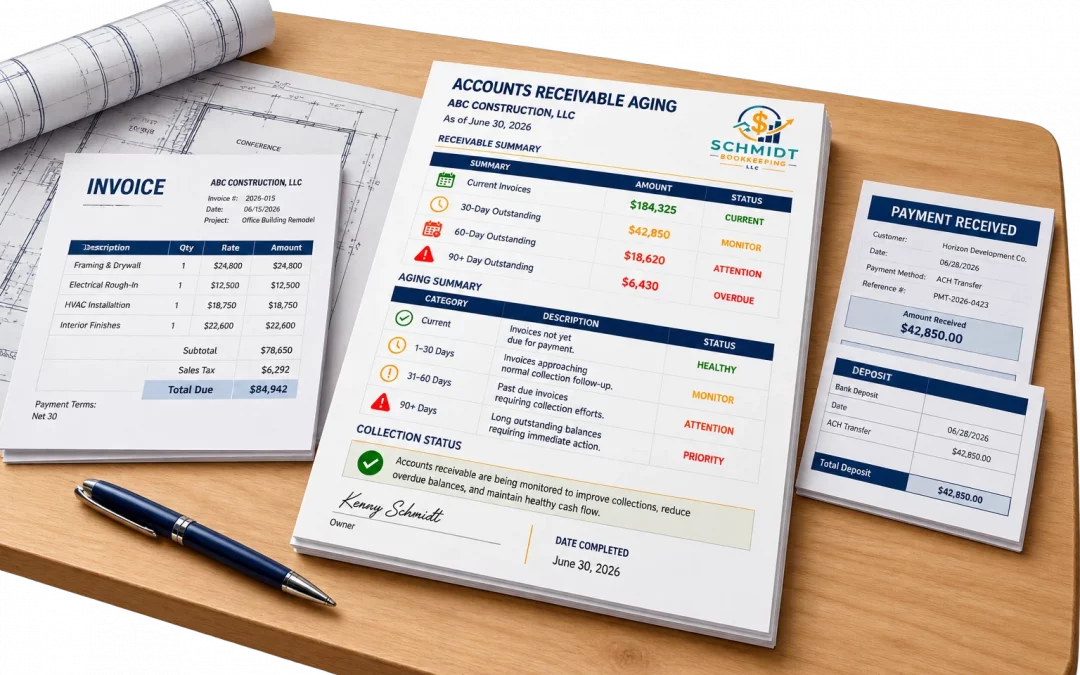
An Accounts Receivable Aging report organizes outstanding customer balances based on how long they have remained unpaid.
Depending on the accounting system and report configuration, you may see categories such as:
- Current
- 1–30 days past due
- 31–60 days
- 61–90 days
- More than 90 days
The exact categories are less important than what the report helps you see.
Suppose two contractors each have $300,000 in accounts receivable.
For the first contractor, most of the balance may be current and consistent with normal customer payment terms.
For the second contractor, a large portion may have been outstanding for 60, 90, or more days.
The total receivable balance is identical.
The collection picture is not.
That is why aging matters.
Aging turns one receivable total into information about collection timing.
Instead of asking only:
How much do customers owe me?
you can begin asking:
How long have they owed it?
Then:
- Is most of the receivable balance current?
- Are older balances increasing?
- Are particular customers repeatedly paying late?
- Are particular jobs producing collection delays?
- Are invoices sitting unresolved because of disputes?
- Are documentation problems preventing approval?
- Is retainage being confused with ordinary overdue receivables?
Those questions move accounts receivable from bookkeeping information toward Financial Visibility.
Not Every Old Receivable Has the Same Cause
An aging report can show you where money is sitting.
It cannot automatically tell you why it is sitting there.
That distinction matters because different causes require different responses.
Customer Payment Behavior
Some customers simply pay more slowly than others.
A customer may routinely pay later than the agreed terms even when invoices are accurate and properly submitted.
Repeated payment behavior becomes useful financial information.
Billing Problems
An invoice may have been submitted late, incorrectly, or incompletely.
If it needs to be corrected and resubmitted, the collection cycle may effectively restart or be extended.
Missing Documentation
Construction billing often depends on supporting documentation.
Depending on the project, payment processing may be delayed because required items such as supporting cost information, time records, lien waivers, change-order documentation, or other required backup have not been provided.
Approval Delays
An invoice or pay application may be waiting for review or approval.
That could involve an owner, general contractor, project manager, architect, or another party in the payment process.
Billing Disputes
The customer may disagree with:
- Scope
- Percentage of completion
- Pricing
- Change orders
- Quantity
- Work performed
- Other billing details
Until the disagreement is resolved, collection may be delayed.
Internal Follow-Up Problems
A valid invoice may simply sit because nobody consistently owns the collection process.
If follow-up happens only when cash becomes tight, receivables can age without anyone identifying the problem early.
Contractual Timing
An amount may appear in accounts receivable while payment is still moving through the timing established by the contract or billing arrangement.
Outstanding does not automatically mean overdue.
Retainage
A portion of the amount may intentionally be withheld until later under the contract.
That is fundamentally different from an ordinary invoice that should already have been paid.
The important lesson is:
The aging report identifies where money is sitting. It does not automatically tell you why it is sitting there.
The report creates visibility.
Analysis provides the context.
Retainage Is Different From an Ordinary Late Payment
Retainage is a particularly important distinction in construction accounts receivable.
Under many construction contracts, a percentage of payment may be withheld until later in the project or until specified requirements are satisfied.
That means the contractor may have performed and billed work while part of the related amount remains intentionally uncollected.
From a cash perspective, the effect is straightforward:
The money is not available to the business yet.
But that does not mean retainage should automatically be interpreted the same way as an ordinary overdue invoice.
When reviewing receivables, it is useful to understand:
- How much retainage is outstanding
- Which projects contain retainage
- How long those amounts have been held
- When release is expected
- Whether required release conditions have been satisfied
- Whether retainage is accumulating across multiple jobs
If retainage is mixed mentally with ordinary receivables, the contractor may have difficulty distinguishing money that is late from money that is intentionally being held.
Money being intentionally withheld under contract should not automatically be interpreted the same way as an ordinary receivable that should already have been collected.
That distinction improves the quality of the accounts receivable review.
Slow Collections Can Create Cash Pressure Even When the Business Is Profitable
A construction business can be busy, generating revenue, performing profitable work, and carrying substantial accounts receivable while still experiencing cash pressure.
The reason is timing.
Construction expenses often occur before the related customer money is collected.
The business may already have paid for:
- Payroll
- Materials
- Subcontractors
- Equipment
- Insurance
- Fuel
- Overhead
- Other operating expenses
while the customer payment remains in accounts receivable.
The company may therefore be financing the gap between spending the money required to perform the work and collecting the money earned from the customer.
The longer earned money remains uncollected, the longer the business may need to finance that gap itself.
That is one reason a large accounts receivable balance should not automatically make a contractor feel financially comfortable.
A receivable may represent money owed to the business.
It does not provide the same immediate financial capacity as cash already collected.
Accounts Receivable Also Affects Working Capital
Accounts receivable can be an important current asset and therefore part of the company’s working-capital position.
But as we have seen, a receivable is not the same as available cash.
A business may show positive working capital while a meaningful portion of its current assets consists of customer balances that have not yet been collected.
That means the quality and timing of receivables matter when evaluating short-term financial capacity.
Ask:
- How much working capital consists of accounts receivable?
- How old are those receivables?
- How quickly are customers actually paying?
- How much may remain unavailable because of retainage?
- Are older balances becoming a larger portion of the total?
A contractor can therefore have a positive financial position on paper while still feeling significant short-term cash pressure.
Growth Can Make Collection Problems More Expensive
More work can produce more revenue.
It can also produce more money waiting to be collected.
As a construction company grows, it may need to support:
- More employees
- Larger payroll
- More material purchases
- More subcontractor costs
- More active projects
- More invoices and pay applications
- Larger accounts receivable balances
- More retainage
If billing and collection processes do not scale with the business, the amount of money tied up in receivables can increase.
The contractor may become busier while cash pressure gets worse.
That does not mean growth is the problem.
It means growth increases the financial importance of getting work billed accurately, monitoring receivables, and understanding collection timing.
More revenue can create more money waiting to be collected.
That is another reason accounts receivable deserves attention before collection problems become large enough to interfere with the business.
Days Sales Outstanding Can Help Show the Collection Trend
Days Sales Outstanding, often called DSO, is a metric used to estimate the average collection period represented by the company’s receivables and sales activity.
It can provide another perspective on collection performance.
But DSO should not be treated as a universal score.
There is no single DSO number that automatically tells every construction company whether its collection performance is good or bad.
Payment terms, customer types, billing arrangements, retainage, project structure, and other factors can affect the result.
DSO becomes more useful when it is interpreted in context.
For example:
- How does it compare with the company’s actual payment terms?
- Is DSO increasing or decreasing?
- How does the current result compare with prior periods?
- Did a large project or unusual receivable affect the number?
- Does the trend match what the Accounts Receivable Aging is showing?
A rising DSO may identify a question worth investigating.
It does not automatically identify the cause.
A metric is useful when it helps identify a question—not when it replaces judgment.
Collection Problems Should Be Separated From Billing Problems
When a contractor is waiting for money, it is useful to determine whether the underlying problem is primarily a billing problem or a collection problem.
A Billing Problem
The customer has not received an accurate, complete, timely bill that can move through the payment process.
Examples might include:
- Late invoicing
- Missing documentation
- Incorrect amounts
- Incomplete pay applications
- Unresolved billing details
- Missed submission requirements
The solution begins with improving the billing process.
A Collection Problem
A valid amount has been properly billed, payment is due, and the customer still has not paid.
That requires attention to collection activity and the reason payment remains outstanding.
The distinction matters.
A contractor cannot solve a billing-process problem simply by making more collection calls.
And perfect invoicing does not guarantee that every customer will pay on time.
Before deciding what to do about slow payment, identify which problem you actually have.
A Practical Construction Receivables Review
Accounts receivable becomes more useful when you move beyond the total balance and examine the entire billing-to-collection process.
1. Review What Has Been Earned and Billed
Start with the work itself.
Is billable work being invoiced promptly?
Are progress bills or pay applications being submitted according to schedule?
Is required job information reaching the billing process quickly enough?
Are completed change orders being incorporated into billing appropriately?
The objective is to identify whether unnecessary delays exist before the receivable is even created.
2. Review What Is Still Outstanding
Determine how much customers owe the business.
Then look beyond the total.
Which customers account for the balance?
Which jobs?
Are a few large receivables driving the total?
Are balances concentrated with one customer or spread across many?
3. Review the Aging
Look at how long the balances have remained outstanding.
What is current?
What is past due?
Where are older balances accumulating?
Are balances moving into older aging categories?
Are the same customers repeatedly appearing there?
The aging pattern can help direct attention where it is needed.
4. Separate Retainage
Identify amounts being intentionally withheld under contractual retainage provisions.
Do not automatically evaluate those balances the same way as ordinary overdue invoices.
Understand which jobs contain retainage, how much is being held, and when release is expected.
5. Identify the Cause of Material Delays
For significant outstanding balances, ask why the money has not been collected.
Is the amount:
- Not yet due?
- Waiting because of a billing problem?
- Missing documentation?
- Waiting for approval?
- Disputed?
- Associated with a slow-paying customer?
- Retainage?
- Simply not being followed up consistently?
The reason matters because the next action depends on the cause.
6. Review Collection Ownership
Someone needs visibility into the collection process.
Who reviews receivables?
Who follows up with customers?
When does follow-up begin?
Are customer responses recorded?
Are promised payment dates tracked?
Are unresolved billing issues assigned to someone?
Consistent ownership makes it easier to identify problems before balances become significantly overdue.
7. Watch the Trend
A single aging report is useful.
A pattern over time can be more useful.
Ask:
- Is total AR increasing?
- Is AR growing faster than revenue?
- Are older receivables increasing?
- Is DSO changing?
- Are particular customers repeatedly paying late?
- Are certain project types producing collection problems?
- Is retainage becoming a larger portion of outstanding receivables?
Trends can help distinguish an isolated issue from a developing collection problem.
8. Connect Collections to Cash Needs
Finally, connect accounts receivable to the operating needs of the business.
How much money is currently unavailable because it remains in receivables?
What payroll, vendor, subcontractor, tax, debt, and operating obligations must the company support while waiting?
This is where accounts receivable becomes more than a bookkeeping balance.
It becomes part of understanding the company’s financial capacity.
Which Reports Help You Understand Why You're Waiting?
Several financial reports can help answer different parts of the payment question.
Accounts Receivable Aging
The Accounts Receivable Aging is the primary report for understanding outstanding customer balances and collection timing.
It can help show:
- Which customers owe money
- How much they owe
- How long balances have remained outstanding
- Where older receivables are concentrated
- Which balances may require investigation
The aging report tells you where money is sitting.
You still need context to determine why.
Cash Flow Statement
The Cash Flow Statement provides broader information about how cash moved through the business during a reporting period.
It does not replace the Accounts Receivable Aging.
Instead, it can help provide context for how customer collections interact with the company’s overall cash movement.
Balance Sheet
The Balance Sheet shows accounts receivable as part of the company’s financial position.
It can help show how significant receivables are relative to other assets and obligations.
Again, each report answers a different part of the question.
The goal is not to collect reports.
The goal is to use the right information to understand what is happening.
What Better Receivables Visibility Helps You Decide
Knowing that customers owe you money is useful.
Knowing where the money is, how long it has been there, and why it has not been collected is more useful.
Better accounts receivable visibility can help you decide:
- Which invoices need immediate follow-up
- Which customers require closer attention
- Whether billing procedures need improvement
- Whether required documentation is creating delays
- Whether unresolved disputes need action
- Whether retainage is becoming significant
- Whether collection timing is creating cash pressure
- Whether customer payment behavior should influence future business decisions
This is where accounts receivable moves beyond administrative bookkeeping.
Payment behavior can become decision information.
A customer that consistently creates billing disputes, requires excessive follow-up, or pays substantially later than expected may affect the business differently from a customer that pays reliably.
The purpose here is not to determine customer profitability from receivables alone.
It is to recognize that collection behavior is part of the financial relationship the business has with its customers.
And that relationship deserves visibility.
Financial Visibility Helps Explain Why the Money Is Still Outstanding
The Construction Visibility System™ provides a practical way to understand how accounts receivable information becomes useful:
Capture → Organize → Analyze → Report → Advise
Billing activity, customer balances, payments, and retainage are captured through accurate bookkeeping.
Receivables are organized by customer, job, age, and relevant status so outstanding balances can be understood.
Billing patterns, aging balances, payment behavior, and collection delays are analyzed to identify where attention may be required.
Accounts Receivable Aging and related financial reports make that information easier to report and review.
Then the information can help advise the next decision.
Which invoices need follow-up?
Are billing procedures contributing to delays?
Are particular customers consistently paying late?
Is retainage creating significant pressure?
Are slow collections affecting working capital or available cash?
Those are better questions than simply asking:
Why haven’t they paid me yet?
Bookkeeping records what customers owe.
Financial Visibility helps you understand why the money is still outstanding and what deserves attention.
The Goal Is to Make the Collection Cycle Visible
Construction businesses will not always get paid immediately.
Payment timing is part of the industry.
Invoices need to be processed.
Pay applications may require approval.
Contract terms matter.
Retainage may be withheld.
Some customers pay more slowly than others.
The objective is not to eliminate every normal payment delay. It is to make the collection cycle visible enough to know what is happening.
You should be able to distinguish:
Work that has not been billed
from
money that has been billed but is not yet due
from
money that is past due
from
money delayed because of a billing or documentation problem
from
money intentionally held as retainage.
Those distinctions create Financial Visibility.
When the collection cycle is visible, you can identify where money is getting delayed, determine which problems deserve attention, and make better decisions about the financial demands your business can support while you wait to collect.
Frequently Asked Questions
What is accounts receivable in a construction business?
Accounts receivable represents amounts customers owe the construction business that have not yet been collected.
Depending on the company’s billing arrangements, those receivables may come from invoices, progress billings, pay applications, or other customer amounts due.
The total receivable balance tells you how much is outstanding. Supporting information such as Accounts Receivable Aging helps show how long those balances have remained unpaid.
Why does it take construction companies so long to get paid?
Construction payment timing can be affected by many factors, including billing schedules, invoice preparation, pay-application requirements, supporting documentation, approval processes, contract terms, customer payment behavior, disputes, and retainage.
The useful question is not simply whether payment is slow, but where in the billing-to-collection process the delay is occurring.
What does an Accounts Receivable Aging report tell me?
An Accounts Receivable Aging report organizes outstanding customer balances based on how long they have remained unpaid.
It helps show which receivables are current and which have moved into older aging categories.
The report can help identify balances that deserve investigation, but it does not automatically explain why a particular customer has not paid.
What is the difference between accounts receivable and cash?
Accounts receivable represents money customers owe the business.
Cash represents money the business has actually collected and has available.
A construction company can therefore have substantial accounts receivable while still experiencing cash pressure because the customer money has not yet been collected.
How does retainage affect accounts receivable?
Retainage can cause part of the money associated with completed or billed work to remain uncollected until later under the terms of a construction contract.
That means retainage can contribute to the amount of money the contractor is waiting to receive.
It is useful to distinguish retainage from ordinary overdue receivables because the reasons and expected timing of collection may be different.
What is Days Sales Outstanding (DSO)?
Days Sales Outstanding, or DSO, is a metric used to estimate the average collection period represented by the company’s receivables and sales activity.
It is most useful when interpreted in context, including the company’s payment terms, billing arrangements, customer mix, retainage, and historical trends.
There is no single DSO number that automatically defines good collection performance for every construction business.
See What Your Receivables Are Doing to Cash Flow
These resources can help you understand why the same accounts receivable balance can create very different cash problems and review how effectively your construction business is turning completed work into collected cash.
Better Decisions Start With Knowing Where the Money Is
Waiting to get paid is not just frustrating.
It affects the financial capacity of the business.
The company may already have paid employees, suppliers, subcontractors, and operating expenses while the related customer money remains outstanding.
That makes it important to understand more than the total amount customers owe.
You need visibility into what has been billed, what is still outstanding, how old the balances are, what is being held as retainage, why material balances remain unpaid, and how collection timing affects available cash.
Schmidt Bookkeeping helps contractors organize and understand their accounts receivable information so billing delays, aging balances, collection patterns, retainage, and cash pressure become visible enough to support better business decisions.