
Growth can create new opportunities, but more revenue does not automatically mean your construction business can support the additional costs, cash demands, and financial commitments that come with it.
Before you decide to grow, you need to understand what the decision will require from the business—and whether your numbers support it.
Frame the Decision
Growth can mean different things in a construction business.
You might be thinking about hiring another employee, buying equipment, taking on bigger projects, adding a new service, or expanding into another market.
Each opportunity is different, but the financial question underneath them is the same:
Can the business support what this decision will require?
It is tempting to answer that question by looking at revenue. If sales are increasing and the schedule is full, growth can seem like the natural next step.
But revenue alone does not tell you whether the business is financially ready to take on another commitment.
Your bank balance cannot answer the question by itself either. Having enough cash to make a down payment, cover the first payroll, or buy the equipment does not necessarily mean the business can support everything that comes afterward.
Even profit is only part of the answer. A profitable business can still experience cash pressure if money has to leave the business before customer payments arrive.
Evaluating growth requires you to put several pieces of financial information together.
You need to understand where the business stands today, what the opportunity will actually cost, what financial benefit you expect it to produce, when cash will move, what has to happen for the decision to support itself, and how much room the business has if things do not go exactly as planned.
That is where Financial Visibility becomes useful.
The goal is not to predict the future perfectly. It is to understand the financial demands of the decision well enough to make it with your eyes open.
Start With Your Current Financial Position
Before asking whether your construction business can support growth, understand the financial condition of the business you already have.
A busy company is not automatically a financially strong company.
You may have plenty of work scheduled and still have tight cash flow. Revenue may be increasing while gross profit is getting weaker. The business may be profitable overall but have very little working capital available to carry another financial commitment.
That is why you need more than one number.
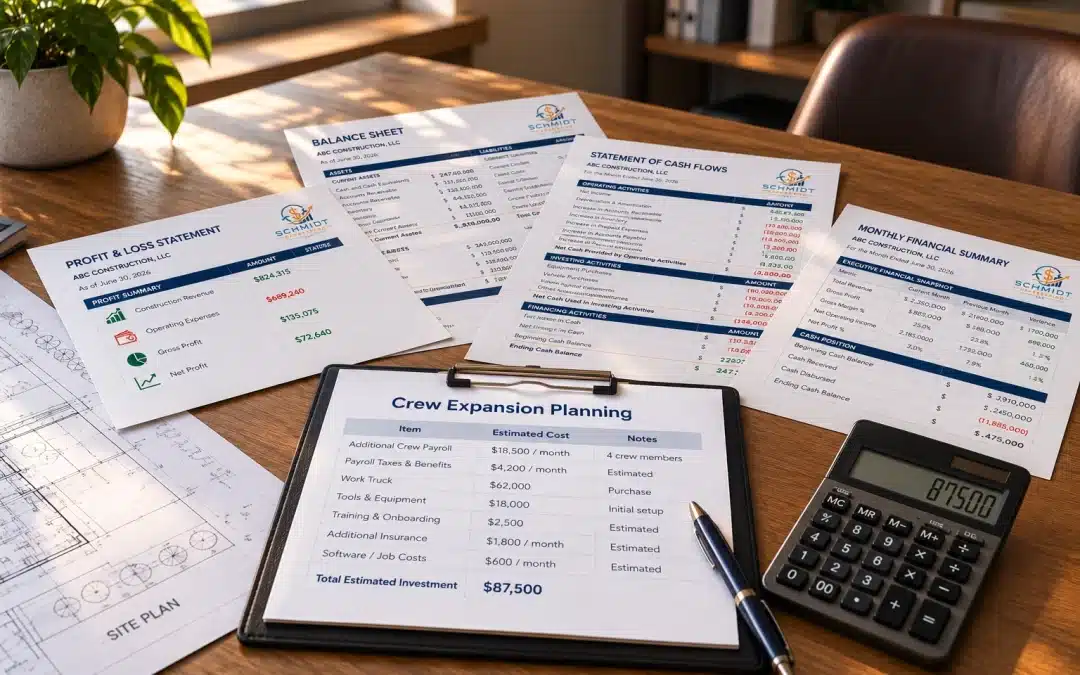
Profit & Loss
Helps you understand whether the business is producing enough gross profit to cover overhead, generate profit, and support additional financial commitments.
Balance Sheet
Helps you understand what the business owns and owes, and whether working capital is available to support operations and additional financial commitments.
Statement of Cash Flows
Helps you understand how cash is moving through the business and whether operations are generating enough cash to support additional financial commitments.
Monthly Financial Summary
Helps you bring key financial information together so you can see important changes and patterns before taking on additional financial commitments.
Why does this matter before growth?
Imagine that your company has been profitable for several months and you are considering another employee.
Profitability is encouraging, but it does not answer the whole question.
If customers are paying slowly, several large bills are coming due, or working capital is already tight, the business may have less room to absorb the added payroll than the profit number suggests.
The same issue can appear with equipment, bigger jobs, or other expansion plans.
Growth often requires the business to commit resources before it receives the full benefit of the decision.
Your current financial position tells you what kind of foundation that new commitment will be sitting on.
If profitability, cash flow, working capital, or overall financial health is unclear, improving that visibility may need to come before making the growth decision.
What Will the Growth Decision Actually Cost?
Once you understand where the business stands today, the next question is:
What will actually change financially if you move forward?
The cost of growth is often larger than the first number you see.
Suppose you are considering hiring an employee at $25 an hour.
It would be easy to use the hourly wage as the cost of the decision. But the wage may be only part of what the business takes on.
The company may also have payroll taxes, workers’ compensation, benefits, tools, software, training, uniforms, vehicle costs, or other expenses related to adding that person.
Some costs may happen once. Others may continue every week or month.
Equipment creates the same issue.
A purchase price or monthly payment is easy to identify, but equipment may also create costs for insurance, maintenance, fuel, repairs, storage, transportation, or additional labor.
Taking on a larger project can create additional costs too. The business may need more labor, materials, subcontractors, equipment, supervision, or working capital before the customer pays.
These are examples of incremental growth costs—the additional costs created because you choose to move forward with the decision.
Why does identifying the full cost matter?
If you compare the expected benefit of growth against only part of its cost, the opportunity can look better than it really is.
Suppose a new piece of equipment has a payment the business can comfortably afford. That tells you the company may be able to make the payment.
It does not yet tell you whether buying the equipment is a good financial decision.
You still need to understand the other costs the equipment creates and what financial benefit the business expects to receive in return.
You do not need every estimate to be perfect.
You do need a reasonable picture of the costs that will change if you move forward.
Once you understand those costs, you can start asking what the business expects to receive in exchange for taking them on.
What Is the Growth Expected to Produce?
Growth usually comes with an expectation.
You hire because you expect more work to get done. You buy equipment because you expect it to improve capacity or productivity. You take on bigger jobs because you expect them to produce additional profit. You add a service because you expect it to create another source of profitable work.
The problem is that growth is often discussed in terms of additional revenue.
Revenue matters, but revenue is not the same as financial benefit.
Imagine that a new service could add $200,000 in annual revenue.
That sounds meaningful. But what does the business have to spend to produce that revenue?
If the new service requires substantial labor, materials, equipment, supervision, marketing, or overhead, the amount left after those costs may be much smaller than the revenue number suggests.
That is why the better question is:
What additional financial benefit should the business receive from the money and resources being committed?
For one decision, that benefit might come from additional gross profit.
For another, it might come from completing more work with the same team, reducing an existing operating cost, improving production capacity, or allowing the company to pursue work it could not handle before.
The exact benefit depends on the decision.
Compare the benefit to what the business must give up
A growth opportunity uses resources.
Those resources might include cash, borrowing capacity, employee time, management attention, equipment, or working capital.
If you commit those resources to one opportunity, they may not be available for something else.
That does not mean the opportunity is bad. It means the expected benefit needs to make sense compared with what the business must commit to get it.
Understanding the cost and expected benefit gives you a better picture of the economics of the decision.
But there is still another question:
When will the business actually pay those costs—and when will the benefit turn into cash?
When Will the Cash Leave—and When Will the Benefit Arrive?
A growth decision can look profitable on paper and still create cash pressure.
That is because costs and benefits rarely happen at the same time.
Construction businesses experience this problem regularly.
Imagine that you take on a larger project.
The estimate shows that the project should be profitable. But before you collect the full amount from the customer, the business may need to pay for labor, materials, subcontractors, equipment, insurance, or other job costs.
Payroll cannot necessarily wait for the customer to pay.
Vendors and subcontractors may have payment terms that do not match your billing and collection schedule.
The project can still be profitable overall. But during the time between paying those costs and collecting the related revenue, the business has to carry the financial load.
That is growth cash timing.
The same problem can happen with hiring
Suppose you add an employee because you expect the company to complete more work.
The employee starts receiving a paycheck immediately.
But it may take time to train that person, schedule additional work, complete the work, bill the customer, and finally collect the cash.
The expected financial benefit may be real.
The cash required to reach that benefit is real too.
Equipment can create a similar gap
An equipment payment may begin this month, but the equipment might not reach the level of use you expected for several months.
During that period, the business is paying for the investment before receiving its full expected benefit.
That timing difference matters because the business needs enough cash and working capital to get through the gap.
This is why the question cannot stop at:
Will this opportunity make money?
You also need to ask:
Can the business support the cash required while we wait for the financial benefit to arrive?
A growth opportunity can ultimately be profitable and still put significant pressure on cash along the way.
What Has to Happen for the Decision to Support Itself?
Once you understand the additional cost, expected benefit, and cash timing, you can ask another practical question:
What does this decision have to produce for the additional commitment to support itself?
That is the basic idea behind growth break-even.
Break-even does not mean the entire company starts over at zero.
In this situation, you are looking specifically at the new commitment.
Consider another employee
Suppose adding an employee increases the company’s costs.
Being able to cover the first few payrolls does not tell you whether the hire will support itself over time.
The employee needs to help the company produce enough additional profitable work—or create another measurable financial benefit—to justify the added cost.
The exact calculation will depend on the role and the business.
A field employee, estimator, project manager, and office employee may contribute to the company in different ways.
The purpose is not to force every employee into the same formula. It is to understand what financial result the company expects from taking on the additional cost.
Consider equipment
Equipment works in a similar way.
Being able to make the payment does not necessarily mean the investment makes financial sense.
Maybe the equipment allows your crews to complete more work. Maybe it replaces rental costs. Maybe it reduces labor hours. Maybe it allows the company to perform work that was previously subcontracted.
Whatever the expected benefit is, you should be able to explain how the equipment is expected to create enough value to support its cost.
Break-even creates a useful reference point
There is no single break-even target that works for every construction business or every growth decision.
The purpose is to create a reference point.
If you know what has to happen for the commitment to support itself, you can compare that requirement with what you realistically expect the business to achieve.
Then you can ask the next question:
What happens if the result is not as good—or does not happen as quickly—as you expect?
How Much Financial Cushion Will Remain?
Plans do not always unfold exactly as expected.
That is normal.
A new employee may take longer to become productive.
Equipment may be used less than planned.
A larger project may collect more slowly.
A new service may take longer to generate consistent work.
Costs may come in higher than expected. Margins may be weaker. A customer may pay late. Another project may need cash at the same time.
A good financial evaluation should make room for those possibilities.
Your growth financial cushion is the room the business has to absorb differences between the plan and what actually happens without immediately creating financial pressure.
Think beyond the best-case outcome
Suppose your plan works if a new employee is fully productive within 30 days.
What happens if it takes 60 or 90 days?
Suppose a piece of equipment makes sense if it stays busy most of the month.
What happens during a slower period?
Suppose a larger project works financially if customer payments arrive according to schedule.
What happens if a payment is delayed while payroll, materials, and subcontractor bills still have to be paid?
These questions are not meant to talk you out of growing.
They help you understand how dependent the decision is on your assumptions.
A decision that still works when the results are somewhat slower, weaker, or more expensive than expected gives the business more room to adjust.
A decision that works only when every assumption goes perfectly leaves much less room.
There is no universal amount of financial cushion that every construction company should keep before growing. The right amount depends on the business, the size of the commitment, the timing of the cash flows, and the uncertainty involved.
The goal is to see the margin for error before you make the commitment.
Put the Numbers Together Before You Decide
The individual pieces become more useful when you look at them together.
Consider a contractor thinking about adding another crew.
The owner might start with strong demand: there appears to be enough work available to keep another crew busy.
That is useful information, but it does not answer the financial question.
First, look at the current financial position.
Is the existing business profitable? Is cash flow stable enough to support another commitment? Is there enough working capital to handle normal operations while the company grows?
Next, identify the incremental costs.
Another crew may mean additional payroll, payroll taxes, workers’ compensation, vehicles, tools, equipment, supervision, software, or other costs.
Then estimate the expected financial benefit.
How much additional profitable work should the new capacity allow the business to complete?
Next comes cash timing.
When do those new costs begin? How long before the additional work is completed, billed, and collected?
Then consider break-even.
What does the additional crew need to produce for the financial benefit to support the added commitment?
Finally, consider the financial cushion.
What happens if hiring takes longer, work starts later, production is slower, a project is delayed, or customer payments arrive later than expected?
Now the decision looks very different from:
“We have more work. Should we add another crew?”
You are using the company’s financial information to understand what the opportunity actually requires.
Each part answers a different question
Looking only at expected benefit can make an opportunity appear better than it is because you have not considered the full cost.
Looking at cost and benefit without cash timing can hide the working-capital pressure created while you wait for the benefit to arrive.
Calculating break-even without considering financial cushion can produce a plan that works on paper but gives the business very little room when actual results differ from the forecast.
That is why no single number can answer whether your construction business can afford to grow.
You need the whole picture.
What Kind of Growth Are You Considering?
Once you understand the financial capacity of the business, you can apply the same thinking to the specific growth decision in front of you.
The questions become more detailed depending on what you are considering.
Paying Yourself More
Increasing owner compensation is different from hiring an employee or buying equipment.
The question is whether the business can support the additional cash leaving the company while still meeting payroll, bills, taxes, working-capital needs, and other business obligations.
Adding People
If you need more capacity, one question may be whether that capacity should come from an employee or a subcontractor.
Those options create different cost structures and financial commitments.
If an employee is the appropriate choice, the next question is whether the business can support the full cost of the hire and the time it may take for that person to become productive.
Buying Equipment
Equipment decisions involve more than the purchase price or monthly payment.
You need to understand the total cost of ownership, expected use, financial benefit, cash timing, break-even, and how long it may take the investment to pay back.
Taking On Bigger Jobs
A larger project may produce more revenue and profit, but it can also require the business to carry more payroll, materials, subcontractor costs, retainage, and other project-related cash demands.
The question is not simply whether you can perform the work. It is whether the business has the financial capacity to support the larger exposure.
Adding a New Service
A new service may require training, equipment, marketing, additional labor, new processes, or management attention before it produces consistent profitable work.
You need to understand what it will cost to launch, how long it may take to develop, what financial contribution you expect, and what existing resources will be committed to it.
Expanding Into a New Market or Territory
A new market may create opportunities, but it can also change travel time, labor efficiency, supervision requirements, transportation costs, marketing expenses, and other costs of serving customers.
You need to understand what entering the market will require and whether the expected financial benefit supports those additional costs and commitments.
Each of these decisions deserves its own evaluation.
The purpose of this article is not to answer all of them at once. It is to give you the financial framework you can use before moving into the specific decision you are considering.
Better Growth Decisions Start With Financial Visibility
Growth is a forward-looking decision, but the evaluation begins with the financial information your construction business already produces.
Reliable bookkeeping gives you organized financial information.
Financial Visibility helps you understand what that information means for the decision ahead.
Can the current business support another commitment?
What will change financially if you move forward?
What does the opportunity need to produce?
When will the cash leave the business, and when should the benefit arrive?
How much room do you have if things do not happen exactly as planned?
Those are better questions than simply asking whether revenue is growing or whether there is enough money in the bank today.
The goal is not to prove that you should grow.
It is not to prove that you should wait.
The goal is to understand the numbers well enough to evaluate the opportunity and make a better-informed business decision.
That is what Financial Visibility is supposed to provide.
FINANCIAL VISIBILITY
Need a Clearer View of Your Numbers Before You Grow?
If your financial reports do not give you enough clarity to evaluate the decisions ahead, Schmidt Bookkeeping can help you understand what your numbers are telling you and where better Financial Visibility may be needed.