
As the owner of a construction business, there may come a point when you want to increase what you are taking from the company.
Maybe revenue has grown. Maybe the business has been profitable for several months. Maybe there is more money in the bank than there used to be.
Those can all be positive signs. But none of them, by itself, answers the question: Can the business afford to pay me more?
Owner pay is not only a personal-income decision. It is also a business cash decision.
Every additional dollar that leaves the company is a dollar that is no longer available for payroll, materials, subcontractors, taxes, debt payments, upcoming jobs, unexpected costs, or the normal timing gaps that happen in construction.
That does not mean you should avoid paying yourself more.
It means the decision should be based on Financial Visibility rather than the bank balance alone.
Start With What the Business Can Actually Support
The question is not simply whether you want or need more money personally.
The financial question is whether the business can provide more money to you while still supporting everything the company needs to operate.
That starts with understanding the financial condition of the business before the additional owner pay happens.
Look at whether the company is consistently profitable, how cash is moving through the business, how much working capital is available, and what obligations the company already has to meet.
A business with strong revenue can still have limited financial room if cash is tied up in receivables, upcoming jobs require significant materials or labor, debt payments are consuming cash, or the company has little cushion for unexpected costs.
The amount the business can support should come from its financial capacity—not simply from how much money happens to be in the bank today.
A contractor has had several profitable months and sees $90,000 in the business bank account.
At first, taking an additional $20,000 may seem reasonable.
But $35,000 of that cash will be needed for payroll and subcontractors over the next few weeks. Another $25,000 is needed for materials on jobs already under contract, and quarterly tax and debt payments are approaching.
The bank balance is real, but much of that cash already has a job.
The decision should be based on what remains after the business’s operating needs and obligations are considered.
A higher bank balance can make additional owner pay feel affordable even when the business has limited financial room.
Understanding what the company actually needs to keep gives you a better starting point for the decision.
Before increasing owner pay, ask what financial condition the business would be in after the additional money leaves—not simply whether the cash is available today.
Profit and Available Cash Are Not the Same Thing
Profit matters when evaluating owner pay because a business needs to produce enough financially to support what the owner takes from it.
But profit and available cash are not the same thing.
Your Profit & Loss Statement shows whether the business generated a profit over a period of time. It does not tell you exactly how much cash is available to remove from the business today.
Construction businesses often experience timing differences between when income is earned, when customers pay, and when the business has to pay employees, subcontractors, suppliers, taxes, and other expenses.
A profitable month can therefore occur while cash is tight.
The opposite can happen too. A large customer payment can temporarily increase the bank balance even though some of that cash is needed to pay costs connected with the job.
A construction company reports a $30,000 profit for the month.
Near the end of the month, the company also receives a large customer payment, bringing the bank balance to $100,000.
That does not mean the owner has $100,000—or even the full $30,000 of reported profit—available for additional owner pay.
Payroll, subcontractor invoices, material bills, taxes, debt payments, and costs for work already scheduled may still need to be paid from that cash.
If you use profit alone to decide what to take from the business, you can remove cash the company needs before the timing of its obligations becomes visible in the bank account.
Use profitability to understand what the business is producing, then use cash flow and the company’s upcoming obligations to determine what the business can actually support.
Understand What the Business Needs to Keep
Some of the cash in a construction business needs to stay in the business.
The company needs money to cover normal operating expenses and the timing gaps between paying for work and collecting from customers.
That can include payroll, materials, subcontractors, insurance, taxes, debt payments, equipment costs, overhead, and costs required to start upcoming jobs.
The business also needs enough working capital to continue operating when customer payments arrive later than expected or a project requires more cash up front than usual.
There is no universal cash balance or working-capital number that tells every contractor how much the business should keep.
The right amount depends on the size of the company, the type of work it performs, its payment cycles, its financial obligations, and the amount of uncertainty it needs to absorb.
Two contractors may each have $75,000 in the bank.
One has low overhead, small projects, short payment cycles, and few upcoming obligations.
The other has a large payroll, several jobs starting at once, significant material purchases due, and customers that typically pay 30 to 45 days after billing.
The same bank balance does not create the same financial capacity for both businesses.
Owner pay should not reduce the business below the level of cash and working capital it reasonably needs to operate.
Before deciding what additional amount the business can provide to you, identify what the company needs to retain for operations, obligations, timing differences, and financial cushion.
Look at Owner Pay as a Business Cash Commitment
It is easy to think about an increase in owner pay as a personal monthly amount.
For the business, however, that increase becomes another use of cash.
An additional $2,000 each month means $24,000 of additional cash leaving the company over a year if the increase continues.
An additional $5,000 each month means $60,000.
Looking at the decision over a longer period helps you see the financial commitment more clearly.
The question becomes whether the business can repeatedly support the additional amount while continuing to meet its other financial needs.
An owner considers increasing the amount taken from the company by $3,000 per month.
Looking only at the next payment makes the decision seem like a $3,000 question.
Over twelve months, however, the business would need to provide an additional $36,000 of cash to the owner.
That larger view makes it easier to compare the decision with expected profitability, cash flow, working-capital needs, and other commitments.
A recurring increase in owner pay affects more than one month’s bank balance.
The business needs enough ongoing financial capacity to support the commitment over time.
Translate the proposed increase into its monthly and annual cash impact before deciding whether the business can sustainably support it.
Use More Than One Good Month
Construction financial results can change significantly from month to month.
A large job may finish. Several customers may pay at once. Material purchases may fall into a different month than the related revenue. Seasonal changes can also affect workload and cash flow.
That makes one strong month a weak foundation for a recurring owner-pay decision.
Instead, look for patterns.
Review profitability and cash flow across multiple months. Consider whether the business is consistently producing enough to support its existing needs and whether the current cash position is normal or unusually strong.
A trend gives you more useful information than a single point in time.
A contractor has an unusually strong month and considers immediately increasing owner pay.
Looking back over the previous six months shows that profitability has been inconsistent and cash has regularly fallen during payroll-heavy weeks.
The strong month is encouraging, but the longer pattern suggests the business may not yet have enough consistent financial capacity to support a permanent increase.
A temporary improvement can disappear. A recurring increase in owner pay continues unless you change it again.
Use several months of financial information to determine whether the business’s ability to support more owner pay is becoming consistent rather than reacting to one unusually good period.
What Happens to the Business After You Pay Yourself More?
One of the most useful ways to evaluate additional owner pay is to stop looking only at the amount you want to take and look instead at the financial condition that remains afterward.
Imagine the additional payment has already happened.
What does the business look like now?
Is there still enough cash for normal operations?
Is working capital still adequate for upcoming jobs?
Can the company meet payroll, supplier obligations, taxes, debt payments, and other commitments?
Can it handle a customer paying late?
Can it absorb an unexpected repair, job cost, or slow period?
The financial room that remains after the decision is part of your Growth Financial Cushion.
Suppose the business has enough cash to make an additional $15,000 owner payment today.
Before deciding that the payment is affordable, look at the business after the $15,000 is gone.
If the remaining cash still supports payroll, materials, upcoming obligations, working-capital needs, and a reasonable financial cushion, the decision may be supportable.
If the payment leaves the company dependent on the next customer deposit arriving exactly on time, the same $15,000 decision carries much more financial risk.
A business can technically have enough cash to make a payment without having enough financial capacity to make that payment responsibly.
Evaluate the financial condition that remains after additional owner pay. The amount left in the business can be just as important as the amount leaving it.
Run the Decision Through Different Business Conditions
Financial decisions become more useful when you consider what happens if conditions change.
Start with the result you reasonably expect.
Then consider a weaker condition.
What if a customer pays later than expected?
What if a job requires more cash than planned?
What if revenue slows for a month or two?
What if an unexpected equipment repair occurs?
You do not need to predict every possible problem. The purpose is to understand whether the proposed owner pay works only when everything goes according to plan or whether the business has enough financial cushion to absorb normal uncertainty.
A contractor’s current numbers suggest the business could support an additional $2,500 per month of owner pay.
Under expected conditions, the company still maintains adequate cash and working capital.
The owner then considers what happens if a major customer pays 30 days late while payroll and material costs continue on schedule.
If that delay would immediately create a cash shortage, the proposed increase may be too aggressive even though it works under the expected case.
Construction businesses operate with uncertainty. A decision that works only under ideal conditions may leave very little room for normal timing problems or unexpected costs.
Consider both expected and weaker business conditions before making a recurring increase in owner pay.
Put the Numbers Together Before You Increase Owner Pay
No single financial number should make the owner-pay decision for you.
Instead, bring several pieces of Financial Visibility together.
Your Profit & Loss Statement helps you understand whether the business is consistently producing profit.
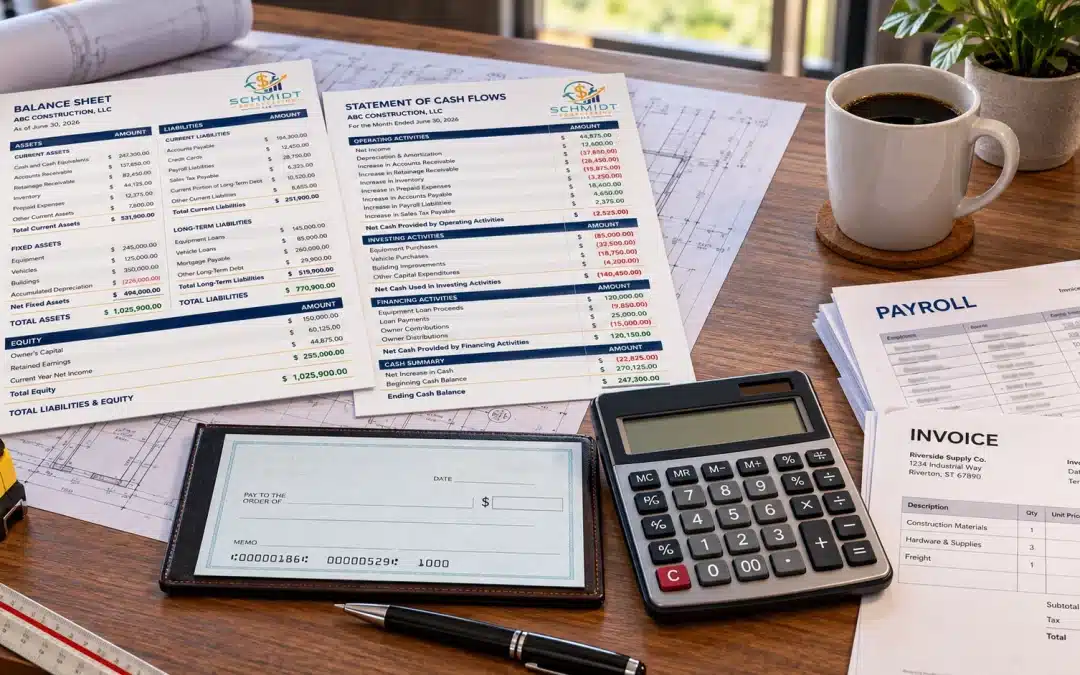
Your Balance Sheet helps you understand the company’s financial position, including cash, liabilities, and working capital.
Your Statement of Cash Flows helps you understand how cash is actually moving through the business.
Your Monthly Financial Summary can help you see important trends and changes across the business.
Together, those reports provide a much clearer picture than the bank balance alone.
Before increasing owner pay, ask:
Is the business consistently profitable?
How is cash moving through the business?
What cash and working capital does the company need to keep operating?
What obligations are coming due?
What would the proposed increase cost the business each month and over a full year?
What financial condition would remain after the additional owner pay?
Would the business still have enough cushion if cash comes in later or costs are higher than expected?
The purpose is not to find one perfect number. It is to understand whether the financial evidence supports the additional commitment.
The Reports That Help You Evaluate Owner Pay
No single financial report can tell you how much more you should take from your construction business.
The decision becomes clearer when you look at profitability, financial position, cash movement, and financial trends together.
These reports help you understand different parts of the decision.
Profit & Loss Statement
Shows whether the business is generating enough income to cover its expenses and produce a profit.
Use it to understand whether the business has been consistently profitable enough to consider supporting additional owner pay.
Balance Sheet
Shows what the business owns, what it owes, and its financial position at a specific point in time.
Use it to understand cash, liabilities, and working capital before deciding how much financial capacity the business can safely send to the owner.
Statement of Cash Flows
Shows how cash is moving into and out of the business.
Use it to understand whether the company’s cash flow can support additional owner pay while still covering operating needs and other financial commitments.
Monthly Financial Summary
Brings important financial information together so you can see changes and trends over time.
Use it to determine whether the business’s financial capacity is becoming consistently stronger instead of relying on one unusually good month.
Financial Reports Give You the Numbers. Understanding Them Helps You Make the Decision.
Financial reports become more useful when you understand how the information connects to the decision you are trying to make.
For an owner-pay decision, that means looking beyond a single profit number or bank balance and understanding how profitability, cash flow, working capital, upcoming obligations, and financial cushion work together.
The goal is not simply to know how much money is in the business today.
It is to understand what the business can sustainably support.

More Owner Pay Should Come From Financial Capacity—not Guesswork
Wanting to take more from a successful construction business is reasonable.
The important question is whether the business has developed enough financial capacity to support the increase without weakening the company.
That requires more than checking the bank account.
Look at profitability. Understand cash flow. Protect the working capital the business needs. Consider upcoming obligations. Look at financial trends instead of one strong month. Then evaluate what financial condition will remain after the additional money leaves the company.
When those pieces are visible, owner pay becomes a decision you can evaluate using your numbers instead of a decision based on guesswork.
Strengthen the Financial Visibility Behind This Decision
If you need a clearer understanding of the financial information behind this decision, these Stage 1 resources can help you strengthen the foundation before deciding whether the business can support more owner pay.
Am I Actually Making Money?
Understand whether your construction business is actually producing a profit and why revenue alone does not answer that question.
Why Don't I Have Any Cash?
Understand why a profitable construction business can still feel short on cash and where the money may be going.
Is My Business Financially Healthy?
Learn how to look beyond one financial number and evaluate the broader financial condition of your construction business.
Do I Have Enough Working Capital?
Understand how working capital helps your construction business cover operating needs and manage the timing between paying costs and collecting cash.
Need a Clearer View of What Your Business Can Support?
A clear set of construction financials can help you understand profitability, cash flow, working capital, and the financial room available for decisions like increasing owner pay.
A Book Review can help identify where your current bookkeeping is giving you useful Financial Visibility—and where clearer financial information may be needed.