
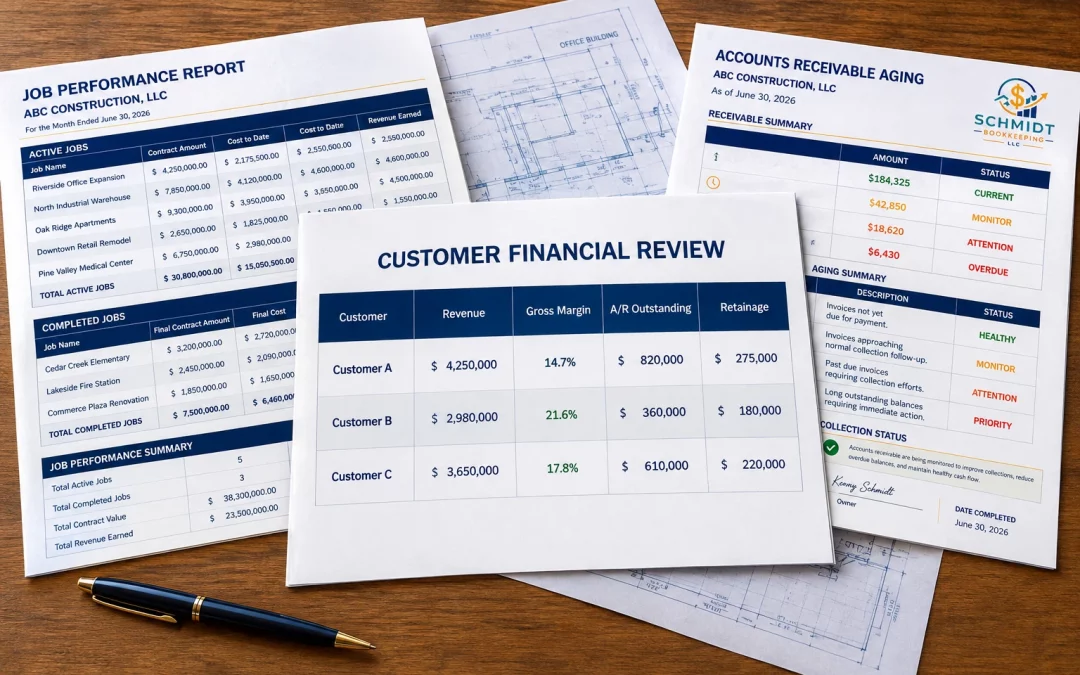
Your biggest customer may feel like your best customer.
They may give you a steady stream of projects. They may represent a large percentage of your annual revenue. Their name may appear on your schedule more often than anyone else’s.
But revenue alone does not tell you what that customer relationship contributes to your business.
A customer can generate a lot of revenue while their jobs consistently produce thinner margins, payments arrive slowly, retainage remains outstanding, or the relationship requires significant amounts of cash and management attention.
Another customer may give you less work but produce stronger margins, pay reliably, and require fewer financial and operational resources.
So the question is not simply:
Which customer gives me the most work?
The more useful question is:
Which customers contribute the most to my business after I consider profitability, payment behavior, financial exposure, and what it takes to serve them?
Answering that question requires looking beyond revenue.
It requires Financial Visibility into the entire customer relationship.
Your Biggest Customer Is Not Automatically Your Most Profitable Customer
Revenue is easy to notice.
If one customer generates $1 million of annual work while another generates $500,000, it is natural to think of the $1 million customer as more valuable.
But those revenue numbers tell you only how much work each customer generated.
They do not tell you what happened financially while you performed that work.
Suppose the larger customer’s jobs consistently produce weaker Gross Margins, require significant upfront spending, and take longer to collect.
Meanwhile, the smaller customer’s projects consistently produce stronger margins and payments arrive predictably.
Which relationship contributes more?
You cannot answer that from revenue alone.
You need to understand what the work actually produces and what the business has to commit before that financial result is realized.
Your biggest customer is not automatically your most profitable customer.
Customer Profitability Is Bigger Than One Project
Customer profitability starts with the profitability of the jobs you perform for that customer.
But deciding how financially valuable the relationship is requires a broader view.
Profitability tells you what the work produced. Payment behavior, receivable exposure, retainage, and resource demands help you understand what the relationship requires from the business.
One construction project can perform unusually well or unusually poorly for reasons that may not repeat.
A job might be affected by:
- an estimating mistake;
- unusual site conditions;
- labor inefficiency;
- material price changes;
- subcontractor problems;
- rework;
- scheduling disruptions;
- unbilled change orders.
Those issues tell you something about that particular project.
They do not necessarily tell you what the overall customer relationship looks like.
If you have completed multiple jobs for the same customer, look at those results together.
Ask:
- Are the jobs consistently profitable?
- Are Gross Margins relatively strong or consistently weak?
- Do projects regularly finish close to expectations?
- Do similar cost overruns keep appearing?
- Are change orders consistently captured and paid?
- Are financial problems isolated or recurring?
The unit of analysis has changed.
You are no longer asking only:
How did this job perform?
You are asking:
What do the financial results across this customer’s jobs tell me about the relationship?
That distinction matters.
Revenue Tells You How Much Work a Customer Gives You
Customer revenue is useful information.
It tells you how much business came from that customer during a particular period.
What it does not tell you is how much of that revenue became Gross Profit.
Consider two customers.
Customer A generates substantially more revenue than Customer B.
But Customer A’s jobs regularly require aggressive pricing and finish at weaker margins.
Customer B gives you less total work, but their projects consistently produce stronger Gross Margins.
Customer A may still produce more total Gross Profit because of the amount of work involved.
Or Customer B may ultimately contribute more effectively relative to the resources required.
You have to look at the actual financial results to know.
That is why revenue should be treated as the beginning of the analysis rather than the conclusion.
Revenue measures how much work a customer gives you. Profitability helps show what that work contributes.
Combine Job Results to See the Customer Relationship
To understand customer profitability, organize the financial results from multiple jobs around the customer who generated them.
Useful information may include:
- Revenue
- Actual job costs
- Gross Profit
- Gross Margin
- Estimated versus actual performance
- Labor performance
- Material performance
- Subcontractor performance
- Significant cost overruns
Then look across the jobs.
Suppose a customer has completed six projects with your company.
One produced a weak margin.
The other five performed close to or above expectations.
That weak project deserves investigation, but it may not tell you much about the customer relationship by itself.
Now suppose five of the six projects finished below expected margin and experienced similar problems.
That is more meaningful.
You may be seeing a recurring pattern associated with:
- pricing;
- project conditions;
- contract terms;
- scope management;
- change-order recovery;
- execution;
- or some combination of those factors.
The purpose is not to blame the customer for every weak job.
It is to understand whether the financial results associated with the relationship show a pattern.
Customer profitability becomes visible when individual job results are organized around the customer relationship.
Large Customers Can Still Produce Weak Margins
Large customers can create a lot of activity.
More projects.
More revenue.
More crews working.
More invoices.
More opportunities for future work.
But activity is not the same thing as profitability.
A customer’s jobs may repeatedly produce weaker margins because of factors such as:
- aggressive pricing expectations;
- difficult contract terms;
- recurring scope changes;
- unrecovered change orders;
- project complexity;
- unusual scheduling requirements;
- recurring cost overruns.
That does not automatically make the customer unattractive.
It tells you there is something about the financial relationship worth understanding.
For example, perhaps the work itself performs well but your pricing does not reflect what the projects require.
Perhaps the customer’s contract terms make change-order recovery difficult.
Perhaps a particular kind of project performed for that customer consistently creates problems.
Those are different causes and may require different responses.
The important point is:
A customer can be important to your revenue without being equally important to your profitability.
Evaluating the Customer Does Not End When the Job Is Billed
A profitable job is valuable.
But profitability is only one part of evaluating the customer relationship.
Billing the job does not put the money in your bank account. Payment still has to occur.
That means customer profitability should be considered alongside customer payment behavior when you evaluate the broader financial relationship.
Ask:
- Does the customer generally pay according to agreed terms?
- Do invoices regularly become overdue?
- Do billing approvals create delays?
- Are invoices frequently disputed?
- Does collecting payment require significant follow-up?
- Does the same payment pattern appear across multiple projects?
A customer whose jobs produce strong margins but who consistently pays slowly creates a different financial relationship from a customer with similar margins who pays reliably.
The Gross Profit may look similar.
The cash experience may not.
That matters because your business still has to pay:
- employees;
- subcontractors;
- suppliers;
- equipment costs;
- overhead;
- other operating expenses
while it waits to collect.
Payment behavior does not replace profitability analysis. It adds another dimension to the customer relationship.
Look at How Much Money the Customer Keeps Outstanding
Your Accounts Receivable provides another view of the relationship.
A customer may represent a large amount of revenue while also representing a large amount of money that has not yet been collected.
Review questions such as:
- How much does this customer currently owe?
- How old are the outstanding invoices?
- Do balances regularly move into older aging categories?
- Does the customer consistently maintain a large outstanding balance?
- How much of the company’s total A/R is associated with this customer?
A large receivable balance is not automatically a problem.
A large active customer may naturally have more outstanding invoices than a smaller one.
The useful question is whether the amount and age of those receivables are reasonable for the work being performed and the agreed payment terms.
A customer who generates substantial revenue but consistently leaves a large amount of it outstanding creates receivable exposure.
That exposure is part of the broader financial relationship.
Retainage Can Extend the Financial Commitment
Construction adds another important consideration: retainage.
A project may be substantially complete and profitable while a portion of the amount earned remains withheld under the contract.
If you perform multiple projects for the same customer, those retained amounts can accumulate.
Ask:
- How much retainage is currently associated with this customer?
- How long does retainage typically remain outstanding?
- Is retainage generally released when expected?
- Does the customer relationship consistently leave a significant amount of earned money unavailable for long periods?
Retainage does not make a profitable customer unprofitable by itself.
But it affects the timing of the financial return.
Your business may have already paid much of the labor, materials, subcontractors, and other costs required to produce the work while part of the money earned remains unavailable.
Retainage changes how long the business may have to financially support the customer relationship before receiving the full amount earned.
Some Customers Require More From the Business Than Their Revenue Suggests
Not every demand created by a customer appears neatly in one financial report.
Some relationships require more:
- estimating;
- project management;
- supervision;
- scheduling coordination;
- billing documentation;
- change-order administration;
- collection effort;
- management attention;
- Working Capital.
Some of those costs may already be reflected in job costs or operating expenses.
The point is not to subtract them twice or manufacture a new profitability calculation.
The point is to recognize that two customer relationships producing similar reported profit can still place very different demands on the company’s people, cash, and capacity.
That does not mean you should try to assign an arbitrary dollar value to every phone call, meeting, or administrative task.
It means you should recognize that two customers producing similar financial results may place very different demands on the business.
Suppose two customers generate similar Gross Profit.
One relationship is predictable, bills cleanly, pays reliably, and requires normal project management.
The other requires repeated billing corrections, extensive documentation, constant schedule accommodation, difficult change-order negotiations, and substantial collection effort.
The Gross Profit figure may look similar.
The relationships are not necessarily equivalent.
Financial contribution should be considered alongside the resources required to produce and collect that contribution.
Customer Concentration Is a Separate Risk Question
A customer can be highly profitable, pay reliably, and be relatively easy to work with—and still represent a large share of the business.
That does not reduce the profitability of the relationship.
It creates a separate question:
How dependent is the company on this customer?
If one customer represents an unusually large share of your revenue, Gross Profit, or receivables, changes in that relationship can have an outsized effect on the company.
A customer may:
- reduce the amount of work they award;
- change purchasing or contracting practices;
- delay projects;
- change payment terms;
- move work to another contractor.
That does not mean a large profitable customer is a problem.
It means profitability and dependence are different questions.
Customer concentration is therefore useful context when deciding how much of the business you want tied to one relationship.
It should not erase the value of a strong customer.
It helps you understand the exposure that comes with that value.
Customer concentration provides risk context. It should not be confused with customer profitability itself.
Evaluate Customers Across More Than One Dimension
You do not need one complicated customer score to begin understanding customer profitability.
A more useful approach is to look at several financial dimensions separately and then consider what they tell you together.
1. Revenue Contribution
Ask:
How much work does this customer generate?
Revenue gives you scale.
It tells you how significant the customer is to the volume of business you perform.
But it does not tell you what that work ultimately contributes.
2. Profitability
Ask:
What do this customer’s jobs actually produce?
Review:
- Gross Profit;
- Gross Margin;
- Job Profitability;
- estimated versus actual performance;
- recurring cost problems.
This shows whether the work associated with the customer is producing the financial results you expect.
3. Payment Behavior
Ask:
How reliably does this customer pay?
Look at:
- payment timing;
- overdue invoices;
- recurring billing delays;
- disputes;
- collection patterns.
Strong profitability becomes less financially useful when the business waits an unusually long time to receive the cash.
4. Financial Exposure
Ask:
How much financial capacity does this relationship require?
Consider:
- Accounts Receivable;
- retainage;
- cash requirements;
- Working Capital demands;
- the timing between paying project costs and collecting customer payments.
This helps you understand what the business has to support while the relationship produces its financial return.
5. Resource Demand
Ask:
What does it take to serve this customer effectively?
Consider unusual demands on:
- estimating;
- project management;
- supervision;
- administration;
- billing;
- collections;
- management attention.
The goal is not to calculate an artificial customer score.
The goal is to see the relationship more completely.
No single measure determines whether a customer is financially valuable. The relationship becomes clearer when these views are considered together.
Compare Customers Using the Same Financial Questions
Once you have useful information organized by customer, compare relationships using the same questions.
Customer question |
What to review |
|---|---|
| How much work do they give us? | Revenue |
| Are their jobs profitable? | Gross Profit, Gross Margin, Job Profitability |
| Do they pay reliably? | Payment history, A/R Aging |
| How much money stays outstanding? | Accounts Receivable, Retainage |
| How much financial capacity do their jobs require? | Cash demands, Working Capital |
| How demanding is the relationship to support? | Project and administrative resource demands |
This is not a scorecard.
There is no universal formula that says:
Revenue + Margin + Payment Speed = Customer Value
Different construction businesses have different:
- margins;
- capacity;
- cash positions;
- project types;
- risk tolerances;
- customer mixes.
The purpose of using the same questions is consistency.
You want to evaluate Customer A and Customer B using comparable financial information rather than judging one based on revenue and another based on how easy they are to work with.
Avoid the “Most Revenue Wins” Trap
Once customer information is organized, it may be tempting to choose one number and rank everyone by it.
Highest revenue wins.
Highest Gross Margin wins.
Fastest payer wins.
Lowest A/R wins.
Each measure can tell you something useful.
None tells you everything.
A customer with the highest Gross Margin may generate very little total work.
A high-revenue customer may produce substantial Gross Profit even at a lower margin.
A fast-paying customer may still have jobs that consistently underperform.
A profitable customer may create substantial retainage or Working Capital demands.
That is why customer-level Financial Visibility requires context.
The strongest customer relationships tend to make sense across several financial dimensions, not just one.
Good Jobs and Good Customers Are Related—but They Are Not the Same Question
Job profitability and customer profitability are closely connected.
But they answer different questions.
Job analysis asks:
What happened financially on this project?
Customer analysis asks:
What happens financially across the work we perform for this customer?
And job-selection analysis asks another question:
What kinds of work should we pursue in the future?
Those distinctions matter.
A type of job might perform well overall but consistently underperform for one particular customer because of:
- pricing;
- contract terms;
- project conditions;
- scope management;
- payment behavior;
- administrative requirements.
Or one difficult project may distort your impression of a customer whose other jobs perform well.
Customer-level analysis gives you another layer of Financial Visibility.
It helps you distinguish:
a project result
from:
a customer relationship pattern.
Which Financial Information Helps You Evaluate Customers?
You do not need every financial report to begin evaluating customer relationships.
You need information that helps you understand both the work performed and the money still tied to the customer.
Job Performance Report
A Job Performance Report provides job-level evidence such as:
- Revenue;
- actual job costs;
- Gross Profit;
- Gross Margin;
- estimated versus actual performance.
Reviewing that information across multiple jobs for the same customer helps you understand whether the relationship consistently produces strong or weak financial results.
Accounts Receivable Aging
Your A/R Aging helps you understand what remains unpaid.
It can help you see:
- customer balances;
- aging of invoices;
- overdue amounts;
- recurring payment patterns;
- receivable exposure.
The A/R Aging does not tell you whether the customer’s jobs are profitable.
And the Job Performance Report does not tell you whether the customer pays reliably.
Together, they provide two different views of the relationship.
One helps show:
What did the work produce?
The other helps show:
What money are we still waiting to collect?
Neither should be interpreted in isolation.
Financial Visibility Makes Customer Profitability Easier to Understand
Customer profitability depends on financial information being captured and organized in a way that allows the relationship to be seen.
The process follows the Construction Visibility System™:
Capture → Organize → Analyze → Report → Advise
Capture
Record the financial activity associated with the work accurately.
That includes:
- revenue;
- job costs;
- invoices;
- payments;
- retainage;
- other relevant financial activity.
Organize
Connect the financial information to the correct jobs and customers.
Without consistent organization, customer-level patterns become difficult to see.
Analyze
Review multiple jobs performed for the same customer.
Look at profitability, margins, payment behavior, receivable exposure, and financial demands.
Report
Use job-performance and Accounts Receivable information to make those patterns visible.
Advise
Use the resulting Financial Visibility to make better decisions about:
- where to focus capacity;
- where pricing or terms may need attention;
- where financial exposure may need to be limited;
- which relationships deserve deeper investigation.
That is how bookkeeping supports a customer decision rather than simply recording customer transactions.
Frequently Asked Questions
How do I know which customers are the most profitable?
Start by combining or reviewing the financial results of multiple jobs performed for the same customer.
Look at Revenue, Gross Profit, Gross Margin, Job Profitability, and estimated versus actual performance.
Then add context from payment behavior, Accounts Receivable, retainage, financial demands, and the resources required to support the relationship.
The customer generating the most revenue is not automatically the customer making the strongest financial contribution.
Is my biggest customer always my most profitable customer?
No.
Your biggest customer may generate the most revenue, but their jobs may produce weaker margins, require more Working Capital, create larger receivable balances, or take longer to collect.
A smaller customer may produce less revenue while generating stronger margins and more predictable cash collection.
You need more than revenue to compare the relationships.
How do I calculate profitability by customer?
At a basic level, organize the revenue and relevant job costs from multiple jobs around the customer who generated them.
Then review the combined Gross Profit and Gross Margin, along with individual job performance.
The calculation alone does not provide the complete customer picture. Payment behavior, Accounts Receivable, retainage, and other financial demands provide additional context.
Should payment behavior affect how I evaluate a customer?
Yes.
Payment behavior does not change the Gross Profit already produced by a job, but it affects how quickly that financial result becomes available to the business as cash.
Repeated late payments, billing delays, disputes, or large outstanding balances can increase the financial demands associated with the customer relationship.
Can a profitable customer still be bad for cash flow?
Yes.
A customer’s jobs can be profitable while requiring substantial upfront spending, long billing cycles, large Accounts Receivable balances, or significant retainage.
The business may therefore have to support the work financially for a meaningful period before receiving the cash associated with that profit.
Should I stop working with customers who are less profitable?
Not automatically.
First understand why the relationship is producing weaker results.
The issue may involve pricing, project mix, contract terms, payment behavior, change-order recovery, execution, or another factor that can potentially be improved.
The purpose of customer-profitability analysis is not to label customers good or bad. It is to understand what the relationship contributes so you can make a better decision about it.
What is the difference between customer profitability and job profitability?
Job profitability evaluates the financial performance of an individual project.
Customer profitability looks across multiple jobs performed for the same customer.
Evaluating the broader customer relationship then adds context such as payment behavior, receivable exposure, retainage, and financial or resource demands.
Job profitability provides part of the evidence.
Customer-level analysis organizes that evidence around the customer relationship.
Compare Customers by More Than Revenue
These resources can help you see why customers who generate similar revenue can create very different financial results and compare which customer relationships are actually contributing the most value to your construction business.
Better Customer Decisions Start With Better Financial Visibility
The customer who gives you the most work may be valuable to your business.
But the amount of revenue they generate does not tell you everything you need to know.
Look at the jobs.
Look at Gross Profit and Gross Margin.
Look at payment behavior.
Look at Accounts Receivable.
Look at retainage.
Look at the cash and Working Capital required to support the work.
Look at the resources required to manage the relationship.
Then look at those factors together.
You are not trying to create a universal customer score.
You are trying to understand what each customer relationship actually contributes.
That Financial Visibility can help you recognize:
- relationships that consistently produce strong financial results;
- relationships where pricing or terms deserve attention;
- relationships that create significant financial exposure;
- relationships that consume more capacity than their financial contribution suggests;
- areas where deeper investigation is needed.
The purpose is not to label customers good or bad.
It is to make the financial relationship visible enough to make a better business decision.
Schmidt Bookkeeping helps construction business owners organize job-level and customer-level financial information so they can understand which relationships are contributing to the business and make better decisions about where to focus their capacity.