
Not every job that performs poorly is a type of work you should stop taking.
A construction project can miss its expected profit for many reasons. The estimate may have been wrong. Labor may have taken longer than expected. Material costs may have increased. Change orders may not have been captured. The schedule may have created inefficiencies. Unusual site conditions may have increased costs.
Or the work itself may simply be difficult for your company to perform profitably.
Those are very different problems.
If you treat every bad job as proof that you should never take that kind of work again, you may walk away from work that could become profitable with better estimating, pricing, or execution.
But if you repeatedly take the same kinds of jobs and they consistently produce weak margins, cost overruns, cash pressure, and disappointing financial results, continuing to pursue them can hurt the business.
The question is not simply:
Which jobs lost money?
The more useful question is:
Which kinds of jobs are consistently hurting my profitability—and what should I do about them?
Answering that requires more than looking at one job.
You need to look for patterns.
Start With What the Jobs Actually Produced
Before deciding whether to pursue similar work again, start with the financial results of the jobs you have already completed.
Look at information such as:
- Revenue
- Actual job costs
- Gross Profit
- Gross Margin
- Estimated versus actual costs
- Labor performance
- Material performance
- Subcontractor performance
- Change orders
- Significant cost overruns
This gives you a financial picture of what actually happened.
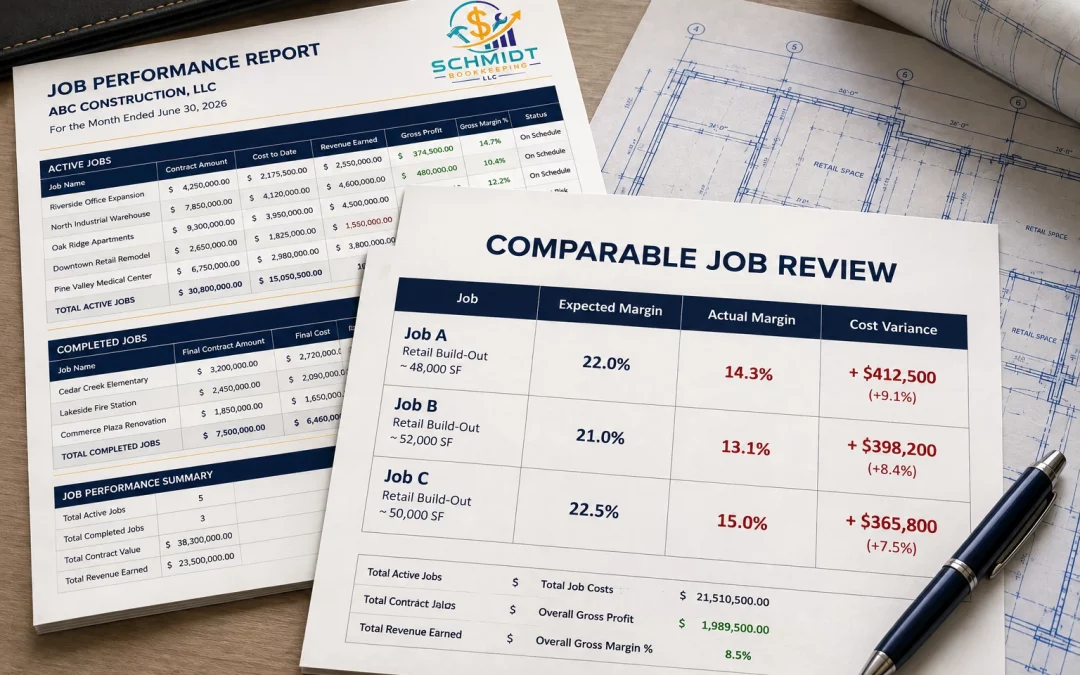
Suppose a project was expected to produce a 30% gross margin but finished at 18%.
That difference deserves attention.
But the margin difference alone does not tell you whether you should stop taking that type of job.
You still need to understand why the result changed.
Was the estimate too low?
Did labor take longer than expected?
Were materials underestimated?
Did subcontractor costs increase?
Was additional work performed but never billed?
Was the job poorly managed?
Or does this particular type of work consistently require more resources than the price customers are willing to pay?
Those questions move you from measuring the result to understanding what the result means for future work.
Job profitability tells you what happened. Job-selection analysis asks what that result should change about the work you pursue next.
Do Not Make a Strategic Decision From One Bad Job
One weak job can be frustrating.
It can also be misleading.
Individual projects are affected by circumstances that may not repeat.
A job might perform poorly because of:
- unusual site conditions;
- severe weather;
- one estimating mistake;
- an inexperienced crew;
- excessive rework;
- an unreliable subcontractor;
- an unusually compressed schedule;
- unbilled change orders;
- customer-driven scope disruption;
- project management problems.
Those issues matter.
But they do not necessarily mean the underlying type of work is financially unattractive.
Imagine that you complete five similar projects.
Four perform close to expectations.
One performs poorly because the project required significant rework after an installation error.
That result tells you something about the job.
It does not necessarily tell you to stop pursuing that kind of work.
Now imagine five similar projects consistently finish below expected margin, require more labor than estimated, and create the same types of cost overruns.
That is different.
You are beginning to see a pattern.
One bad job is a result. Repeated underperformance is evidence.
Before changing what your company pursues, ask:
Does this type of work repeatedly underperform, or did this particular job go wrong?
Group Similar Jobs Before You Judge the Work
Patterns become easier to recognize when you compare similar jobs.
Comparing a small service project with a large commercial project may not tell you very much. Their cost structures, schedules, staffing requirements, billing cycles, and financial demands may be completely different.
Instead, look for meaningful similarities.
You might compare jobs based on:
- project type;
- project size;
- complexity;
- delivery method;
- location;
- labor intensity;
- subcontractor reliance;
- schedule demands;
- other characteristics that materially affect how the work is performed.
Then look at the financial results across those jobs.
Ask:
- Do these jobs consistently finish below expected Gross Margin?
- Do they repeatedly experience similar cost overruns?
- Does labor consistently take longer than estimated?
- Are material costs repeatedly underestimated?
- Do these projects create recurring scheduling problems?
- Do they require unusually high amounts of cash before payment is received?
- Do they consume significant Working Capital?
- Do they require more management attention than the profit they produce seems to justify?
The objective is not to create a list of jobs you liked and jobs you disliked.
It is to identify repeated financial and operating patterns.
That is what gives you useful evidence for future job-selection decisions.
Low Gross Margin Is a Warning Sign, Not the Whole Decision
Gross Margin is an important measure when evaluating work.
If a particular kind of job repeatedly produces weaker margins than expected, you should understand why.
But Gross Margin should not be the only factor in the decision.
A lower-margin job may still fit the business well.
It might:
- use available capacity efficiently;
- require relatively little management attention;
- have predictable costs;
- move quickly;
- collect reliably;
- complement other profitable work.
Another job may show an acceptable margin while creating significant financial or operational demands.
It might:
- require large upfront purchases;
- tie up crews for long periods;
- require extraordinary supervision;
- create recurring disputes;
- consume significant Working Capital;
- take a long time to convert completed work into cash.
That means the question is not simply:
Which job has the highest margin?
A more useful question is:
What does the business have to commit in order to produce that profit?
Profitability matters.
So does the financial and operating effort required to produce it.
Repeated Cost Overruns Point to a Deeper Problem
If similar jobs repeatedly exceed their estimated costs, the overruns can help you understand what needs to change.
The important question is:
What keeps going wrong?
Labor
Labor problems can have a significant effect on job profitability.
Ask:
- Are labor hours consistently underestimated?
- Is labor burden fully reflected in the estimate?
- Does this work regularly take longer than expected?
- Does it require more supervision than anticipated?
- Does the company have the skills and experience to perform the work efficiently?
If labor performance repeatedly misses the estimate, the issue may be estimating, productivity, crew structure, supervision—or some combination of them.
Materials
Look for repeated differences between estimated and actual material costs.
Ask:
- Are quantities consistently underestimated?
- Is material waste higher than expected?
- Are price changes creating recurring overruns?
- Do specifications regularly create unexpected costs?
- Are purchasing assumptions realistic?
One unusual material overrun may not mean much.
The same problem appearing repeatedly deserves attention.
Subcontractors
Subcontractor costs can also change the economics of a job.
Ask:
- Are subcontractor costs consistently higher than estimated?
- Are quotes reliable?
- Are change orders common?
- Does coordination create additional internal cost?
- Are subcontractor delays affecting labor or scheduling?
Equipment and Other Job Costs
Some work requires costs that are easy to underestimate.
Examples may include:
- equipment;
- rentals;
- mobilization;
- permits;
- logistics;
- specialized tools;
- temporary facilities;
- travel or other project-specific requirements.
If those costs repeatedly appear after the estimate is built, they can steadily reduce profitability.
The lesson is not:
Cost overrun = stop taking the work.
The lesson is:
Repeated cost overruns help reveal whether the problem is estimating, execution, or the economic structure of the work itself.
Some Work May Not Fit Your Current Operating Model
A construction company can be capable of performing a type of work without being particularly efficient at it.
That distinction matters.
Certain jobs may require:
- more labor hours than your company can deliver efficiently;
- specialized skills your crews do not regularly use;
- intensive supervision;
- unusually complicated coordination;
- schedule demands that disrupt other projects;
- project-management effort that is difficult to recover through pricing.
You may technically be able to complete those jobs.
But if the same work repeatedly consumes more resources than expected, the financial results may tell you that the current operating model is not well suited to it.
That does not automatically mean you should stop.
The appropriate response might be to:
- improve estimating;
- train the crew;
- change crew structure;
- improve project management;
- use subcontractors differently;
- improve scheduling;
- charge more;
- limit how much of that work you accept.
The important question is whether the problem can realistically be corrected.
Is the Work Bad—or Is the Price Bad?
Sometimes the work is not the problem.
The price is.
A contractor may perform a certain type of project efficiently and still produce disappointing financial results because the work is consistently underpriced.
That can happen when:
- costs are underestimated;
- labor burden is incomplete;
- overhead is not adequately considered;
- markup is insufficient;
- productivity assumptions are unrealistic;
- project complexity is not reflected in the price;
- risk is not adequately priced;
- change orders are not consistently captured and billed.
If the company can perform the work well but cannot produce an adequate financial result at its current pricing, stopping the work entirely may be premature.
The better question may be:
Would this work make sense at a different price?
If the answer is yes, the appropriate response may be to reprice the work rather than abandon it.
But the opposite is also important.
A higher price does not automatically fix work that consistently creates operational problems or financial demands the business cannot support.
There may be a price at which the work becomes attractive—but customers may not be willing to pay it.
That is useful information too.
Do not stop taking potentially profitable work simply because you are currently pricing it poorly.
But do not assume that every bad type of work can be fixed by increasing the price.
A Job Can Be Profitable and Still Be Financially Difficult
Profitability is important, but construction businesses do not operate on profit alone.
They also need cash and financial capacity.
A job can appear profitable while requiring significant amounts of money to support it before the company receives the cash associated with that profit.
For example, a project may require:
- large material purchases before billing;
- substantial payroll before customer payments arrive;
- subcontractor payments before collections;
- retainage;
- long billing cycles;
- slow customer payments;
- significant Working Capital throughout the project.
That creates another important job-selection question:
How much financial capacity does this type of work require before the profit is actually realized?
A business with substantial cash and Working Capital may be able to support that demand comfortably.
Another contractor may find that the same type of project creates constant financial pressure.
That does not automatically make the job bad.
But it changes what the job requires from the business.
When you evaluate the work you want to pursue, consider both:
What profit does this work produce?
and
What does the business have to commit to produce it?
Underperforming Work Does Not Have Only Two Outcomes
When repeated evidence shows that a type of work is underperforming, the decision does not have to be:
Keep taking it or stop taking it.
There are at least four useful responses:
Improve → Reprice → Restrict → Stop Pursuing
The right response depends on what the financial evidence tells you.
1. Improve
Choose improvement when the underlying economics of the work may be reasonable but execution is reducing the financial result.
Potential improvement areas include:
- estimating;
- labor productivity;
- crew structure;
- project management;
- purchasing;
- scheduling;
- subcontractor coordination;
- change-order processes.
Ask:
Can we realistically improve how we perform this work enough to produce the result we expect?
If the answer is yes, the work may still fit the business.
The problem may be the process rather than the opportunity.
2. Reprice
Choose repricing when the company can perform the work effectively but the current price does not adequately reflect what the work requires.
That may include:
- actual costs;
- labor demands;
- project complexity;
- risk;
- Working Capital requirements;
- management effort;
- desired profitability.
Ask:
Would this work make financial sense at a different price?
If so, the problem may be pricing rather than the type of work itself.
3. Restrict
Some work may make sense only under certain conditions.
You might decide to pursue it:
- only above a certain job size;
- only within a reasonable geographic area;
- only with acceptable contract terms;
- only when project duration fits your capacity;
- only when trusted subcontractors are available;
- only when sufficient labor capacity exists;
- only when the financial demands can be supported.
Ask:
Should we take this work only when specific conditions are met?
Restriction can allow you to keep profitable opportunities while avoiding the conditions that repeatedly create poor results.
4. Stop Pursuing
Sometimes repeated evidence points to a harder conclusion.
A type of work may:
- consistently underperform;
- repeatedly produce weak margins;
- require excessive management attention;
- create financial demands disproportionate to its return;
- be difficult to price competitively at a profitable level;
- continue producing the same problems after realistic corrective efforts.
At that point, the appropriate question becomes:
Is there enough evidence that this type of work simply does not fit our business?
If the answer is yes, stopping may free labor, Working Capital, management attention, and capacity for better opportunities.
That is not failure.
It is a business decision based on evidence.
Review the Evidence Before You Change What You Sell
You do not need an elaborate scoring system to begin evaluating the work you pursue.
You need a repeatable process.
1. Identify Similar Jobs
Start by grouping projects that are reasonably comparable.
The goal is to evaluate repeated performance rather than unrelated jobs.
2. Review Actual Profitability
Look at Revenue, actual costs, Gross Profit, and Gross Margin.
Determine what the jobs actually produced.
3. Compare Estimated Results With Actual Results
Identify where performance differed from expectations.
Did labor change?
Materials?
Subcontractors?
Other costs?
4. Identify Repeated Cost Drivers
Look for problems that appear across multiple similar jobs.
The same overrun occurring repeatedly is more useful for decision-making than one unusual event.
5. Review the Financial Demands
Consider cash timing, Working Capital, billing requirements, retainage, and collection timing.
Understand what the business must support while the work is being performed.
6. Separate Pricing Problems From Execution Problems
Ask whether the company:
- charged too little;
- performed inefficiently;
- or experienced both problems.
The solution depends on the cause.
7. Look for a Pattern
Do not make the decision from one project.
Look for enough repeated evidence to understand whether the result is unusual or characteristic of the work.
8. Choose the Appropriate Response
Then decide:
Improve?
Reprice?
Restrict?
Stop pursuing?
That creates a much stronger job-selection process than simply deciding whether you liked the last project.
Which Financial Information Helps You Decide?
You do not need every financial report to make this decision.
You need the information that helps explain job performance and its effect on the business.
Job Performance Report
A Job Performance Report can help you review information such as:
- job revenue;
- actual job costs;
- Gross Profit;
- Gross Margin;
- estimated versus actual performance.
This is often the most direct financial evidence for understanding what an individual job produced.
Profit & Loss Statement
Your Profit & Loss Statement provides company-level context by showing whether the combined results of your jobs are translating into overall business profitability.
It does not replace job-level reporting, but it helps you understand individual job results within the broader financial performance of the company.
Work in Progress
For active jobs, Work in Progress information can help you understand how current projects are developing financially while the work is still underway.
When combined with job-level cost and performance information, it may help you identify whether concerns seen on completed jobs are beginning to appear again.
Other Supporting Financial Information
Depending on the question, information from your A/R Aging, Balance Sheet, or cash-flow reporting may help you understand the financial demands associated with certain work.
Those reports do not replace job-level analysis.
They provide additional context.
Use a Clear Pattern Before Making a Broad Job-Selection Decision
The purpose of this analysis is not to eliminate every difficult job.
Construction work is rarely perfectly predictable.
Some projects will perform better than expected.
Others will perform worse.
The goal is to distinguish normal variation from a recurring financial problem.
For a broader decision about whether to continue pursuing a type of work, comparable financial evidence helps you determine whether the problem is isolated or recurring.
If similar jobs repeatedly produce weak margins, labor overruns, cash pressure, management strain, or other problems—and realistic improvements do not change the result—you have stronger evidence that the work may not fit the business.
That is very different from reacting to one disappointing project.
Financial Visibility helps you distinguish a bad job from a bad pattern.
And once the pattern becomes visible, you can make a deliberate decision about what to do next.
Monthly Monitoring Helps Reveal Where to Investigate
You may first notice the problem during your regular financial review.
Job profitability may weaken.
Gross Margin may decline.
Working Capital may tighten.
Cash demands may increase.
Those changes are signals.
They do not automatically tell you which work to stop taking.
They tell you where to investigate.
From there, job-level financial information can help you determine whether the change came from:
- one unusual project;
- an estimating problem;
- an execution problem;
- a pricing problem;
- or a repeated pattern associated with certain work.
That is why recurring financial monitoring and job-selection analysis work together.
One helps you recognize that something changed.
The other helps you understand what that change should mean for future decisions.
Financial Visibility Makes Better Job Selection Possible
A contractor cannot make a strong job-selection decision from incomplete or inconsistent financial information.
If job costs are missing, labor is not allocated correctly, change orders are not captured, or revenue and costs are not organized by job, the results become harder to trust.
The process begins with reliable financial information:
Capture → Organize → Analyze → Report → Advise
Capture the financial activity associated with the work.
Organize it by job and meaningful cost categories.
Analyze estimated and actual performance.
Report the results in a form that makes patterns visible.
Then use those patterns to advise the next business decision.
That is how bookkeeping becomes more than transaction processing.
It creates Financial Visibility into the work your business should pursue.
Frequently Asked Questions
How do I know which construction jobs I should stop taking?
Start by reviewing repeated financial results across similar jobs.
Look at Job Profitability, Gross Margin, estimated versus actual costs, labor performance, cost overruns, pricing, and the financial demands required to perform the work.
Then determine why the work is underperforming.
The appropriate response may be to improve how the work is performed, reprice it, restrict the conditions under which you accept it, or stop pursuing it.
Should I stop taking every job that loses money?
No.
One job can lose money because of an estimating error, execution problem, unusual site condition, rework, scope issue, or another event that may not repeat.
A strategic decision should be based on repeated evidence rather than one result.
How many jobs should I review before deciding a type of work is unprofitable?
There is no universal number.
The amount of evidence you need depends on how comparable the jobs are, how often you perform the work, and whether the same financial patterns are appearing consistently.
The objective is to have enough relevant information to distinguish an unusual project from a recurring problem.
What financial information should I review before deciding to stop taking a type of job?
Useful information can include:
- Job Profitability
- Gross Profit
- Gross Margin
- Estimated versus actual costs
- Labor performance
- Material and subcontractor costs
- Cost overruns
- Pricing
- Cash requirements
- Working Capital demands
The goal is to understand both the financial result and what the business had to commit to produce it.
Can a profitable job still be a bad job for my business?
Potentially.
A job may produce profit while requiring disproportionate amounts of cash, Working Capital, management attention, labor capacity, or risk.
Profitability is important, but it should be considered alongside the financial and operating demands required to produce that profit.
Should I raise the price before I stop offering a type of work?
Sometimes.
If the company can perform the work efficiently but the current price does not adequately reflect its costs, complexity, risk, or financial demands, repricing may improve the result.
But increasing the price will not necessarily fix work that is fundamentally difficult for the company to execute efficiently or support financially.
What is the difference between a bad job and a bad type of work?
A bad job is an individual result.
A bad type of work is a repeated pattern of financially unattractive performance that persists across comparable jobs and cannot be adequately corrected through realistic changes to pricing or execution.
That distinction is why reviewing patterns matters.
Compare the Jobs Before Deciding What to Keep Taking
These resources can help you see why similar construction jobs can produce different financial results and review which types of work are actually worth continuing for your business.
Better Job Selection Starts With Better Financial Evidence
You do not need to stop taking every difficult job.
And you should not keep taking work simply because it produces revenue.
You need to understand what different kinds of work actually contribute to the business.
Look at profitability.
Look at margins.
Look at cost performance.
Look at labor.
Look at pricing.
Look at cash and Working Capital demands.
Then look for patterns.
If the work is fundamentally sound but execution is weak, improve it.
If the work can perform well at a different price, reprice it.
If the work makes sense only under certain conditions, restrict it.
If repeated evidence shows that the work does not fit the financial and operating model of the business, stop pursuing it.
That is a much stronger decision than reacting to one bad project.
It is a decision built on Financial Visibility.
Schmidt Bookkeeping helps construction business owners organize job-level financial information, understand job performance, and build the visibility needed to make better decisions about the work they pursue.