
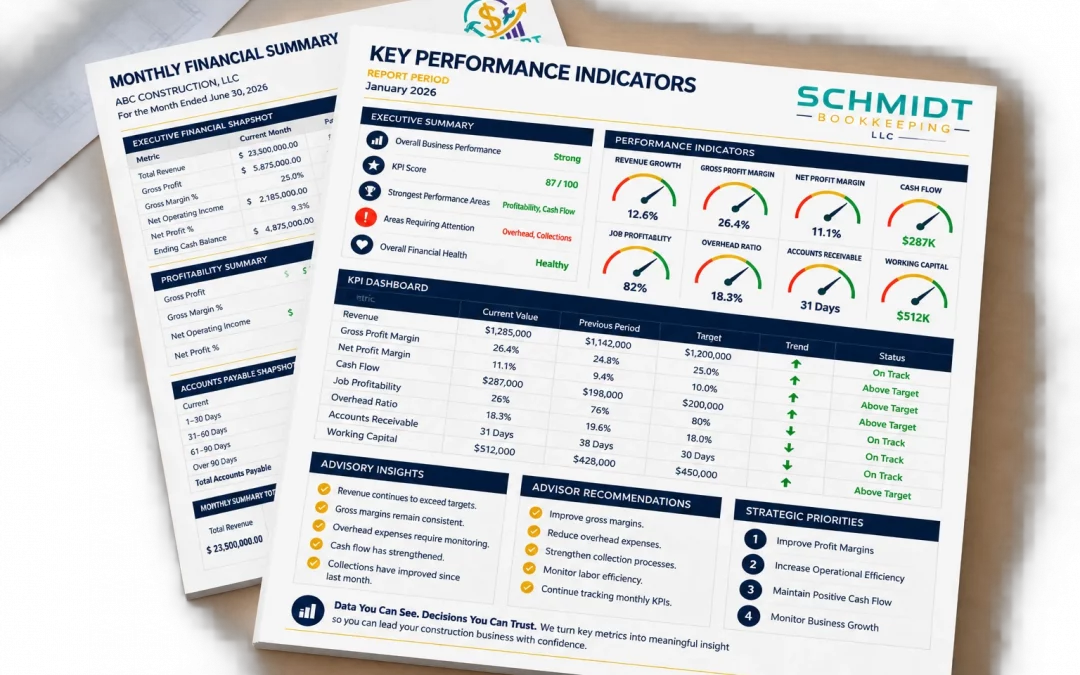
Your accounting system can give you hundreds of numbers.
That does not mean you should monitor hundreds of numbers every month.
Revenue, profit, cash, receivables, job costs, estimated costs, actual costs, Work in Progress, liabilities, margins, and dozens of other figures can all tell you something about your construction business. But simply having more numbers does not automatically create Financial Visibility.
The more useful question is:
Which financial measures should I review consistently so I can understand how the business is actually performing?
For most contractors, the answer is not one perfect KPI.
It is a focused group of connected measures that helps you see what is happening with profitability, cash flow, short-term financial capacity, collections, and job performance.
Reviewed consistently, those measures can help you notice changes, investigate problems, and make better business decisions.
Measuring More Does Not Automatically Create More Visibility
A construction business generates a lot of financial information.
You may have revenue by month, expenses by category, bank balances, accounts receivable, accounts payable, job costs, estimated costs, actual costs, gross profit, net profit, Work in Progress, and more.
All of that information can be useful.
But trying to monitor everything with equal attention can make it harder to see what actually matters.
Monthly financial monitoring should help you answer practical questions such as:
- Is the business profitable?
- Is profitability improving or declining?
- What is happening to cash?
- Does the business have enough short-term financial capacity to support operations?
- Are customers paying us?
- Are jobs performing the way we expected?
- Is active work creating financial pressure we need to understand?
That is the purpose of a useful KPI.
A key performance indicator, or KPI, is simply a measure you review consistently because it helps you understand an important part of business performance.
The value is not in calling something a KPI.
The value is in what the measure helps you understand.
What Makes a Financial Measure Useful?
A useful financial measure should connect to a real business question.
Revenue is useful because it helps you understand the amount of revenue recognized by the business during a period.
Gross margin is useful because it helps you understand how much of that revenue remains after the costs classified as cost of goods sold or direct job costs in the company’s financial reporting.
Working capital is useful because it helps you understand short-term financial capacity.
Accounts receivable is useful because it helps you understand how much customers owe the business and whether collections may be slowing.
Job profitability is useful because company-wide profit can hide what is happening on individual projects.
The strongest monthly measures also become more useful when you review them consistently.
A single number gives you a snapshot.
A series of numbers begins to show you direction.
That distinction matters because the purpose of monthly monitoring is not simply to record what happened.
It is to recognize what is changing.
Five Financial Areas Worth Monitoring Every Month
There is no single financial measure that tells you everything you need to know about a construction business.
A more useful approach is to monitor several connected areas of financial performance.
1. Revenue and Profitability
Start with:
- Revenue
- Gross Profit
- Gross Margin
- Net Profit
These measures are related, but they do not tell you the same thing.
Revenue shows the amount of revenue recognized by the business during the period.
Revenue matters, but revenue by itself does not tell you whether the work was profitable.
A contractor can increase revenue while producing less profit.
That is why Gross Profit and Gross Margin matter.
Gross Profit shows what remains after the costs classified as cost of goods sold or direct job costs in the company’s financial reporting are deducted from revenue.
Gross Margin expresses that relationship as a percentage, which can make comparisons between periods more useful.
If revenue is growing but gross margin is declining, the business may be producing more work without producing proportionately more gross profit.
Net Profit takes the view further by considering the broader expenses required to operate the business.
Together, these measures help answer a much more useful question than revenue alone:
Is the work the business is producing actually creating profit?
And because each measure provides a different perspective, a change in one should often lead you to investigate the others,
2. Cash Flow
Profit and cash are related, but they are not the same thing.
That makes Cash Flow another important area to monitor.
A profitable month does not necessarily mean cash increased.
Customer payments may not have arrived yet. Debt principal may have been paid. Equipment may have been purchased. Owner distributions may have occurred. Money may simply be moving through the business differently than profit suggests.
Monthly cash-flow monitoring should help you ask:
- Did cash increase or decrease?
- Was that change expected?
- Are normal operations generating or consuming cash?
- Is cash movement consistent with what the other financial information is telling me?
- Is something happening that deserves further investigation?
The goal is not to react to every increase or decrease.
It is to understand why cash changed.
3. Working Capital
Cash tells you something important about the business, but cash alone does not tell you whether the company has enough short-term financial capacity to support its obligations and ongoing operations.
That is where Working Capital becomes useful.
At its simplest:
Current Assets − Current Liabilities = Working Capital
Working capital brings short-term resources and short-term obligations into the same view.
But for monthly monitoring, the direction can be just as important as the calculation itself.
Is working capital strengthening?
Is it tightening?
Are current liabilities growing faster than current assets?
Is growth creating more short-term financial demand?
Are receivables increasing without producing available cash?
One calculation gives you a snapshot.
Monitoring working capital consistently helps you see whether the business’s short-term financial position is changing.
That can be particularly important in construction, where payroll, materials, subcontractors, retainage, billing schedules, and collection timing can create significant demands on cash.
4. Accounts Receivable
Knowing the total amount customers owe you is useful.
Knowing how long they have owed it to you is more useful.
That means useful monthly A/R monitoring should consider both the total amount outstanding and how that balance is distributed across aging periods.
Ask:
- How much is currently outstanding?
- Is the balance increasing or decreasing?
- Are receivables getting older?
- Is more money moving into older aging categories?
- Are collections keeping pace with billing?
- Are a small number of customers responsible for a large portion of what is outstanding?
An increasing A/R balance is not automatically a problem.
The business may simply be doing more work.
But if receivables are increasing and getting older, that tells you something different.
Consistent review helps you distinguish between normal business activity and a collection pattern that deserves attention.
5. Job Performance and Work in Progress
Company-wide financial results can look healthy while individual jobs are struggling.
That is why contractors also need visibility at the job level.
Two important areas are:
- Job Profitability
- Work in Progress
Job Profitability helps you understand whether individual projects are performing financially the way you expected.
Monthly review can help identify questions such as:
- Which jobs are producing the expected profit?
- Which jobs are losing margin?
- Are actual costs moving differently than expected?
- Is a project beginning to perform differently than it did earlier?
Work in Progress, or WIP, adds another perspective by helping you understand the financial position of active work.
Construction projects often span multiple accounting periods. Billing, costs, estimated completion, and project progress do not always move together neatly.
WIP helps bring those relationships into view.
The purpose of monitoring these areas is not to turn every monthly review into a complete job analysis.
It is to identify which jobs deserve a closer look.
A Number Becomes More Useful When You Compare It
A financial number by itself tells you what the number is.
Comparison begins to tell you what it means.
There are several useful ways to add context to monthly financial measures.
Current Month Compared With the Prior Month
This helps answer:
What changed recently?
Maybe gross margin declined.
Maybe receivables increased.
Maybe working capital tightened.
Maybe cash improved.
The comparison does not automatically explain why.
It tells you where to investigate.
Current Performance Compared With Prior Periods
Looking across several months can help distinguish a one-time change from a developing pattern.
One unusual month may have a reasonable explanation.
A measure moving in the same direction for several months may deserve more attention.
This is where consistent monthly review becomes especially useful.
You begin to see trends instead of isolated numbers.
Actual Performance Compared With Expectations
Your own expectations can also provide useful context.
If a job was expected to produce a certain financial result, is actual performance moving in that direction?
If the business planned for a particular level of activity, are revenue, profitability, cash requirements, and working capital behaving as expected?
The purpose is not to force every number to match a plan perfectly.
It is to recognize meaningful differences and understand them.
The direction and context of a financial measure can be more useful than the number by itself.
Be Careful With Universal “Good” KPI Targets
It is natural to want a simple answer to questions such as:
- What should my gross margin be?
- What should my net profit margin be?
- How much working capital should I have?
- How much cash should I keep?
- How old should my receivables be?
Benchmarks can provide context.
But a universal target can also create false confidence—or unnecessary concern.
Construction businesses differ.
The financial characteristics of a general contractor may differ from those of a specialty trade contractor.
A company using substantial subcontractor labor may behave differently from one with a large internal workforce.
Project size, project duration, customer type, geography, seasonality, growth, payment terms, retainage, financing, and the mix of work can all affect what a financial measure means.
That is why a benchmark should not replace understanding your own business.
A better starting point is to understand:
- what the measure represents;
- how it has changed;
- why it changed;
- how it compares with your expectations;
- and whether that change requires further investigation.
A number becomes useful when it has context.
A Practical Monthly Measurement Framework
You do not need to start with a complicated dashboard.
Start with the business questions you need to answer.
Financial question |
Monthly measure(s) to watch |
|---|---|
| Is the business growing? | Revenue |
| Is the work profitable? | Gross Profit, Gross Margin, Net Profit |
| What is happening to cash? | Cash Flow |
| Can we support short-term obligations and operations? | Working Capital |
| Are customers paying us? | Accounts Receivable and Aging |
| Are our jobs performing? | Job Profitability |
| Where does active work stand? | Work in Progress |
This is not a universal scorecard.
It is a practical way to connect recurring financial measures to the questions they are meant to help answer.
If one of those measures changes, the next question becomes:
Why?
That is where your financial reports become important.
Your KPIs and Your Financial Reports Are Not the Same Thing
A financial report and a KPI serve different purposes.
A financial report organizes financial information into a useful view.
A KPI is a measure you monitor because it helps you understand an important aspect of performance.
For example, you may monitor Gross Margin each month.
Your Profit & Loss Statement can provide the financial information you need to evaluate it.
You may monitor Working Capital.
Your Balance Sheet provides the current-asset and current-liability information behind that calculation.
You may monitor whether receivables are getting older.
Your A/R Aging report provides the detail needed to understand what is outstanding and how long it has been unpaid.
That relationship is important:
The measure tells you what deserves attention. The report helps you investigate what is happening.
This is why choosing the right report and choosing the right measure are related—but different—financial decisions.
Build a Repeatable Monthly Financial Review
The value of monthly measurement comes from consistency.
A complicated review process that happens twice and gets abandoned is not particularly useful.
A focused review that happens every month can become part of how you manage the business.
A practical monthly process can look like this:
1. Review the Same Core Measures
Use a consistent set of measures tied to the financial questions that matter to your business.
You can refine that set as the business changes, but avoid changing the entire framework every month.
Consistency makes comparison possible.
2. Compare With Prior Periods
Look at what changed.
Then look beyond the most recent month to determine whether the change appears isolated or part of a broader pattern.
3. Identify Meaningful Changes
Not every movement deserves the same amount of attention.
Focus on changes that could affect profitability, cash, financial capacity, collections, or job performance.
4. Investigate the Reports Behind the Change
If Gross Margin moved, look deeper into the financial information behind profitability.
If A/R is increasing, review the A/R Aging.
If working capital is tightening, examine the Balance Sheet and the short-term financial activity contributing to the change.
If a job’s profitability is deteriorating, review the job-level information.
The KPI identifies the question.
The financial information helps you investigate it.
5. Decide What Requires Action
Some changes require immediate attention.
Others require more analysis.
Some simply need to be monitored.
The purpose of the monthly review is not to manufacture a problem every time a number changes.
It is to make sure meaningful financial changes do not remain invisible.
A Monthly Financial Summary Can Make Monitoring Easier
Reviewing the same core measures every month does not mean you need to open every available financial report before you know where to look.
A Monthly Financial Summary can bring important recurring financial information into one review experience.
That can make it easier to identify:
- what changed;
- which measures deserve attention;
- where a trend may be developing;
- and which underlying report should be reviewed more closely.
But a summary does not replace the underlying reports.
Think of the relationship this way:
The summary helps identify what deserves attention. The underlying reports help explain why.
That keeps the monthly review focused without reducing the business to a handful of disconnected numbers.
Financial Visibility Depends on Reliable Information
A KPI is only as useful as the financial information behind it.
If transactions are missing, expenses are misclassified, receivables are inaccurate, job costs are incomplete, or financial activity is not organized consistently, the measures built from that information become less reliable.
That is why monthly financial monitoring does not begin with a dashboard.
It begins with the underlying financial system:
Capture → Organize → Analyze → Report → Advise
Financial activity is captured.
The information is organized into meaningful categories and records.
It can then be analyzed and reported.
From there, recurring measures can help you recognize patterns, investigate changes, and make better business decisions.
That is the difference between simply having financial data and having Financial Visibility.
What You Measure Should Help You Decide What to Investigate
Monthly measurement is not the end of the process.
It should help you identify the next question.
A change in job profitability may tell you that certain projects deserve deeper investigation.
A collection pattern may tell you that you need to look more closely at where receivables are concentrated.
A change in overall profitability may tell you that you need to understand what is driving the result.
Those are deeper questions.
The purpose of monthly monitoring is to make those questions visible.
It is not to answer all of them with one KPI.
Frequently Asked Questions
What KPIs should a construction company track?
A useful starting point is a focused set of measures covering revenue and profitability, cash flow, working capital, accounts receivable, job profitability, and Work in Progress.
The exact measures that deserve the most attention can vary by contractor and business circumstances.
The goal is not to track the largest possible number of KPIs. It is to consistently monitor the measures that help you understand important areas of financial performance.
What financial numbers should a contractor review every month?
Contractors should consider regularly reviewing Revenue, Gross Profit, Gross Margin, Net Profit, Cash Flow, Working Capital, Accounts Receivable and aging, Job Profitability, and Work in Progress.
These measures provide different perspectives. No single one gives a complete view of the business.
What is the difference between a KPI and a financial report?
A financial report organizes financial information into a particular view.
A KPI is a measure you monitor consistently because it helps you understand an important aspect of performance.
The two work together. A KPI may show that something changed, while the appropriate financial report can help you investigate why.
Should contractors track revenue every month?
Revenue is useful to monitor, but it should not be viewed by itself.
Increasing revenue does not automatically mean the business is becoming more profitable or financially stronger.
Revenue becomes more useful when it is considered alongside measures such as Gross Profit, Gross Margin, Net Profit, Cash Flow, and Working Capital.
What is the most important construction KPI?
There is no single KPI that is always the most important.
The most useful measure depends on the business question and the conditions facing the company.
A contractor concerned about collections may need to pay particular attention to Accounts Receivable and aging. A contractor experiencing cash pressure may need to focus more closely on Cash Flow and Working Capital. A contractor questioning project performance may need to examine Job Profitability and WIP.
The purpose of a monthly measurement framework is to provide several useful perspectives rather than depend on one number.
How often should construction KPIs be reviewed?
A monthly review provides a practical recurring cadence for many financial and construction-performance measures.
Some information may need to be reviewed more frequently depending on the business. Cash, collections, or job conditions, for example, may require closer attention when circumstances change.
The important point is to establish a consistent review process rather than look at financial information only when there is already a problem.
Should I compare my construction KPIs with industry benchmarks?
Industry benchmarks can provide useful context, but they should not replace understanding your own business.
Construction companies can differ significantly in project mix, customer type, cost structure, geography, growth, payment terms, labor model, and other factors.
Your own trends, expectations, and business economics provide important context for interpreting any external benchmark.
Turn Monthly Numbers Into Useful Patterns
These resources can help you distinguish a one-month change from a meaningful financial trend and consistently track the measurements that matter to your construction business.
Better Decisions Start With Measuring the Right Things
You do not need to monitor every financial number every month.
You need a consistent set of measures that helps you see what is changing, understand where to investigate, and decide what deserves attention.
Revenue tells you something.
Profitability tells you something else.
Cash Flow, Working Capital, Accounts Receivable, Job Profitability, and WIP each add another financial perspective.
None tells the whole story by itself.
But reviewed consistently and interpreted in context, they can help turn financial activity into something much more useful:
Financial Visibility.
Schmidt Bookkeeping helps construction business owners organize financial information, produce meaningful financial reporting, and build the visibility needed to understand what is changing in the business and make better decisions.